
Germany's Persistent Current Account Surplus: A Strategic Tailwind for Eurozone Stability and German Export Stocks
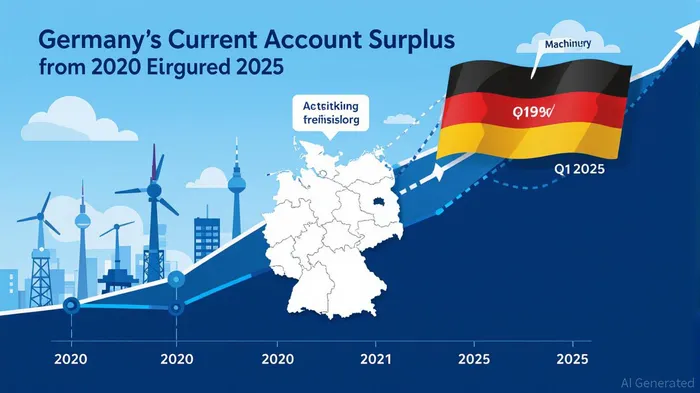
Germany's current account surplus, a perennial feature of its economic landscape, has once again proven to be a linchpin of Eurozone stability. In the first quarter of 2025, the surplus stood at €75.3 billion, a modest decline from €82.7 billion in the same period of 2024. Yet, beneath this seemingly static headline lies a dynamic interplay of primary income surpluses and a narrowing services deficit that underscores the country's resilience in a slowing global economy. For investors, this balance of payments story is not just a macroeconomic curiosity—it is a strategic opportunity.
The Engine of the Surplus: Primary Income and Services
Germany's primary income surplus, driven by robust returns on foreign investments and a strong labor market, remains a cornerstone of its external strength. In Q1 2025, the primary income surplus hit €19.9 billion, up from €15.7 billion in March 2024. This growth is fueled by compensation of employees (€9.0 billion) and other investment income (€4.9 billion), which offset deficits in direct and portfolio investments. These figures reflect Germany's deep integration into global capital markets and its ability to generate consistent returns from abroad—a critical buffer as global trade frictions persist.
Meanwhile, the services account deficit, though still a drag, has shown signs of improvement. The €12.4 billion deficit in Q1 2025 was a marked reduction from previous quarters, driven by surpluses in telecommunications, computer, and information servicesIII-- (€56.2 billion) and financial services (€4.4 billion). These sectors are not just offsetting traditional deficits in transport and intellectual property licensing; they are also signaling a shift toward high-value, technology-driven services that align with global demand for digital infrastructure.
A Defensive Play in a Fragile Global Economy
As the world grapples with inflationary pressures, geopolitical tensions, and a slowdown in China and the U.S., Germany's current account surplus offers a rare source of stability. The surplus acts as a natural hedge against external shocks, providing a steady flow of capital that supports domestic demand and corporate earnings. For investors, this translates into a defensive positioning in sectors that benefit from Germany's export prowess and capital inflows.
Consider the machinery and automotive sectors, which together account for over 20% of Germany's exports. Companies like Siemens, Bosch, and Volkswagen have long been beneficiaries of the country's trade surplus. Even as global demand for traditional vehicles wanes, these firms are pivoting to electric vehicles, industrial automation, and renewable energy infrastructure—sectors where Germany's engineering expertise and export networks give them a competitive edge.
The Services Sector: A Hidden Catalyst
While the services deficit persists, its narrowing is a positive signal for long-term investors. The rise in telecommunication and computer services—driven by 5G infrastructure, cloud computing, and AI adoption—positions Germany as a key player in the digital economy. Deutsche Telekom and SAPSAP--, for instance, are capitalizing on this trend, with SAP's cloud solutions and Telekom's 5G expansion attracting both domestic and international clients.
Moreover, the EU's push for digital sovereignty and green energy transitions amplifies the relevance of these sectors. Germany's ability to export high-margin services—such as software, cybersecurity, and industrial IoT—creates a virtuous cycle of capital inflows and reinvestment, further bolstering its current account position.
Investment Implications: Where to Allocate Capital
For investors seeking exposure to Germany's economic resilience, the focus should be on sectors that align with its structural strengths:
1. Export-Driven Industrials: ETFs like the iShares MSCIMSCI-- Germany Industrial Index (IEUR) or individual stocks in machinery, automotive, and renewable energy.
2. Digital Services: Companies in telecommunications, software, and AI, such as Deutsche Telekom, SAP, and T-Systems.
3. Capital Goods: Firms supplying equipment for green energy projects, including Siemens Energy and MAN Energy Solutions.
However, caution is warranted. The slight decline in the current account surplus and the volatility in the goods trade (e.g., the €22.4 billion surplus in March 2025, down from €23.5 billion in 2024) highlight the need for diversification. Investors should also monitor the EU's fiscal policies and Germany's domestic demand trends, which could influence the sustainability of the surplus.
Conclusion: A Strategic Anchor in Uncertain Times
Germany's current account surplus is more than a statistical anomaly—it is a testament to the country's ability to adapt and thrive in a fragmented global economy. By leveraging its strengths in primary income and high-value services, Germany offers a rare combination of stability and growth potential. For investors, this means opportunities in sectors that are not only resilient but also aligned with the future of global trade and technology. In a world where uncertainty is the norm, Germany's balance of payments dynamics provide a compelling case for a defensive, forward-looking portfolio.







Comentarios
Aún no hay comentarios