
Germany's Manufacturing Sector: A Cautious Path to Recovery and Investment Implications
The Industrial AI Cloud: A Sovereign Leap for German Industry
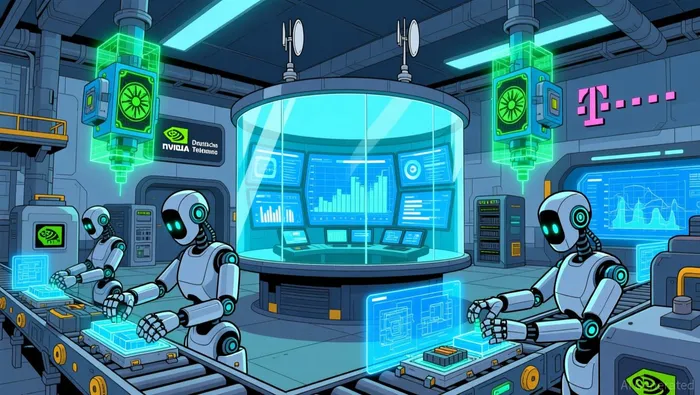
Deutsche Telekom and NVIDIA's Industrial AI Cloud, set to launch in early 2026, represents a pivotal shift in Germany's industrial strategy. This sovereign platform, hosted in German data centers and powered by up to 10,000 NVIDIANVDA-- GPUs, is designed to accelerate digital twins, robotics, and AI-driven manufacturing processes, as explained in a NVIDIA blog post. By prioritizing data sovereignty and secure infrastructure, the initiative aligns with Europe's broader push to reduce reliance on foreign technology and assert control over critical industrial data, according to an SAP news article.
The platform's strategic importance is underscored by its adoption by industry leaders. Siemens, for instance, is leveraging the AI Cloud for digital twin applications in factory optimization, while BMW and Mercedes-Benz are using it to simulate complex vehicle systems, potentially shortening development cycles, according to a Deutsche Telekom media release. SAP, a key partner in the "Deutschland-Stack," is integrating its Business Technology Platform with the AI Cloud to deliver scalable AI solutions for enterprises, as noted in an earnings call transcript. These partnerships position Germany as a leader in the next industrial revolution, but their success hinges on execution and market adoption.
Stock Performance and Strategic Positioning: Key Players in the AI Cloud Ecosystem
The financial performance of companies involved in the Industrial AI Cloud initiative reveals a mixed landscape. SAP, a critical enabler of the platform, has seen its stock trade at $259.64 as of November 2025, , according to a TS2 Tech analysis. Its partnership with Snowflake to enhance enterprise data integration further solidifies its role in AI-driven business transformation, per a GuruFocus report. Analysts remain cautiously optimistic, citing SAP's strategic alignment with Germany's industrial AI ambitions.
BMW, meanwhile, faces a more complex picture. While its Q3 2025 earnings per share (EPS) of $3.22 exceeded expectations, revenue fell short at $37.9 billion versus a projected $44.3 billion, according to a FinancialModelingPrep analysis. The company's stock, however, . BMW's collaboration with Samsung SDI and Solid Power on solid-state battery technology also positions it to capitalize on the electric vehicle (EV) boom, as reported in an InsideEVs report.
Siemens, an early adopter of the Industrial AI Cloud, reported strong Q3 2025 results, with EPS beating estimates and a stock price rising 9.3%, as covered by . Its focus on digital twins and industrial automation aligns with the AI Cloud's objectives, making it a key player in the sector. However, its stock's volatility reflects broader uncertainties in the manufacturing sector.
Risks and Opportunities in the AI-Driven Transition
While the Industrial AI Cloud offers transformative potential, challenges persist. The manufacturing PMI's stagnation and weak export demand-particularly to Asia and the U.S.-highlight the sector's vulnerability to global economic shifts, as Reuters reported. Additionally, companies like C3.ai, which faced a 50% stock decline in 2025 due to leadership issues and poor financial performance, underscore the risks of over-reliance on AI partnerships without robust execution, according to a Motley Fool analysis.
For investors, the key lies in balancing long-term strategic positioning with short-term financial metrics. SAP and Siemens, with their established industrial expertise and AI integrations, appear better poised to weather near-term volatility. BMW's innovation in EV technology and battery partnerships also offers a compelling narrative, though its revenue shortfalls warrant caution.
Conclusion: A Calculated Bet on Germany's Industrial Renaissance
Germany's manufacturing sector is at a crossroads. The Industrial AI Cloud initiative represents a bold step toward sovereignty and technological leadership, but its success depends on the ability of key players to translate innovation into tangible growth. For investors, the path forward involves a careful assessment of companies like SAP, BMW, and Siemens, which are not only adapting to the AI-driven paradigm but also shaping it. While the sector's recovery remains cautious, the strategic alignment of these firms with Germany's industrial vision suggests that the long-term rewards could outweigh the current uncertainties.





Comentarios
Aún no hay comentarios