
Germany's Industrial Resurgence: Auto and Machinery Sectors as Key Growth Drivers
Germany's economy stands at a pivotal crossroads in 2025, marked by a stark divergence between the resilience of its export-oriented industrial sectors and the stagnation of domestic demand. While overall GDP growth in Q1 2025 was a modest 0.4% year-on-year, the auto and machinery sectors have emerged as bright spots, defying broader economic headwinds. This divergence underscores a critical opportunity for strategic equity investors: leveraging Germany's industrial strengths in a landscape where global demand for advanced manufacturing and green technologies is accelerating.
The Auto Sector: Navigating Global Competition and Premium Positioning
Germany's automotive industry, long a cornerstone of its industrial might, faces mounting pressures from Chinese electric vehicle (EV) competition and domestic labor market challenges. Yet, its export performance remains robust. In Q1 2025, vehicle exports surged by 36% compared to Q4 2023, with 303,994 TEUs shipped. This resilience stems from the sector's strategic focus on premium product positioning and geographic diversification. German automakers are capitalizing on their reputation for high-quality engineering and innovation, particularly in hybrid and battery-electric vehicles, to maintain a competitive edge in markets like North America and Southeast Asia.
However, domestic production challenges persist. Job losses and production bottlenecks highlight the sector's vulnerability to energy costs and supply chain disruptions. For equity investors, this duality presents a nuanced opportunity: supporting firms that can scale their global footprint while navigating domestic constraints.
The Machinery Sector: A Pillar of Global Industrial Demand
Parallel to the auto sector, Germany's industrial machinery industry has demonstrated remarkable strength. Exports of machinery (HS Code 84) rose by 26% in Q1 2025 compared to Q4 2023, reaching 298,317 TEUs. This growth reflects the sector's technological leadership and its ability to integrate service components such as digital optimization and predictive maintenance. As global industries modernize, demand for German machinery-particularly in automation and energy-efficient systems-remains robust.
Yet, the machinery sector is not immune to macroeconomic headwinds. Year-on-year investments in machinery and equipment declined by 3.8% in Q1 2025, signaling caution among domestic firms amid weak industrial output. For investors, this points to the need for targeted strategies that align with long-term trends, such as the energy transition and Industry 4.0 adoption.
Strategic Equity Opportunities: Government Incentives and Private Capital Mobilization
Germany's recent policy initiatives offer a compelling framework for equity investors. The Germany Fund, a 30 billion euro initiative launched in Q4 2025, is designed to de-risk private investments in energy transition, technology, and industrial modernization. Coordinated by KfW, the fund provides guarantees, loans, and equity stakes, with up to 8 billion euros allocated for industrial transformation projects. This public-private partnership model is particularly relevant for capital-intensive sectors like auto and machinery, where high energy costs and infrastructure bottlenecks have eroded competitiveness.
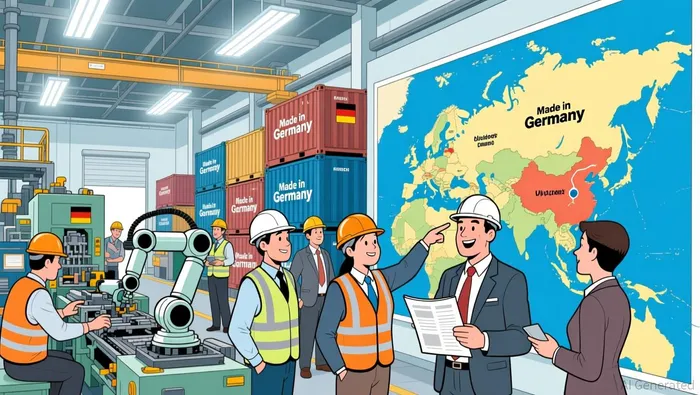
Complementing this is the "Made for Germany" initiative, which has secured 631 billion euros in private and corporate investments by 2028. This coalition of 61 leading companies and investors emphasizes R&D, capital expenditures, and infrastructure projects, positioning Germany as a hub for innovation. For equity investors, the initiative highlights the importance of aligning with firms that can leverage these incentives to scale operations and reduce regulatory friction.
Infrastructure-linked investments further amplify the appeal of Germany's industrial sectors. The government's 500 billion euro special fund for infrastructure and climate neutrality includes 300 billion euros dedicated to federal projects, with a focus on transport, digitalization, and energy modernization. For example, 11.7 billion euros in 2025 is allocated for rail network development, directly supporting logistics for export-oriented industries. Such investments not only enhance operational efficiency but also create long-term value for equity holders in infrastructure-linked manufacturing.
Navigating Risks and Structural Challenges
While the opportunities are substantial, investors must remain cognizant of structural risks. High energy costs, labor market rigidities, and geopolitical uncertainties continue to weigh on Germany's industrial competitiveness. Additionally, the BDI's projection of a 0.5% decline in industrial output for 2025 underscores the need for disciplined capital allocation.
Strategic equity investments should prioritize firms with strong balance sheets, R&D capabilities, and alignment with government priorities. For instance, companies integrating AI and deep tech into their machinery offerings- areas explicitly targeted by the Germany Fund-are well-positioned to capture growth. Similarly, automakers investing in battery technology and sustainable supply chains can mitigate exposure to global competition while aligning with decarbonization trends.
Conclusion: A Path Forward for Investors
Germany's industrial resurgence hinges on its ability to transform export strengths into sustained domestic growth. For equity investors, the auto and machinery sectors represent not just a bet on manufacturing, but a strategic alignment with global megatrends-automation, decarbonization, and digitalization. By leveraging government incentives, infrastructure investments, and the resilience of German industrial innovation, investors can navigate current challenges and position themselves for long-term value creation.
As the economy recalibrates, the key lies in identifying opportunities where policy, technology, and market demand converge-a space where Germany's industrial legacy meets its future.







Comentarios
Aún no hay comentarios