
Germany's Energy Transition at a Crossroads: Risks and Opportunities for Investors
Germany's energy transition, or Energiewende, has long been a global benchmark for decarbonization. However, as the country hurtles toward its 2030 target of 80% renewable electricity and full decarbonization by 2045, investors face a complex landscape of risks and opportunities. The financial implications of energy insecurity-stemming from the intermittent nature of renewables-and the strategic value of flexible power infrastructure, such as battery energy storage systems (BESS) and grid upgrades, are reshaping the investment calculus.
Energy Insecurity Risks: A Looming Challenge
Despite Germany's progress in reducing average grid disruption times to 11.7 minutes in 2024 down from 12.8 in 2023, the energy system remains vulnerable to supply fluctuations. The rapid phaseout of nuclear and fossil fuels, coupled with slower-than-expected adoption of electrification technologies like heat pumps and electric vehicles, has created uncertainties in demand forecasting and infrastructure planning according to government advisors. For instance, the overvoltage-induced blackout in the Iberian Peninsula-a rare but illustrative event-has heightened concerns about cascading failures in interconnected grids as reported.
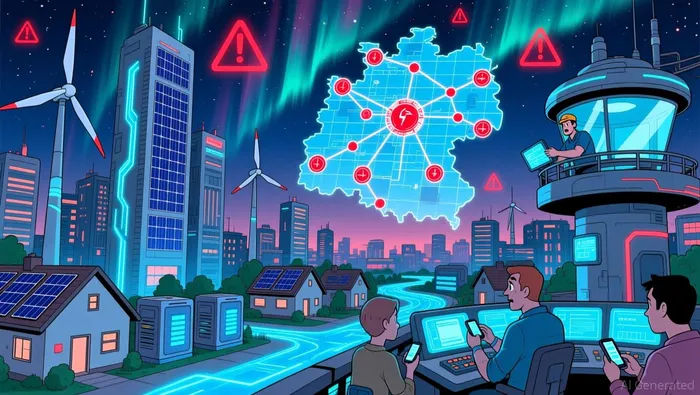 The economic burden of the transition further amplifies risks. Industry groups warn that cumulative costs could reach 5.4 trillion euros by 2049, threatening industrial competitiveness and potentially driving manufacturing relocation. Regulatory and legal ambiguities, such as inconsistent grid connection rules and unresolved classifications of BESS as both consumers and generators, also deter investment according to industry analysis. These challenges underscore the need for robust contingency planning, including gas-fired backup capacity and advanced storage solutions.
Flexible Power Infrastructure: A Strategic Opportunity
Investors seeking to capitalize on Germany's energy transition must focus on technologies and projects that enhance grid flexibility. Battery energy storage systems (BESS) are at the forefront of this shift. By mid-2024, Germany's total BESS capacity had reached 16 GWh, with projections of 7.1 GWh added in 2024 alone. Private-sector participation is surging: Green Flexibility, a German BESS developer, recently secured €400 million in funding from Swiss private equity firm Partners Group to expand its pipeline of over 10 GW of projects according to company reports.
Grid upgrades represent another critical investment area. The Federal Network Agency estimates that 650 billion euros will be required by 2045 to modernize transmission and distribution networks, with annual investments needing to double to 34 billion euros. While permitting delays and public resistance to overhead lines have slowed progress, international partnerships-such as Germany's role in the Global Energy Storage and Grids Pledge-offer pathways to accelerate infrastructure development as announced by the ministry.
The economic viability of these projects is bolstered by diverse revenue streams. BESS operators in Germany are already generating up to €200,000/MW/year through day-ahead electricity trading, ancillary services, and emerging markets like inertia payments according to research. Future capacity markets and hydrogen integration could further stabilize returns.
Navigating the Crossroads: Key Considerations for Investors
For investors, the key lies in balancing short-term risks with long-term opportunities. Energy insecurity risks, while significant, are mitigated by Germany's proactive measures, including grid reserves, capacity markets, and international collaboration as outlined in policy reports. However, regulatory clarity is essential. A reformed legal framework-addressing permitting timelines, grid connection rules, and cost subsidies-could unlock trillions in private capital according to industry experts.
Opportunities are most pronounced in sectors where Germany is already leading. Solar energy, for example, is expanding rapidly, with ground-mounted and Agri-PV systems dominating 2024-2025 installations. Offshore wind, though lagging, is poised for growth due to recent tenders and grid agreements as reported. Investors should also monitor hydrogen and carbon capture technologies, which are gaining traction as part of a technology-neutral policy approach according to policy analysis.
Conclusion
Germany's energy transition is at a pivotal juncture. While energy insecurity risks and regulatory hurdles persist, the strategic value of flexible infrastructure-particularly BESS and grid upgrades-presents compelling opportunities for investors. Success will depend on aligning private capital with policy frameworks that prioritize stability, scalability, and innovation. As the Energiewende enters its final stretch, those who navigate this crossroads with foresight will be well-positioned to profit from a decarbonized future.







Comentarios
Aún no hay comentarios