
Germany's Aging Infrastructure: A Hidden Opportunity in Bridge Repairs and Renewal
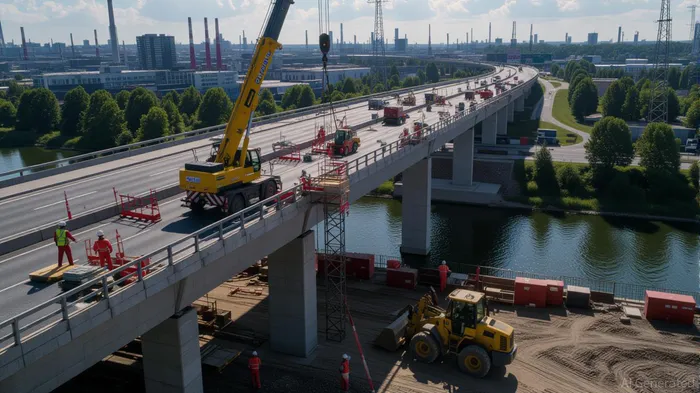
Germany's infrastructure crisis has reached a critical juncture. In September 2024, the partial collapse of Dresden's Carolabrücke and the closure of Berlin's Ringbahn Bridge due to structural cracks sent shockwaves through policymakers and economists alike. These incidents are not isolated but symptomatic of a broader systemic failure: according to Transport & Environment (T&E), approximately 16,000 bridges under federal jurisdiction are in disrepair, with an estimated EUR100 billion required for their replacement and reinforcement across all levels of government [4]. The federal audit office has further warned that Germany is falling behind its 2032 bridge renovation targets, completing only 69 of 280 planned projects in 2024—a pace that makes the goal “unrealistic” without urgent intervention [1].
A Crisis with Cascading Economic Costs
The economic implications of inaction are severe. Deteriorating bridges disrupt transportation networks, increasing logistics costs for Germany's export-dependent industries and slowing regional economic activity. A report by AP News highlights how crumbling infrastructure is already straining Germany's industrial heartland, where delays in freight movement reduce productivity and deter foreign investment [2]. Meanwhile, safety risks loom large: the average age of Germany's bridges exceeds 50 years, with many constructed during the post-war reconstruction era using materials and designs ill-suited for modern traffic volumes [4].
Government Priorities and the EUR500 Billion Infrastructure Fund
Recognizing the urgency, the German government has allocated EUR500 billion over 12 years to modernize infrastructure, including bridge repairs, digital networks, and energy systems [2]. This funding aligns with broader European Union goals for sustainable development and economic resilience, positioning Germany to maintain its status as Europe's largest economy and a global industrial861072-- leader [1]. However, experts emphasize that success hinges on accelerating planning and approval processes, which have historically delayed projects. As one analyst notes, “The key is not just securing capital but deploying it efficiently to avoid further bottlenecks” [4].
The Investment Opportunity
For investors, Germany's infrastructure push represents a unique confluence of public policy and market demand. The scale of required repairs—spanning federal, state, and municipal levels—creates opportunities for construction firms, engineering consultants, and technology providers specializing in smart infrastructure solutions. Moreover, the government's emphasis on sustainability opens avenues for green financing, such as bonds tied to energy-efficient bridge designs or electric vehicle-ready infrastructure [3].
Foreign and domestic capital can also benefit from Germany's commitment to public-private partnerships (PPPs). By leveraging private expertise and funding, the government aims to fast-track projects while sharing risk and reward with investors. For example, the EUR500 billion fund includes incentives for companies that adopt innovative materials or digital monitoring systems, which could reduce long-term maintenance costs [2].
Long-Term Economic Benefits
Modernizing Germany's bridges is not merely a repair effort—it is an investment in economic competitiveness. Improved transportation networks will lower business costs, enhance trade efficiency, and attract industries seeking reliable logistics hubs. Additionally, the shift toward green infrastructure, such as bridges designed to support renewable energy grids and electric vehicle charging stations, aligns with Germany's net-zero targets and positions the country to lead in emerging technologies [3].
Conclusion
Germany's aging bridges are a ticking time bomb, but they also represent a golden opportunity for strategic investment. With EUR100 billion in urgent repair needs and a EUR500 billion government fund primed for deployment, the stage is set for a transformative modernization drive. For investors willing to navigate regulatory frameworks and collaborate with public authorities, the rewards are clear: a stable, growing market with cascading benefits for Germany's economy—and for those who build its future.







Comentarios
Aún no hay comentarios