
German Equities Under Pressure: Navigating US Tariff Risks and Strategic Entry Points
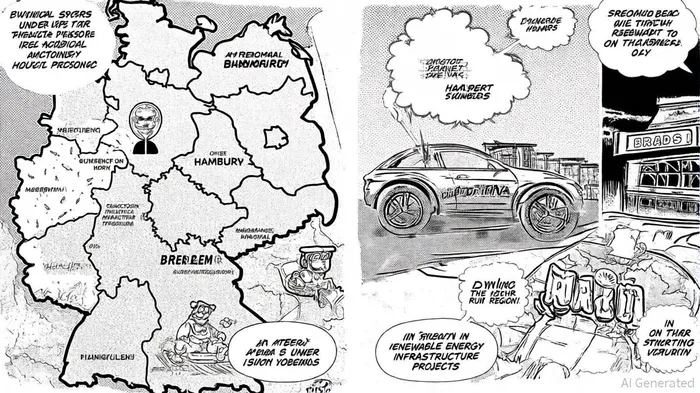
The German economy, long a linchpin of European industrial might, now faces a crossroads. U.S. tariffs—particularly the 25% duties on automobiles and automotive parts—have sent shockwaves through Germany's export-dependent sectors, with the automotive industry bearing the brunt. According to a report by KPMG, the U.S. market accounts for 2.5% of Germany's GDP, and the new tariffs have forced automakers like Audi and Jaguar Land Rover to halt U.S. exports entirely [1]. Luxury brands face even steeper costs, with per-unit price increases exceeding $20,000 [2]. Meanwhile, the machinery sector, reliant on steel and aluminum, is grappling with tariffs on 407 product codes, compounding supply chain constraints [3].
Yet, amid this turbulence, Germany's fiscal and strategic responses offer a blueprint for resilience. The government's €500 billion infrastructure fund, unveiled in March 2025, signals a deliberate pivot toward domestic growth and technological modernization. This initiative, coupled with EU trade initiatives like the “zero-for-zero” tariff proposal, aims to insulate the economy from external shocks while accelerating the green and digital transitions. For investors, the challenge lies in identifying sectors and equities that can thrive in this new landscape.
Sectoral Vulnerabilities: Automotive and Machinery Under Fire
The automotive sector's exposure to U.S. tariffs is existential. As stated by Bloomberg, German automakers have seen production capacities strained, with no immediate relief in sight [4]. Volkswagen, BMW, and Mercedes-Benz, which collectively export over 2 million vehicles annually to the U.S., are now recalibrating supply chains and pricing strategies. The ripple effects extend beyond cars: machinery manufacturers, dependent on steel and aluminum derivatives, face margin compression as U.S. tariffs on these materials take hold [5].
The Bundesbank has warned that these trade tensions could reduce Germany's GDP by 1.5 percentage points by 2027 [6]. Export hubs like Hamburg and Bremen, which rely heavily on transatlantic trade, are particularly vulnerable. Prime rent growth in these cities has stagnated, while inland regions like Berlin and the Ruhr area—closer to domestic consumption centers—show relative resilience [7].
Tactical Rebalancing: Infrastructure, Renewables, and Tech as Safe Havens
Germany's fiscal stimulus package, however, is creating new opportunities. The €500 billion infrastructure fund, allocated over 12 years, prioritizes climate neutrality, digitalization, and defense. This spending spree is already boosting demand for construction materials and grid modernization. Heidelberg Materials (HEI.DE), the world's largest building materials supplier, has seen revenue surge to €22.6 billion in 2024, driven by infrastructure projects [8]. Analysts project a 23% upside for the stock, citing its role in carbon-neutral cement production [9].
Renewable energy is another bright spot. Siemens Energy (ENR.DE), with a €109 billion order backlog, is capitalizing on offshore wind and hydrogen projects. Goldman Sachs has reiterated a “Buy” rating, targeting €63 per share [10]. Similarly, PNE AG (PNE.DE), a wind power specialist, is poised to benefit from Germany's 115 GW onshore wind target by 2030. Its 6 GW project pipeline and expansion into solar and green hydrogen suggest a 77% upside potential [11].
In technology, SAP SE (SAP) and Deutsche Telekom AG (DTEGY) are leveraging Germany's digital infrastructure push. SAP's AI-driven enterprise software and Telekom's 5G investments align with the government's High-Tech Agenda, which prioritizes AI, quantum computing, and microelectronics [12]. These sectors, less exposed to U.S. tariffs, offer a counterbalance to export-driven vulnerabilities.
Strategic Entry Points: ETFs and Funds for the Energy Transition
For diversified exposure, the Aquila Capital Energy Transition Fund I (ETF I) stands out. This Article 9 SFDR-compliant fund targets grid-connected battery storage and decentralized renewables, aiming for 14–16% annual returns . Global ETFs like the iShares Global Clean Energy ETF (ICLN) and Invesco Solar ETF (TAN) also provide access to Germany's green shift, though with broader geographic focus .
Defensive plays in the DAX index, such as Bechtle and Cancom, are gaining traction due to increased public sector IT spending . These stocks, less sensitive to trade wars, reflect the broader market's optimism about Germany's fiscal plans.
Conclusion: Balancing Risk and Resilience
German equities are at a crossroads. While U.S. tariffs threaten traditional export sectors, the government's fiscal and strategic initiatives are creating fertile ground for innovation-driven growth. Investors must hedge against short-term volatility in automotive and machinery while capitalizing on long-term opportunities in infrastructure, renewables, and technology. As the EU's largest economy navigates this transition, the key lies in aligning portfolios with the twin engines of domestic modernization and global re-industrialization.







Comentarios
Aún no hay comentarios