
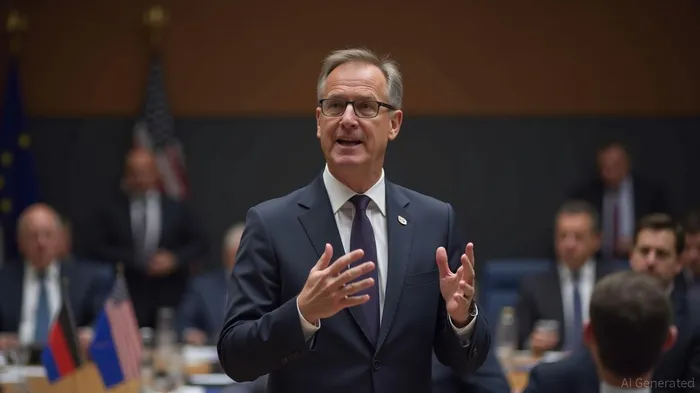
German economy minister Reiche on EU-US trade deal: there will be a need for adaption for some sectors
PorAinvest
lunes, 28 de julio de 2025, 5:35 am ET2 min de lectura
German economy minister Reiche on EU-US trade deal: there will be a need for adaption for some sectors
The European Union and the United States have reached a tentative trade deal, which aims to avert a potential tariff war between the two economic powerhouses [1]. The agreement, finalized on July 27, 2025, by European Commission President Ursula von der Leyen and US President Donald Trump, introduces a 15% tariff for the majority of EU products entering the US market [1]. This rate is lower than the 20% tariff initially imposed by Trump in April and the 30% threat made earlier in July [1].German Economy Minister Robert Reiche has emphasized the need for adaptation in certain sectors as a result of this trade deal. "While the 15% tariff is a significant reduction from the initial threat, some sectors will still face challenges," Reiche stated. "We expect to see a need for strategic adjustments in production and supply chains to mitigate the impact of these tariffs."
The deal includes a "zero-for-zero" scheme for specific products, such as aircraft, semiconductor equipment, and certain agricultural and chemical products [1]. This provision is aimed at minimizing the impact on strategic sectors. Additionally, the EU has committed to spending over $250 billion per year on American liquefied natural gas (LNG), oil, and nuclear fuels to replace Russian energy, totaling approximately $700 billion by the end of Trump's term [1].
The trade agreement has received mixed reactions from businesses. Dutch brewer Heineken, for instance, welcomed the certainty brought by the deal but cautioned on softer volumes for the remainder of the year due to ongoing trade disruptions [2]. Heineken's CEO, Dolf van den Brink, noted that while the 15% tariff is still challenging, all options are being considered to mitigate long-term tariff impacts, including potential shifts in manufacturing [2].
Minister Reiche underscored the importance of these adjustments. "The EU market is open, and we are committed to fostering a balanced trade relationship with the US. However, the 15% tariff will require some sectors to adapt their strategies to remain competitive," he said. "We are working closely with industry stakeholders to ensure a smooth transition and minimize disruptions."
The agreement has also sparked discussions about the future of the EU-US trade relationship. Next week, a federal appeals court in the US will begin hearing arguments in a lawsuit challenging Trump's authority to impose across-the-board tariffs under the pretext of a national emergency [1].
In conclusion, the EU-US trade deal represents a significant step towards stabilizing transatlantic commerce. However, the 15% tariff and its implications for various sectors necessitate strategic adaptations. Minister Reiche's emphasis on the need for adaptation underscores the importance of preparing for potential challenges and opportunities in the evolving trade landscape.
References:
[1] https://www.euronews.com/my-europe/2025/07/27/von-der-leyen-and-trump-strike-eu-us-trade-deal-to-avert-all-out-tariff-war
[2] https://www.reuters.com/en/heineken-cheers-eu-us-trade-deal-tariff-problems-hit-shares-2025-07-28/


Divulgación editorial y transparencia de la IA: Ainvest News utiliza tecnología avanzada de Modelos de Lenguaje Largo (LLM) para sintetizar y analizar datos de mercado en tiempo real. Para garantizar los más altos estándares de integridad, cada artículo se somete a un riguroso proceso de verificación con participación humana.
Mientras la IA asiste en el procesamiento de datos y la redacción inicial, un miembro editorial profesional de Ainvest revisa, verifica y aprueba de forma independiente todo el contenido para garantizar su precisión y cumplimiento con los estándares editoriales de Ainvest Fintech Inc. Esta supervisión humana está diseñada para mitigar las alucinaciones de la IA y garantizar el contexto financiero.
Advertencia sobre inversiones: Este contenido se proporciona únicamente con fines informativos y no constituye asesoramiento profesional de inversión, legal o financiero. Los mercados conllevan riesgos inherentes. Se recomienda a los usuarios que realicen una investigación independiente o consulten a un asesor financiero certificado antes de tomar cualquier decisión. Ainvest Fintech Inc. se exime de toda responsabilidad por las acciones tomadas con base en esta información. ¿Encontró un error? Reportar un problema


SOBRE NOSOTROS
Nuestra historiaAutores de noticiasBase de conocimientosPolítica de privacidadTérmino de usoDescargo de responsabilidad de corretaje de tercerosTérminos de uso de AIMEDivulgaciones de riesgos de AInvest AICarrerasCONTÁCTENOS
Email: support@ainvest.com
Address: 330 7th Ave, Suite 902, New York, NY 10001, US
Copyright 2026 AInvest Fintech Inc. All rights reserved.


Comentarios
Aún no hay comentarios