
German Consumer Sentiment and DAX: A Cautionary Signal for European Equities
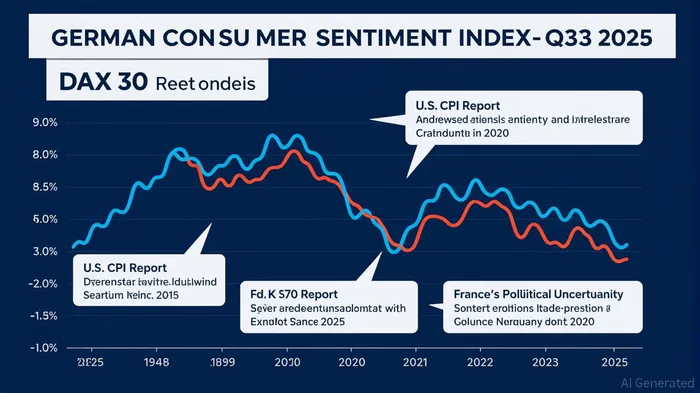
The German economy has long been a linchpin of European stability, but recent data paints a troubling picture. The GfK Consumer Sentiment Index, a critical barometer of household confidence, plummeted to -23.6 in September 2025—the weakest reading since April 2025. This sharp decline, driven by fears of job losses, inflation, and geopolitical tensions, signals a deepening “summer slump” in consumer behavior. Meanwhile, the DAX 30, Germany's flagship equity index, has shown a puzzling disconnect, hovering near a two-week low of 24,078 points despite its year-to-date gain of 28.20%. This divergence raises urgent questions about the resilience of European equities and the risks of overreliance on global optimism.
The Fragile Foundation of Consumer Confidence
The GfK index's components reveal a household sector in retreat. Economic expectations and income expectations hit multi-month lows, while willingness to buy dropped to -10.1, reflecting a reluctance to spend on major purchases. A one-point decline in the index corresponds to a 0.1% annual drop in private consumption, meaning the September reading implies a potential 2.36% contraction in consumer spending. This is particularly alarming given that private consumption accounts for roughly 60% of Germany's GDP.
The labor market, though stable with employment at 46 million, has seen the saving rate fall to 9.7% as households prioritize immediate needs over long-term security. This shift is already manifesting in corporate earnings: financial stocks like Commerzbank (-2.5%) and Deutsche BankDB-- (-2.3%) have underperformed, while energy sector players like Siemens Energy (-1.6%) face headwinds from volatile commodity prices.
The DAX's Resilience: A Mirage or a Strategy?
Despite the bleak domestic outlook, the DAX has maintained a medium-term upward trend, buoyed by global factors. Investors appear to be discounting near-term risks in favor of long-term expectations, such as U.S. Federal Reserve rate cuts and the EU-U.S. trade deal. The index's technical setup—a bear flag on the daily chart and a potential bull flag on the two-hour chart—suggests a consolidation phase, with key resistance levels at 24,600. However, this optimism is fragile.
The DAX's composition skews toward multinational corporations (e.g., automotive giants Porsche, BMW, and Mercedes-Benz), which are less exposed to domestic consumption than global demand. This explains why the automotive sector has outperformed, with Porsche (+2.4%) and BMW (+0.9%) posting gains. Yet, this resilience is a double-edged sword. If global demand falters—particularly in China or the U.S.—the DAX's export-dependent firms could face a sharper correction than the broader European market.
A Cautionary Tale for European Equities
The DAX's muted reaction to the GfK's collapse underscores a broader risk: European equities may be overvalued relative to their fundamentals. While the DAX has outperformed the S&P 500 in 2025 (up 28.20% vs. 10.5%), this outperformance is largely driven by speculative bets on AI-driven tech stocks and trade policy optimism. However, Germany's economic contraction in Q2 2025 (-0.3% quarter-over-quarter) and the EU's lagging GDP growth (0.1% in Q2) suggest that the region's structural challenges—aging demographics, energy transition costs, and regulatory burdens—are far from resolved.
The political uncertainty in France, with a confidence vote scheduled for September 8, 2025, adds another layer of risk. A no-confidence vote could trigger a snap election, disrupting EU-wide reforms and trade negotiations. Meanwhile, the U.S. dollar's weakness, which has supported non-U.S. equities, may reverse if the Fed signals a hawkish pivot.
Investment Implications and Strategic Recommendations
For investors, the key takeaway is to balance optimism with caution. The DAX's current valuation (P/E ratio of 18.5x, as of August 2025) appears attractive compared to the S&P 500's 24x, but this discount reflects underlying economic fragility. Here are three strategic recommendations:
- Hedge Against Volatility: Given the DAX's sensitivity to geopolitical and macroeconomic shocks, consider hedging with defensive sectors (e.g., utilities, healthcare) or European government bonds.
- Focus on Resilient Sectors: Prioritize DAX constituents with strong global demand, such as automotive and industrial firms, while avoiding overexposed financials and energy stocks.
- Monitor Key Indicators: Track the GfK index, Germany's Q3 GDP data, and the U.S. CPI report (August 12, 2025) for signals of a broader economic slowdown.
Conclusion: A Ticking Time Bomb?
The German economy's reliance on consumer spending and its role as a trade hub make it a critical barometer for European stability. While the DAX's recent resilience is encouraging, the widening gap between corporate earnings and household confidence is a red flag. If the GfK's downward spiral translates into a sharper contraction in private consumption, the DAX—and by extension, European equities—could face a painful correction. Investors must remain vigilant, balancing long-term optimism with short-term pragmatism in an increasingly uncertain world.







Comentarios
Aún no hay comentarios