
German Automotive Sector's Strategic Pivots and Investment Opportunities Amid Industry Transformation
The German automotive sector is undergoing a seismic shift as it navigates the dual pressures of decarbonization and global competition. With 2025 marking a pivotal year for policy alignment, electrification momentum, and margin recovery, investors must dissect the interplay between government incentives, OEM strategies, and technological innovation to identify opportunities.
Policy Alignment: A Fiscal and Regulatory Tailwind
Germany's “Responsibility for Germany” programme has introduced a 75% first-year depreciation allowance for electric vehicles (EVs), applicable to both passenger and commercial fleets, to accelerate corporate and private investment in sustainable mobility [1]. This measure, paired with streamlined permitting for high-power charging infrastructure, aligns with EU climate targets and the Alternative Fuels Infrastructure Regulation (AFIR) [1]. The government has also extended vehicle tax breaks for company EVs until 2035, signaling long-term commitment [2].
However, the closure of direct consumer EV subsidies in late 2024 due to budget constraints has shifted focus to supply-side incentives, such as supporting local EV manufacturing and grid upgrades [1]. These policies aim to address structural bottlenecks—such as underdeveloped charging networks and renewable energy integration—while fostering a competitive environment for domestic automakers.
Electrification Momentum: Premium OEMs Redefine the EV Landscape
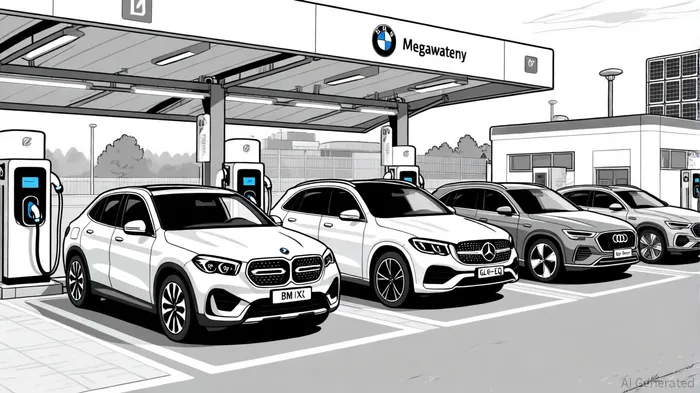
German premium automakers are leveraging distinct strategies to capture market share in the EV space. BMW has emerged as a leader, selling 5,454 battery electric vehicles (BEVs) in Germany in July 2025, outpacing rivals like Audi and Mercedes. The iX1 and iX2 models, coupled with a $1.7 billion investment in its Spartanburg, South Carolina, facility, underscore its aggressive expansion [3]. BMW's collaboration with VW and Mercedes on an open-source EV software platform further strengthens its position, enabling modular autonomous driving capabilities by 2026 [3].
Mercedes-Benz is pivoting toward full electrification, with all new architectures set to be electric from 2025. The GLC with EQ Technology, built on the MB.EA platform, features an 800V system and two-speed transmission, emphasizing performance and luxury [4]. Audi, meanwhile, is leveraging its partnership with Porsche on the PPE platform to deliver the Q6 e-tron, offering ranges up to 625 km and advanced driving dynamics [4].
Margin Recovery: Battery Partnerships and Cost Optimization
The transition to EVs has exposed structural weaknesses in German automakers, including high labor costs and software gaps. To address this, OEMs are forming strategic battery partnerships with Chinese manufacturers. For instance, LMFP (lithium manganese iron phosphate) technology, developed by firms like Gotion High-Tech, offers a 20% performance boost over LFP batteries while retaining cost advantages [5]. This technology, with 93% capacity retention at -20°C, addresses cold-weather performance concerns critical for European markets [5].
Volkswagen is diversifying its battery strategy by investing in sodium-ion and LNMO (lithium nickel manganese oxide) chemistries to reduce reliance on cobalt and improve energy density [6]. Meanwhile, partnerships—rather than vertical integration—are becoming the norm, with over 35% of Volkswagen's battery demand projected to be met through collaborations by 2030 [6]. This shift reflects a broader industry trend of balancing risk, cost, and control in the battery value chain.
Investment Opportunities and Risks
For investors, the German automotive sector presents a mix of high-conviction opportunities and risks. EV infrastructure and battery technology firms stand to benefit from government incentives and OEM partnerships. Premium OEMs with robust electrification roadmaps, such as BMW and Mercedes, are well-positioned to capture market share, particularly in the luxury EV segment.
However, challenges persist. Global competition from Chinese and Indian automakers, coupled with Trump-era tariffs, threatens profit margins [7]. Additionally, the success of these strategies hinges on regulatory continuity and the ability of automakers to execute cost-optimization measures without compromising innovation.
Conclusion
Germany's automotive sector is at a crossroads, with policy alignment, electrification momentum, and margin recovery strategies collectively shaping its trajectory. While the path forward is fraught with challenges, the combination of fiscal incentives, OEM innovation, and strategic partnerships creates a compelling investment narrative. Investors who focus on firms and technologies directly aligned with these trends—be it in EV platforms, battery chemistry, or infrastructure—may find themselves well-positioned for long-term gains.







Comentarios
Aún no hay comentarios