
Georgia-Pacific's $800M Alabama River Cellulose Mill: A Strategic Bet on Sustainable Fiber Demand?
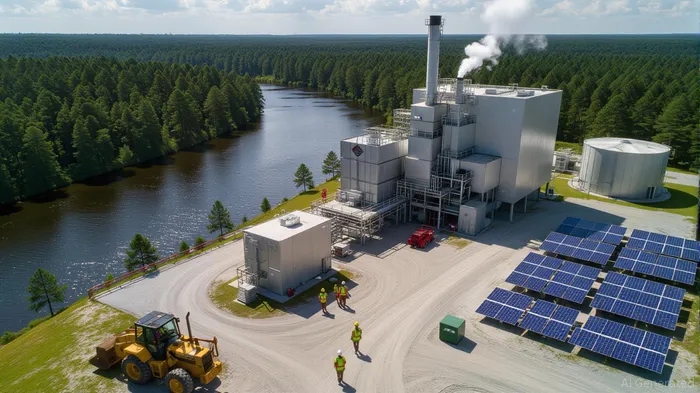
In the race to decarbonize industrial manufacturing, Georgia-Pacific's $800 million investment in its Alabama River Cellulose Mill represents a high-stakes gamble on the future of sustainable fiber demand. As global markets pivot toward circular economy principles and eco-conscious consumers demand greener alternatives, the mill's success could hinge on its ability to align with these trends while navigating financial and operational risks.
Market Dynamics: A Booming Sector with Structural Headwinds
The bleached linter cellulose market, a key segment for Georgia-Pacific's operations, is projected to grow at a compound annual growth rate (CAGR) of 4.32%, reaching $1.8 billion by 2030 [3]. This growth is driven by demand from nonwoven and specialty paper producers, sectors that are increasingly prioritizing sustainability. Meanwhile, the Lyocell fiber market—a subset of sustainable cellulose fibers—has seen even more aggressive growth, with a 2024 valuation of $802 million and a projected CAGR of 9.3% through 2032 [4]. Lyocell's appeal lies in its closed-loop production process, which recycles 99% of solvents and uses 50% less water than conventional cotton [4].
However, the broader sustainable recycled fibers market faces structural challenges. High capital expenditures for recycling infrastructure (30–40% higher than conventional production lines) and inconsistent fiber quality in recycling technologies remain barriers [1]. For Georgia-Pacific, these hurdles underscore the importance of technological differentiation and operational efficiency.
Georgia-Pacific's Strategic Moves: Capacity, Sustainability, and Diversification
The Alabama River Cellulose Mill, set to begin its $800 million modernization in Q4 2025, is central to Georgia-Pacific's strategy. The project will increase daily production capacity by 300 tons, enabling the mill to produce nearly one million tons of fluff and market pulps annually [1]. This expansion is paired with significant sustainability upgrades, including a state-of-the-art digester, a new pulp dryer, and a power boiler designed to reduce fossil fuel use by 72% [1]. The mill's reliance on biomass energy and advanced water recycling systems aligns with industry trends toward decarbonization and resource efficiency [4].
Beyond the Alabama mill, Georgia-Pacific has taken complementary steps to strengthen its position in the sustainable fiber market. The company closed its Cedar Springs, Georgia, containerboard mill in 2025 to optimize its manufacturing footprint [1], while its acquisition of Anchor Packaging in 2025 expanded its thermoforming and food packaging capabilities [5]. These moves reflect a dual strategy: consolidating legacy operations to reduce costs and investing in high-growth, sustainability-aligned segments like food-to-go packaging and recyclable materials.
Financial Risks and Credit Metrics: A Tenuous Balance
Despite these strategic initiatives, Georgia-Pacific's financial health remains a concern. As of 2025, the company holds an A1 credit rating with a 16.28% probability of default, reflecting lingering volatility from operational challenges in 2022 [1]. While the firm has stabilized its credit profile since mid-2023, its debt load and exposure to commodity price swings—particularly in pulp and paper—pose risks. The Alabama River Cellulose Mill's $800 million investment, while ambitious, must generate returns that offset these risks.
The mill's alignment with the $438.4 billion sustainable packaging market by 2032 [3] offers a potential offset. Regulatory tailwinds, such as the EU's Circular Economy Action Plan and U.S. state-level recycling mandates, are creating a “green premium” for companies that can demonstrate environmental stewardship [1]. Georgia-Pacific's focus on recyclable packaging and biomass energy could position it to capture this premium, but only if it maintains cost discipline and technological leadership.
Long-Term Viability: A Test of Adaptability
The Alabama River Cellulose Mill's long-term success will depend on three factors:
1. Market Access: Can Georgia-Pacific secure long-term contracts with Lyocell and nonwoven producers, who are critical to absorbing its expanded capacity?
2. Cost Competitiveness: Will the mill's sustainability upgrades translate into lower operational costs or higher margins through green certifications?
3. Regulatory Resilience: How will evolving environmental regulations and carbon pricing mechanisms impact the mill's profitability?
The company's track record offers mixed signals. The Monticello linerboard mill, which achieved industry-leading production in 2024 through employee-driven efficiency gains [2], demonstrates Georgia-Pacific's operational agility. However, its recent mill closures and acquisitions highlight a reliance on aggressive restructuring—a strategy that can alienate stakeholders if not executed smoothly.
Conclusion: A Calculated Bet with High Stakes
Georgia-Pacific's Alabama River Cellulose Mill is a calculated bet on the future of sustainable fiber manufacturing. The project's scale, sustainability focus, and alignment with market growth trends position it as a strategic asset in a sector poised for transformation. Yet, the company's financial risks and the broader industry's infrastructure challenges mean this investment is far from a guaranteed win.
For investors, the key question is whether Georgia-Pacific can leverage its operational expertise and capital expenditures to outperform peers in a market where green credentials are becoming as critical as cost efficiency. If the company succeeds, the Alabama mill could become a blueprint for industrial decarbonization. If it falters, it may serve as a cautionary tale about the perils of overreaching in a rapidly shifting landscape.







Comentarios
Aún no hay comentarios