
Geopolitical Volatility in West Africa: A Crossroads for Gold Investors
The recent seizure of $245 million in gold reserves by Mali's military-led government from BarrickB-- Gold's Loulo-Gounkoto complex marks a pivotal moment in the evolving landscape of gold mining investments. This incident, now a flashpoint in the broader struggle between foreign mining firms and resource-nationalist regimes, underscores how geopolitical risks are reshaping valuations and investment strategies across West Africa. For gold investors, the Mali crisis is not merely a regional blip but a harbinger of systemic challenges requiring recalibration of risk management frameworks.
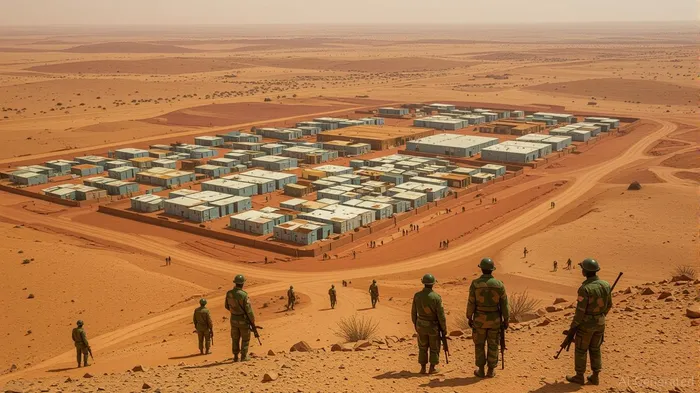
The Mali Dispute: A Microcosm of Resource Nationalism
Mali's actions—seizing gold stockpiles, detaining executives, and appointing a state-aligned administrator—are emblematic of a growing trend across the African mining sector. The junta's justification? A retroactive tax dispute and demands for renegotiated contracts under Mali's revised 2023 mining code, which demands higher royalties and state equity stakes. Barrick's response—halting production and incurring a $484 million impairment charge—reveals the financial stakes: the Loulo-Gounkoto complex alone contributed 15% of the company's global gold output in 2024 and $949 million in revenue.
The conflict's escalation has already caused Barrick to exclude the mine from its 2025 production forecast, slicing its annual output target by 17.7%. This operational blow, compounded by the mine's potential downgrading to “care and maintenance” mode (costing $7.5 million monthly), paints a stark picture of the financial toll of geopolitical instability.
Data visualization showing GOLD's 18% decline since January 2025 versus the GDX's 5% dip, reflecting investor anxiety over Mali's impact
Broader Geopolitical Risks: A Region in Flux
Mali's actions are not isolated. Across West Africa, governments are weaponizing resource nationalism:
- Guinea: In 2023, a military coup led to the seizure of mining licenses held by Rio TintoRIO-- and others.
- Democratic Republic of Congo: Revised mining codes have forced companies like Glencore and Randgold to renegotiate terms, with state ownership demands climbing to 35%.
- Zambia: The Zambian government has aggressively renegotiated copper mining contracts, citing a need to “rebalance” revenue shares.
These trends highlight two critical risks for investors:
1. Contractual Uncertainty: Long-standing agreements are increasingly vulnerable to sudden regulatory shifts or expropriation. Barrick's 2006 Mali mining convention, once a bedrock of stability, now lies in tatters.
2. Judicial Bias: In weak governance environments, courts often side with state interests. Mali's appointment of a provisional administrator—Soumana Makadji, a former health minister with no mining expertise—exemplifies this bias.
Valuation Implications: A Sector-Wide Reassessment
The Mali incident has already triggered a reevaluation of gold mining valuations in politically fragile regions. Key considerations for investors include:
- Production Risk Premium: Mines in unstable jurisdictions now carry higher risk discounts. Barrick's Loulo-Gounkoto, once valued at $2.8 billion, may see its book value slashed if Mali retains control, as its operational viability hinges on technical expertise Barrick has withheld.
- Gold Price Sensitivity: While record gold prices ($3,500/oz in 2025) amplify the value of seized reserves, they also magnify the stakes of disputes. Mali's sale of one tonne of gold ($107 million) to fund operations directly undermines investor returns.
- Contagion Effects: The Mali case sets a dangerous precedent. If expropriation becomes normalized, even high-grade assets in countries like Burkina Faso or Ghana could face valuation downgrades as risk premiums rise.
Morningstar's analysis underscores this: the Loulo-Gounkoto suspension alone has cost Barrick $200–300 million annually in EBITDA, with further losses likely if the mine remains offline.
Strategic Investment Advice: Navigating the New Reality
To mitigate risks, investors should adopt a multi-pronged strategy:
- Geographic Diversification:
- Focus on Stable Markets: Prioritize jurisdictions with strong governance, such as Canada (e.g., Yamana Gold's Jacobina mine), Australia (Newcrest Mining's Telfer complex), or Chile (Barrick's Zaldivar copper-gold project).
Reduce Exposure to Fragile Regions: Limit investments in West Africa unless companies demonstrate robust risk management, such as AngloGold Ashanti's diversified portfolio (South Africa, Ghana, and Brazil).
Contractual and Legal Safeguards:
- ICSID Arbitration Clauses: Insist on binding international arbitration provisions, though recognize their limitations in authoritarian regimes.
ESG Due Diligence: Favor firms with strong local community ties and compliance programs to reduce expropriation risks.
Hedging and Derivatives:
- Use gold price derivatives (e.g., GLD ETF options) to insulate against production shortfalls.
Explore sovereign risk insurance for projects in high-risk zones.
Sector Rotation:
- Shift toward gold streaming companies (e.g., Franco-NevadaFNV--, Royal Gold), which typically face lower operational risks due to fixed-price agreements.
- Consider gold ETFs (e.g., IAU, SGOL) as a safer way to capture price upside without operational exposure.
Conclusion: Geopolitics as a Core Investment Criterion
The Mali-Barrick standoff is a watershed moment. It signals that geopolitical risk is no longer a peripheral consideration but a core determinant of gold mining valuations. Investors must now treat jurisdictional stability as rigorously as they assess ore grades or cost curves. While gold's intrinsic value remains a hedge against global uncertainty, the path to profit in mining now demands relentless focus on where—and with whom—that gold is extracted.
For those willing to navigate this new landscape, opportunities exist in stable markets and well-structured agreements. But in regions like West Africa, the calculus has shifted: the cost of doing business in volatile regimes may soon outweigh the allure of rich mineral reserves.
Final recommendation: Rotate out of single-country West African exposures and into diversified gold equities with ICSID clauses. For pure price exposure, favor ETFs.





Comentarios
Aún no hay comentarios