
Geopolitical Volatility in Developed Markets: Underestimating Political Shocks in Japan and France
Geopolitical volatility in developed markets has increasingly shaped asset allocation strategies, yet investors often underestimate the cascading effects of political shocks. Recent events in Japan and France underscore this phenomenon, revealing how domestic instability and global interdependencies can distort market expectations and force rapid reallocations of capital.
Japan: Political Uncertainty and Market Resilience
Prime Minister Shigeru Ishiba's abrupt resignation in September 2025 triggered immediate turbulence in Japan's financial markets. The yen weakened sharply, while the Nikkei 225 surged 11% from July to September 2025, reflecting a mix of panic and opportunistic buying, a Lombard Odier report noted. This paradox highlights a critical miscalculation by investors: while political uncertainty typically depresses equities, Japan's corporate reforms and reflationary policies created a "safe haven" for risk-on assets, according to the Lombard Odier report.
However, the underestimation of risks persists. Japan's public debt-to-GDP ratio of 264%, according to Kiplinger, and the potential for U.S.-led trade wars-exacerbated by Donald Trump's 2025 re-election-pose long-term threats to its export-driven economy. Despite J.P. Morgan's bullish outlook on Japanese equities, the Bank of Japan's gradual normalization of monetary policy and the government's push to redirect household savings into productive investments in its FSA policy plan remain fragile against these headwinds.
France: Fiscal Paralysis and Investor Flight
France's political instability, marked by a fragmented parliament and repeated government collapses, has eroded investor confidence. The anticipated loss of Prime Minister François Bayrou's confidence vote in 2025 sent ripples through European markets, with French 10-year bond yields climbing to 3.3% in June 2025-nearly double Germany's 1.8%-as investors priced in debt sustainability risks, according to a J.P. Morgan report. The widening OAT-Bund spread (90 basis points) underscored a flight to quality, with capital shifting toward German and Italian bonds, a dynamic also noted in FSA commentary on asset allocation.
The underestimation of France's crisis is evident in its lagging equity performance. The CAC 40 returned just 5% in 2025, underperforming the DAX and lagging behind global benchmarks, as highlighted in the J.P. Morgan analysis. Public debt is projected to reach 120% of GDP by 2027 in the same J.P. Morgan outlook, with interest payments consuming 3% of GDP by 2029-a trajectory that risks a Greek-style financial tutelage scenario. Yet, many investors initially dismissed these warnings, assuming European fiscal coordination would mitigate fallout.
Strategic Adjustments and Lessons Learned
Investors have begun recalibrating portfolios to address these shocks. J.P. Morgan's 3Q 2025 asset allocation report advocates overweights in European sovereign bonds (e.g., Italian BTPs) and targeted equity sectors, while underweighting the U.S. dollar. In Japan, the focus remains on equities, driven by corporate reforms and foreign inflows described by Lombard Odier, though bond markets remain volatile due to shifting demand for JGBs noted in the J.P. Morgan report.
For France, diversification into resilient sectors like technology and communication services has gained traction, while risk-averse investors favor gold (reaching $3,600 per ounce in 2025 in J.P. Morgan's view) and German assets. The key takeaway is clear: political shocks in developed markets are no longer isolated events. They interact with global supply chain shifts, inflationary pressures, and geopolitical risks, demanding a more nuanced approach to asset allocation.
Conclusion
The underestimation of political shocks in Japan and France reveals a broader challenge for investors: balancing short-term market reactions with long-term structural risks. As these cases demonstrate, geopolitical volatility is not merely a backdrop to economic cycles-it is a driver of them. Future strategies must prioritize agility, incorporating real-time political risk assessments and stress-testing portfolios against cascading scenarios. In an era of interconnected crises, complacency is the greatest risk of all.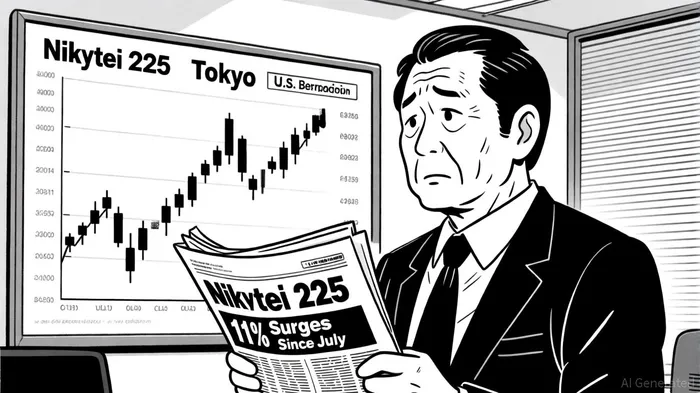







Comentarios
Aún no hay comentarios