
Geopolitical Volatility and Bitcoin Resilience in 2026
Venezuela's political and economic collapse has long served as a proving ground for Bitcoin's utility in times of crisis. By 2026, the country's deepening instability-marked by U.S. military intervention, hyperinflation, and a fractured political landscape-has further cemented cryptocurrency as a lifeline for its citizens. Yet, despite the volatility, Bitcoin's global uptrend remains unshaken. This analysis explores why Venezuela's turmoil, while a catalyst for localized cryptoBTC-- adoption, is unlikely to derail Bitcoin's broader trajectory.
Economic Collapse and the Rise of Crypto as a Hedge
Venezuela's economic crisis has created a perfect storm for BitcoinBTC-- adoption. Inflation hit 71.7% in 2025, while 51.9% of the population lives in poverty. Traditional financial systems have eroded trust, pushing Venezuelans to adopt stablecoins and Bitcoin as alternatives to the bolívar. By 2025, the country ranked 11th globally in crypto adoption, with digital assets facilitating remittances, salary payments, and everyday transactions.
This shift is not merely reactive but structural. As the World Bank notes, Venezuela's financial infrastructure has been crippled by years of mismanagement and sanctions. 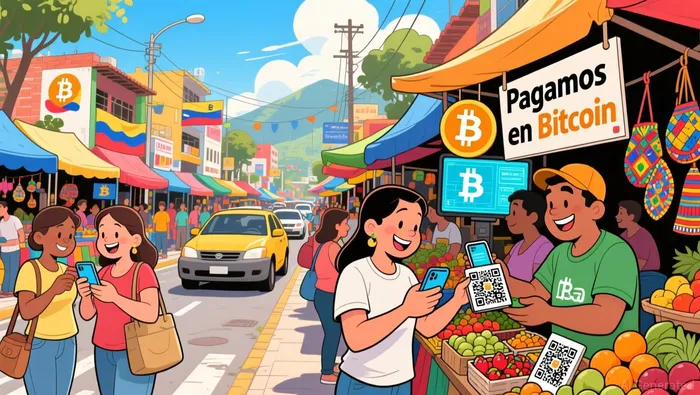 Bitcoin, with its decentralized nature, offers a workaround for individuals excluded from banking systems. For example, remittances from the 6 million Venezuelan diaspora now flow largely through crypto platforms, bypassing state-controlled channels.
Geopolitical Volatility and Market Resilience
The U.S. military's January 2026 operation to capture Nicolás Maduro and his wife triggered immediate geopolitical tremors. While some investors initially fled crypto markets, fearing a regional conflict or regulatory crackdown, Bitcoin's price stabilized within days. This resilience underscores a critical shift: investors now view geopolitical volatility as a feature, not a bug, of the crypto ecosystem.
According to a report by Coingape, U.S. military actions in Venezuela initially spooked traders, but the market quickly recalibrated as it became clear that the operation would not lead to a broader regional war. Furthermore, the Trump administration's emphasis on rebuilding Venezuela's oil sector through private investment has created a narrative of long-term economic restructuring, which many analysts argue could eventually integrate crypto into formal financial systems.
Structural Factors Outweigh Short-Term Jitters
While Venezuela's turmoil has amplified short-term volatility, it has also accelerated Bitcoin's adoption in ways that reinforce its long-term appeal. For instance, the country's 2025 election fraud and subsequent repression have highlighted the need for transparent, tamper-proof financial systems-a niche where blockchain technology excels.
Moreover, a 2025 study by the Americas Quarterly found that over 40% of Venezuelans now use crypto for daily purchases, a figure that has only grown in 2026. This grassroots adoption is not easily reversed, even if political conditions stabilize.
Conclusion: A New Paradigm for Risk and Reward
Venezuela's crisis illustrates a broader trend: Bitcoin's role as a hedge against both economic and geopolitical risk. While the U.S. capture of Maduro and subsequent military actions introduced temporary uncertainty, they also underscored the limitations of fiat currencies in unstable environments. For investors, this reinforces Bitcoin's value proposition-not as a speculative asset, but as a store of value in a world increasingly defined by institutional fragility.
As the Trump administration pivots to reconstruction efforts, the integration of crypto into Venezuela's post-Maduro economy could serve as a blueprint for other nations facing similar crises. In this light, Venezuela's turmoil is not a threat to Bitcoin's uptrend but a catalyst for its next phase of global adoption.







Comentarios
Aún no hay comentarios