
Geopolitical Turmoil and the Evolution of Global Asset Allocation: Navigating Uncertainty in a Multipolar World
The period from 2023 to 2025 has witnessed an unprecedented surge in geopolitical instability, with 59 active military conflicts as of mid-2025-the highest level since World War II, according to a Kolot analysis. These tensions are not merely regional crises but systemic shocks that ripple through global markets, forcing investors to rethink traditional asset allocation frameworks. The interplay between political uncertainty and capital flows has become a defining feature of modern portfolio management, as investors grapple with the dual challenges of volatility and interconnectedness.
The New Normal: From Safe Havens to Dynamic Diversification
Historically, investors relied on a binary approach to geopolitical risk: shifting capital between "risky" equities and "safe haven" assets like U.S. Treasuries or gold. However, the current landscape demands a more nuanced strategy. According to the World Economic Forum's Global Risks Report 2025, the persistence of multiple overlapping conflicts has elevated baseline uncertainty, prompting investors to adopt dynamic, rules-based frameworks that prioritize resilience over short-term gains.
For instance, the Russia-Ukraine war has disrupted energy supply chains, pushing European inflation to multi-decade highs and accelerating the shift toward renewable energy investments, as detailed in an Emory Economics Review article. Similarly, the Israel-Gaza conflict and Hezbollah tensions in Lebanon have destabilized Middle Eastern markets, while China-Taiwan tensions threaten the global semiconductor industry-a sector critical to 16% of global GDP, the Emory Economics Review article also notes. These events underscore the need for proactive diversification, with defensive sectors like healthcare and technology gaining prominence as buffers against sector-specific shocks, a finding echoed by the Kolot analysis.
Reassessing Safe Havens: Gold, Currencies, and Cryptocurrencies
Traditional safe-haven assets are undergoing a reevaluation. The U.S. dollar, long the bedrock of global finance, has faced challenges as central banks diversify reserves amid sanctions and geopolitical realignments, the World Economic Forum report observes. Meanwhile, gold has seen a resurgence, with global demand rising 16% year-over-year in early 2025, driven by its role as a hedge against inflation and currency devaluation, according to the same World Economic Forum report.
Cryptocurrencies, often touted as digital safe havens, remain a double-edged sword. While Bitcoin's decentralized nature appeals to some investors, its volatility-exacerbated by regulatory uncertainty-limits its utility in risk-averse portfolios, the World Economic Forum report warns. This has led to a growing preference for tangible assets like real estate and commodities, which offer both inflation protection and income generation, as highlighted in the Kolot analysis.
The Rise of Multi-Polar Investment Strategies
The fragmentation of global power dynamics is reshaping capital flows. Sovereign wealth funds from emerging markets are increasingly allocating capital to infrastructure and technology sectors in Asia and Africa, bypassing traditional Western-dominated markets, the Kolot analysis reports. This shift reflects a broader trend: investors are no longer bound by geographic or ideological silos but are instead prioritizing stability and growth in regions less exposed to conflict.
For example, the persistent instability in the Sahel and Horn of Africa has driven capital toward Southeast Asia, where political risk remains relatively lower despite its own challenges. Similarly, Latin American markets are attracting attention as criminal groups in Mexico and Colombia destabilize supply chains, pushing multinational corporations to diversify manufacturing hubs, according to a Bunker‑Swiss report.
Scenario Planning and the Future of Portfolio Resilience
As geopolitical risks become more entrenched, scenario planning has emerged as a critical tool for investors. According to S&P Global, firms that incorporate geopolitical stress-testing into their asset allocation models have outperformed peers by an average of 8% annually since 2023. This approach involves stress-testing portfolios against plausible worst-case scenarios, such as a full-scale China-Taiwan conflict or a collapse in global oil trade routes, scenarios explored in the Emory Economics Review article.
Conclusion: Adapting to a Fractured World
The 2023–2025 period has irrevocably altered the investment landscape. Political uncertainty in conflict zones is no longer a peripheral risk but a central driver of asset allocation strategies. Investors must embrace multi-polar diversification, prioritize defensive sectors, and integrate geopolitical scenario analysis into their decision-making. As the world navigates a new era of multipolarity and volatility, adaptability-rather than rigid adherence to historical norms-will define long-term portfolio success, as the Kolot analysis concludes.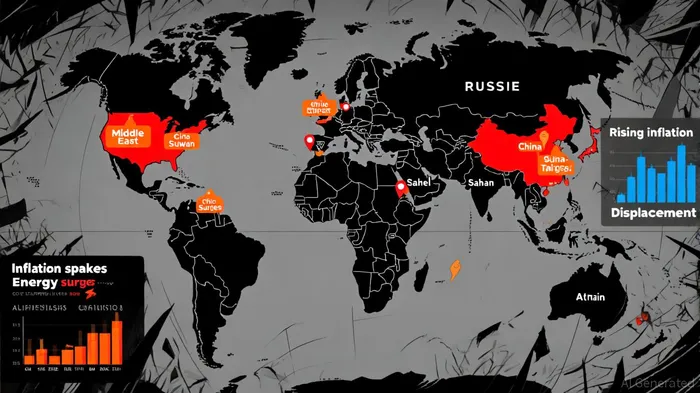






Comentarios
Aún no hay comentarios