
Geopolitical Turmoil and Energy Transition: How Ukrainian Drone Strikes Reshape Oil Markets and Investment Strategies
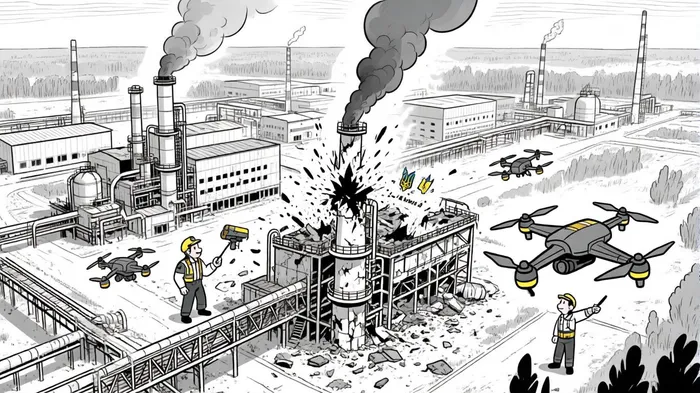
The global energy landscape in 2025 is being reshaped by an unexpected actor: Ukrainian drones. By targeting Russian oil refineries, Ukraine has not only disrupted Moscow's war economy but also introduced a new layer of volatility into global oil markets. These strikes, which have crippled 17–20% of Russia's refining capacity, are forcing investors to reconsider their exposure to fossil fuels and redirect capital toward alternative energy and energy security stocks. The implications are profound, offering both risks and opportunities for a sector already grappling with the dual pressures of geopolitical instability and the energy transition.
The Strategic Impact of Drone Attacks on Russian Refineries
Ukraine's drone campaign has targeted key nodes in Russia's energy infrastructure, including the Kirishi refinery (355,000 barrels per day capacity) and the Baltic port of Ust-Luga, which handles a significant share of Russian crude exports. According to a report by Forbes, these strikes have reduced refining capacity by up to 40% at some facilities, creating bottlenecks that ripple across Russia's domestic fuel supply and export capabilities [1]. The result has been fuel shortages, record-high gasoline prices, and long lines at gas stations—a stark contrast to Russia's historical dominance in energy markets.
The geopolitical ramifications extend beyond Russia. Analysts at JPMorganJPM-- warn that sustained attacks could add upward pressure on global oil prices, as markets factor in the risk of supply disruptions [2]. Indeed, Brent crude prices rose 0.4% to $67.29 per barrel following the Kirishi strike, while WTI crude gained 0.7% to $63.15 [2]. These price movements reflect a growing recognition that energy security is no longer just a function of OPEC+ or U.S. shale but is increasingly influenced by asymmetric warfare tactics.
Energy Market Volatility and the Rise of Alternative Energy
The uncertainty created by these attacks has accelerated a shift in investor sentiment toward alternative energy. According to data from Investing.com, the five largest alternative energy ETFs have surged nearly 25% year-to-date in 2025, outperforming the Energy Select SPDR ETF (XLE), which tracks major oil companies like ExxonXOM-- and ChevronCVX--, by a wide margin [4]. This trend is driven by two key factors: the anticipated surge in electricity demand from AI and data centers, and the growing unattractiveness of fossil fuel investments amid geopolitical risks.
Nuclear energy, in particular, has seen a renaissance. The VanEck Uranium and Nuclear ETF (NLR) has soared over 50% in 2025, reflecting investor confidence in nuclear power as a stable, low-carbon alternative to oil and gas [4]. Similarly, renewable energy stocks are benefiting from policy tailwinds and technological advancements. BloombergNEF projects that renewables will account for more than half of new power generation capacity by 2035, a trajectory that gains urgency as oil markets face persistent volatility [4].
Energy Security Stocks: A Hedge Against Geopolitical Risk
For investors seeking direct exposure to energy security, certain stocks and ETFs are emerging as strategic plays. Suncor EnergySU-- (SU), DNOWDNOW-- Inc. (DNOW), and MRC GlobalMRC-- (MRC) are highlighted by fund managers for their resilience in volatile markets and alignment with long-term energy demand trends [4]. These companies are positioned to benefit from both the immediate need for energy infrastructure hardening and the broader transition to cleaner energy sources.
Energy ETFs, meanwhile, offer diversified access to this evolving landscape. The Energy Select Sector SPDR Fund (XLE) and the United States OilUSO-- Fund (USO) have seen inflows as investors hedge against oil price swings, while funds focused on renewables and battery technologies are attracting capital for their growth potential [3]. The key distinction lies in the balance between short-term volatility and long-term structural shifts.
The Road Ahead: Balancing Risks and Opportunities
The Russian government's response to the drone attacks—ranging from enhanced air defenses to restricting fuel exports—highlights the fragility of its energy infrastructure [5]. However, these measures may only delay the inevitable: a further erosion of Russia's refining capacity and a reallocation of global crude trade flows. China's increased imports of Russian Urals crude, for instance, underscore the market's adaptability, but also its vulnerability to future disruptions [6].
For investors, the lesson is clear: energy security is no longer a niche concern but a central theme in portfolio construction. As Natasha Kaneva of JPMorgan notes, “The interplay between geopolitical shocks and energy transitions is creating a new paradigm for markets—one where resilience and diversification are paramount” [2]. This paradigm favors companies and funds that address both immediate supply chain risks and the long-term decline of fossil fuels.
Conclusion
The Ukrainian drone campaign against Russian refineries is a case study in how modern warfare can disrupt global energy markets and catalyze investment shifts. While the immediate risks of oil price volatility remain, the long-term opportunity lies in energy security and alternative energy. Investors who recognize this duality—balancing exposure to resilient fossil fuel assets with bets on the energy transition—will be well-positioned to navigate the uncertainties of 2025 and beyond.





Comentarios
Aún no hay comentarios