
The Geopolitical Tug-of-War: How Middle Eastern Ceasefire Efforts Could Shake Up Energy and Defense Plays
The Israel-Iran conflict, now in its second year, has become a defining geopolitical flashpoint of 2025, with ripple effects across global markets. Prime Minister Giorgia Meloni's diplomatic push for a ceasefire—highlighted at the G-7 Summit and European summits—has injected new uncertainty into an already volatile landscape. For investors, the question is clear: How should risk-adjusted returns in energy and defense sectors be evaluated as this geopolitical stalemate evolves?
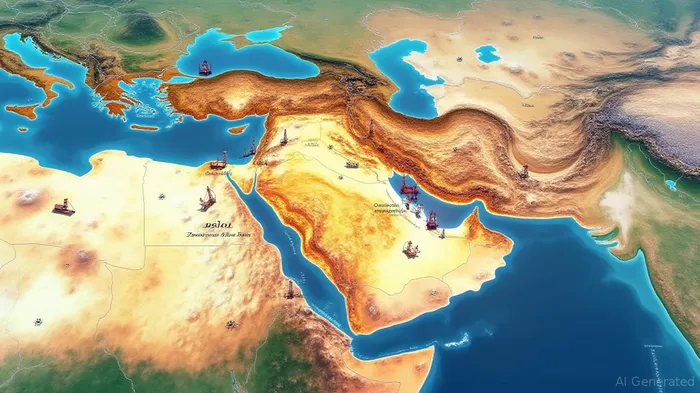
The Energy Sector: Riding Volatility or Betting on Stability?
The conflict has already reshaped energy markets. Israeli strikes on Iranian infrastructure, coupled with sanctions and cyberattacks, have disrupted oil production, pushing Brent crude to $95 per barrel in early 2025. . Middle Eastern energy giants like Saudi Aramco (Saudi Arabia) and the Abu Dhabi National Oil Company (ADNOC) have thrived in this environment, leveraging their stable production and export capacity.
But the calculus is fraught. A successful Meloni-led ceasefire could ease tensions and reduce the risk premium priced into oil. Conversely, continued escalation might sustain high prices. Investors must weigh the likelihood of a breakthrough against the entrenched positions of Israel and Iran.
Opportunity: Overweight exposure to Middle Eastern energy equities if the conflict persists.
Risk: A sudden ceasefire could trigger a 10–15% correction in oil prices, hitting energy stocks.
Defense Sector: Profiting from Uncertainty, or Overpaying for Risk?
Defense contractors are beneficiaries of prolonged instability. Countries in the region, such as the UAE, Saudi Arabia, and Israel, are accelerating military modernization. The U.S.-based Lockheed MartinLMT-- (LMT) and European firms like Airbus (AIR.PA) have secured contracts for drones, missiles, and cybersecurity systems.
Yet Meloni's diplomatic efforts complicate this narrative. If a ceasefire reduces the urgency for arms spending, defense stocks could falter. . Investors must distinguish between companies with diversified portfolios (e.g., Boeing's (BA) non-military aviation divisions) and those overly reliant on Middle Eastern defense deals.
Opportunity: Look for defense stocks with exposure to non-regional markets or dual-use technologies (e.g., cybersecurity).
Risk: A sudden de-escalation could lead to oversupply in defense contracting, pressuring margins.
Navigating the Gray Zone: Risks and Considerations
Meloni's efforts face significant hurdles. Iran's refusal to negotiate without sanctions relief and Israel's distrust of Russian mediation (as proposed by Trump) suggest no quick resolution. Meanwhile, regional actors like the UAE and Saudi Arabia are positioning themselves as neutral mediators, which could enhance their geopolitical—and economic—standing.
Investors must also monitor spillover risks. The conflict has already triggered evacuations, supply chain disruptions, and cyberattacks, raising operational costs for firms in the region. For example, Iran's shift to a domestically controlled internet (the “halal net”) has created barriers for multinational tech companies.
Investment Strategy: Balance Exposure with Hedging
- Energy Plays:
- Buy: Middle Eastern energy stocks (e.g., Saudi Aramco, ADNOC) as long as oil prices remain above $85/barrel.
Hedge: Use options to protect against a ceasefire-driven price drop.
Defense Plays:
- Target: Companies with diversified revenue streams (e.g., Boeing, Airbus) or cybersecurity expertise (e.g., Palantir (PLTR)).
Avoid: Firms overly reliant on short-term Middle Eastern contracts.
Geopolitical Diversification:
- Pair Middle Eastern equities with exposure to regions less tied to the conflict, such as Southeast Asia or Europe.
Conclusion: A Delicate Balancing Act
Meloni's ceasefire push represents a pivotal moment, but the path to resolution remains uncertain. Investors should treat energy and defense sectors as dynamic plays, requiring constant recalibration. The key is to prioritize companies that can thrive in both prolonged conflict and sudden de-escalation—those with resilience built into their business models. As markets parse every diplomatic tweet and missile strike, the winners will be those who stay agile, hedged, and ruthlessly analytical.
Final Take: Middle Eastern equities offer compelling risk-adjusted returns—but only for investors willing to engage with the conflict's volatility head-on.





Comentarios
Aún no hay comentarios