
Geopolitical Trade Shifts: India's Russian Oil Imports and U.S. Engagement
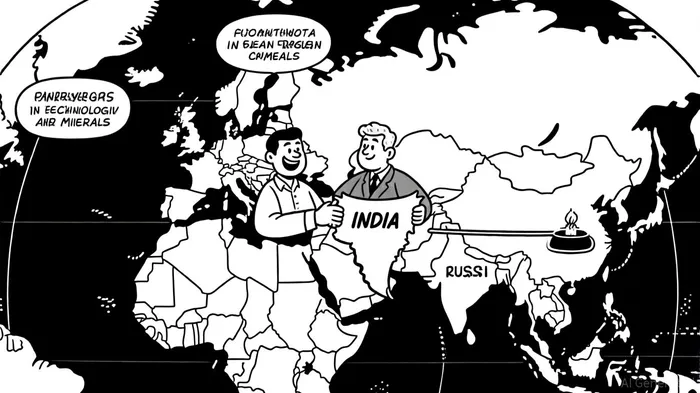
The global energy landscape is undergoing a seismic shift, driven by geopolitical realignments and the urgent need for energy diversification. India, a nation with a voracious appetite for energy, has emerged as a pivotal player in this transformation. By 2025, its imports of Russian crude oil have surged to 35% of total crude oil imports, a stark contrast to the mere 2% recorded in 2020 [2]. Simultaneously, the U.S.-India energy partnership has deepened, focusing on clean energy, critical minerals, and nuclear power. This dual dynamic—India's strategic pivot to Russian oil and its collaboration with the U.S.—presents both risks and opportunities for investors navigating the evolving energy market.
India's Strategic Shift to Russian Crude: A Cost-Driven Imperative
India's embrace of Russian oil is not merely a commercial decision but a calculated strategy to hedge against volatile global markets. According to a report by The Economic Times, the value of India's crude imports from Russia has grown at a compound annual growth rate (CAGR) of 96% since FY2020 [2]. In 2024 alone, these imports were valued at $52.73 billion [1], with provisional vessel-tracking data in early 2025 indicating an average of 1.73 million barrels per day (bpd) of Russian crude flowing into Indian ports .
This shift is underpinned by the cost advantage of discounted Russian oil, which has become increasingly attractive as global supply chains reorient post-Ukraine war. For investors, this trend signals a growing reliance on a single supplier, raising concerns about geopolitical exposure. However, it also highlights India's ability to leverage its position as a key buyer in a fragmented market. The strategic diversification of energy sources—balancing Russian imports with investments in renewables and U.S. partnerships—could mitigate long-term risks while capitalizing on short-term gains.
U.S. Engagement: A Blueprint for Energy Resilience
While India's Russian oil imports have drawn headlines, its collaboration with the U.S. offers a complementary path to energy security. The U.S.-India Strategic Clean Energy Partnership (SCEP) has advanced initiatives in biofuels, solar energy, and hydrogen, while the Initiative on Critical and Emerging Technology (iCET) has strengthened ties in clean technology and Small Modular Reactors (SMRs) [2]. A 2024 Memorandum of Understanding (MoU) on critical minerals aims to build resilient supply chains, addressing India's reliance on China for rare earth processing [2].
Despite challenges such as India's 2010 Nuclear Damage Act, which deters private U.S. investment in nuclear energy, the U.S. remains a key partner in India's 100 GW nuclear power ambitions [2]. For investors, the U.S.-India energy partnership represents a dual opportunity: supporting India's clean energy transition while securing access to critical minerals and technologies. The growing emphasis on green hydrogen and AI-driven energy efficiency further underscores the potential for high-impact investments in this arena.
Strategic Investment Opportunities: Balancing Risk and Reward
The interplay between India's Russian oil imports and U.S. engagement creates a unique investment landscape. For energy infrastructure, the surge in Russian crude imports necessitates investments in refining capacity and storage facilities. Companies with expertise in upgrading India's refining sector—such as those specializing in hydrocracking or sulfur removal—stand to benefit from the influx of discounted Russian oil.
In the U.S.-India clean energy corridor, opportunities abound in solar manufacturing, hydrogen electrolysis, and critical mineral processing. The Quad's focus on supply chain resilience and the U.S. MoU on critical minerals could catalyze investments in India's domestic mining sector and third-country co-investments. Additionally, U.S. firms with AI capabilities for grid optimization or predictive maintenance in energy systems are well-positioned to tap into India's $1.5 trillion energy transition market [3].
Conclusion: Navigating a Fractured Energy Order
India's energy strategy is a masterclass in balancing geopolitical pragmatism with long-term sustainability. While Russian oil provides immediate cost advantages, the U.S. partnership offers a blueprint for resilience in a multipolar world. For investors, the key lies in hedging exposure to single-supplier risks while capitalizing on the synergies between traditional and renewable energy. As India continues to refine its energy matrix, the intersection of Russian imports and U.S. innovation will define the next era of global energy investment.







Comentarios
Aún no hay comentarios