
Geopolitical Tensions and Tech Disruptions: High-Conviction Opportunities in Semiconductor and Consumer Tech Stocks for 2025
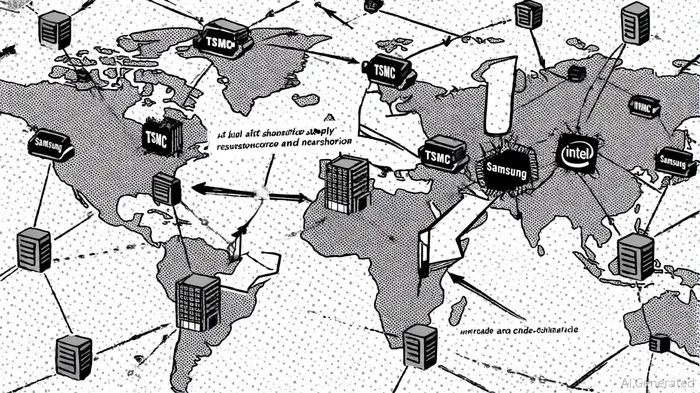
The semiconductor and consumer tech sectors in 2025 are at a pivotal crossroads, shaped by a confluence of geopolitical tensions, regulatory shifts, and technological breakthroughs. As global demand for AI-driven infrastructure surges, investors face both risks and opportunities in a landscape marked by fragmented supply chains, strategic realignments, and innovation-led growth. This analysis identifies high-conviction investment targets amid these disruptions, leveraging data from industry reports and executive insights.
Semiconductor Industry: A $700B+ Market Amid Geopolitical Fractures
The semiconductor industry is projected to reach $697 billion in 2025, with generative AI and data center expansion driving 11% year-over-year growth[1]. This growth is underpinned by a 70% surge in high-bandwidth memory (HBM) revenue and a 27% increase in GPU sales, as AI accelerators become the backbone of cloud computing[2]. However, the industry's trajectory is shadowed by geopolitical volatility.
The U.S.-China trade war has intensified, with tariffs and export controls reshaping supply chains. For instance, the Trump administration's 100% tariffs on non-U.S. chips have forced companies to adopt multi-sourcing strategies, while the U.S. CHIPS and Science Act allocates $52 billion to bolster domestic manufacturing[3]. Meanwhile, China's push for self-sufficiency under “Made in China 2025” faces hurdles due to restricted access to advanced equipment, creating a vacuum for firms like TSMCTSM--, Samsung, and IntelINTC-- to dominate high-margin logic node production[4].
Investors should focus on companies with diversified geographies and advanced node capabilities. TSMC, with a 56.2% foundry market share, remains a cornerstone, but its reliance on Taiwan's geopolitical stability necessitates hedging. Intel's $185 billion 2025 capex plan to expand manufacturing capacity[1] and its leadership in 3nm/5nm nodes position it as a resilient play. Similarly, NVIDIA's 83% dominance in AI GPUs[2] and Qualcomm's 35% share in 5G SoCs[4] highlight their roles in AI and mobile tech ecosystems.
Consumer Tech: Supply Chain Pressures and AI-Driven Demand
The consumer tech sector is grappling with semiconductor supply chain bottlenecks, with lead times for analog ICs and MCUs averaging 16–20 weeks in Q2 2025[5]. Yet, AI adoption is creating new demand vectors. For example, AI server processors are absorbing wafer capacity across node sizes, displacing legacy sectors and creating structural imbalances[5]. This dynamic favors firms investing in advanced packaging technologies like TSMC's CoWoS and Samsung's I-Cube™, which enable compact, high-performance designs critical for AI and 5G[6].
Regulatory risks further complicate the landscape. The EU's REACH regulations and U.S. TSCA compliance requirements are increasing production costs, pushing companies to prioritize sustainability and transparency[7]. Additionally, climate-related risks—such as water stress in Arizona and Texas—are prompting investments in clean energy and recycling systems[7].
High-Conviction Investment Opportunities
- Logic Fabs and AI Specialization: Logic chip fabrication plants (fabs) at 3nm/5nm nodes represent a high-growth niche. TSMC and Samsung's leadership in these nodes, coupled with Intel's aggressive capex, positions them as top picks. Logic fabs require $5–7 billion in upfront investment but offer premium pricing and a CAGR above 7% through 2028[8].
- Analog and Compound Semiconductors: Analog ICs, essential for energy-efficient designs in automotive and IoT, are projected to reach $100 billion by 2027[8]. Similarly, compound semiconductors (GaN/SiC) are gaining traction in 5G and EVs, offering stable, moderate-growth opportunities.
- Supply Chain Resilience Plays: Companies leveraging AI-driven supply chain tools—such as digital twin technology for production optimization—are better positioned to navigate disruptions. Intel and TSMC's investments in predictive analytics and multi-sourcing strategies[2] exemplify this trend.
- Emerging Markets Diversification: India's $10 billion Semiconductor Mission, backed by TSMC and Intel partnerships, is attracting attention as a nearshoring hub[3]. Firms with exposure to India's manufacturing incentives could benefit from long-term supply chain rebalancing.
Risks and Mitigation Strategies
While the outlook is bullish, investors must remain cautious. Geopolitical fragmentation—exemplified by the U.S. Chip 4 Alliance and China's self-sufficiency push—could lead to localized overcapacity or underinvestment in certain regions[4]. Regulatory compliance costs and talent shortages in AI/quantum computing also pose challenges[1]. Mitigation strategies include:
- Diversifying supplier networks to reduce reliance on single regions.
- Prioritizing R&D in sustainable manufacturing to align with regulatory trends.
- Partnering with educational institutions to address talent gaps[1].
Conclusion
The semiconductor and consumer tech sectors in 2025 present a compelling mix of risk and reward. As AI demand reshapes supply chains and geopolitical tensions drive reshoring, companies with advanced node capabilities, diversified geographies, and sustainability-focused strategies are best positioned to thrive. Investors who target these high-conviction opportunities—while hedging against regulatory and trade uncertainties—stand to capitalize on the industry's $1 trillion growth trajectory by 2030[8].







Comentarios
Aún no hay comentarios