
Geopolitical Tensions and Strategic Defense Stocks in a Fractured Global Order
The U.S. military's renewed focus on Greenland and Venezuela in 2025–2026 has ignited a strategic arms race for critical infrastructure, rare earth materials, and geopolitical dominance. As the Arctic thaws and Latin America's resource wealth resurfaces, defense sector equities are poised to benefit from a confluence of national security imperatives and supply chain vulnerabilities. This analysis explores how U.S. military posturing in these regions is catalyzing demand for defense infrastructure, rare earth processing, and geopolitical stability plays-offering a compelling case for near-term action in select equities.
Greenland: The Arctic's Strategic Crossroads
Greenland's strategic value has surged as the Arctic becomes a battleground for global influence. The U.S. has intensified its presence at the Pituffik Space Base, a critical node for missile defense and space surveillance, while President Donald Trump has openly advocated for American control of the territory to counter Russian and Chinese influence. Greenland's rare earth deposits, particularly heavy rare earth elements (HREEs) like dysprosium and terbium, are essential for advanced technologies, including defense systems and AI-driven semiconductors.
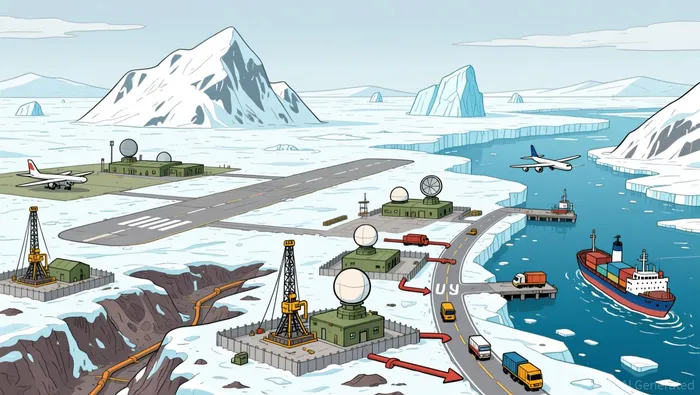
The Tanbreez project, operated by Critical MetalsCRML--, is a linchpin in this race. With a 10-year contract to supply HREEs to a U.S. government-funded Louisiana processing facility, the project has secured a $120 million loan from the U.S. Export-Import Bank and attracted Trump's direct interest in equity stakes. This underscores the federal government's commitment to reducing reliance on China, which dominates 85% of global rare earth processing. For investors, Greenland's geopolitical tensions and resource wealth signal a high-conviction opportunity in companies like Critical Metals and USA Rare EarthUSAR--, which are building domestic supply chains.
Venezuela: A Resource Powerhouse in Turmoil
Venezuela's Orinoco Mining Arc, estimated to hold 300,000 metric tons of rare earth elements valued at over $200 billion, represents a tantalizing but politically fraught opportunity. The U.S. military's January 2026 operation to capture President Nicolás Maduro- framed as a counter-narcoterrorism effort-has shifted the balance of power, with American energy and defense firms now positioned to rebuild Venezuela's oil and infrastructure sectors.
Defense contractors with logistics and security expertise are likely to dominate this reconstruction. Companies like General DynamicsGD-- and Huntington Ingalls IndustriesHII--, which have prior experience in Latin America, are well-placed to secure contracts for fuel management, transportation, and base operations. Meanwhile, Chevron's existing joint ventures with PDVSA provide a foothold for expanded U.S. energy influence. The scale of Venezuela's infrastructure needs- estimated at $58–78 billion-parallels the Iraq reconstruction, where firms like KBR secured $39.5 billion in contracts.
Defense Sector Response: Infrastructure and Supply Chain Resilience
The U.S. National Defense Authorization Act for 2026 includes a non-public line item for "Hardened Arctic C2 Infrastructure" at Pituffik, signaling a long-term commitment to Arctic security. Canada's C$1 billion Arctic Infrastructure Fund further underscores the region's strategic importance, with projects like icebreaker construction under the Icebreaker Collaboration Effort (ICE) accelerating U.S.-Canadian-Finnish cooperation.
In the rare earth sector, MP Materials (MP) and American Resources Corporation (AREC) are scaling production with federal support. MP's $400 million Department of Defense equity investment and $500 million offtake agreement with Apple highlight its role in building a vertically integrated supply chain. Similarly, USA Rare Earth's $35.6 million DOW-funded separation facility in Louisiana is critical for securing heavy rare earths. These developments align with the Inflation Reduction Act's tax incentives for domestic production, creating a tailwind for rare earth equities.
Investment Implications: Equities to Watch
- Critical Metals (CRML): The Tanbreez project's $120 million EXIM Bank loan and Trump's interest in equity stakes position it as a high-growth play in Arctic rare earths.
- MP Materials (MP): With federal backing and Apple's offtake agreement, MP is a cornerstone of U.S. rare earth independence.
- General Dynamics (GD) and Huntington Ingalls Industries (HII): These defense contractors are well-positioned to capitalize on Venezuela's infrastructure rebuild and Arctic icebreaker programs.
- USA Rare Earth (USRR): Its vertically integrated mine-to-magnet strategy, supported by DOW funding, offers exposure to both HREEs and defense applications.
Conclusion: A Fractured Order, A Resilient Sector
The U.S. military's posturing in Greenland and Venezuela reflects a broader strategy to secure critical resources and infrastructure amid a fractured global order. For investors, the convergence of geopolitical tensions, federal policy, and supply chain vulnerabilities creates a compelling case for defense and rare earth equities. As the Arctic becomes a new frontier and Venezuela's resources reemerge, companies with exposure to these regions-and the federal programs backing them-are poised to deliver outsized returns. The time to act is now, before the next phase of this strategic competition unfolds.





Comentarios
Aún no hay comentarios