
Geopolitical Tensions and Market Volatility: Navigating the Trump-China Trade Dynamics in 2025
The U.S.-China trade relationship in 2025 has become a defining axis of global economic uncertainty, with the Trump administration's aggressive tariff policies and China's retaliatory measures creating a volatile landscape for investors. As tensions escalate, strategic portfolio positioning requires a nuanced understanding of sector rotations, regional diversification, and hedging mechanisms to mitigate risks while capitalizing on emerging opportunities.
The Escalation of Tariff Warfare and Diplomatic Truces
Under the Trump administration, U.S.-China trade tensions reached a boiling point in 2025. Following the reimposition of a 10% tariff on Chinese imports in April 2025-framed as a response to fentanyl precursor smuggling-Beijing retaliated with tariffs on U.S. coal, natural gas, and agricultural products, according to a UTSynergy report. By October 2025, the situation had intensified further, with President Trump announcing an additional 100% tariff on all Chinese imports, effective November 1, 2025, according to an EIU analysis. This layered on top of existing tariffs, including the 30% Section 301 duties, pushing the effective rate to 130% in some cases, according to a YCharts analysis.
Diplomatic efforts have provided temporary reprieves. A May 2025 agreement reduced U.S. tariffs to 30% and Chinese retaliatory tariffs to 10%, while an August extension pushed the expiration of higher tariffs to November 10, 2025, according to a China Briefing update. However, these truces have been tactical pauses rather than long-term solutions, with both sides using negotiations to buy time for deeper structural adjustments.
Strategic Sector Rotations: Resilience Over Exposure
Investors are increasingly reallocating capital to sectors less vulnerable to trade disruptions. The healthcare sector, for instance, has emerged as a haven due to its resilience against geopolitical shocks. Global healthcare spending is projected to grow by 1.9% in real terms in 2025, driven by domestic innovation and reduced reliance on globalized supply chains, according to the YCharts analysis. Similarly, the technology sector remains a double-edged sword: while AI and semiconductor investments are robust, regulatory pressures and export controls-such as U.S. restrictions on advanced chip sales to China-introduce volatility, as noted by China Briefing.
Emerging markets are also reshaping portfolio strategies. Countries like Vietnam, India, and Mexico have become critical alternatives to China for manufacturing, with global trade outside the U.S.-China corridor rising by 3% in 2025, according to a BlackRock report. This shift has been accelerated by nearshoring trends, as companies seek to diversify supply chains and avoid tariff-driven cost spikes. For example, U.S. firms are increasingly sourcing components from Mexico to circumvent direct tariffs, leveraging the North American supply chain, as reported by UTSynergy.
Regional Diversification and Hedging Against Currency Volatility
Currency fluctuations have intensified as trade tensions disrupt traditional economic linkages. A strengthening U.S. dollar has amplified risks for non-dollar assets, prompting investors to adopt currency-hedging strategies. Businesses are rethinking exposure to Chinese yuan and euro-denominated assets, favoring hedging tools like forward contracts and options to stabilize returns, according to the EIU analysis.
Regional diversification has also gained traction. The Indo-Pacific Economic Framework and ASEAN partnerships are offering lower-tariff corridors for trade, reducing dependency on the U.S.-China axis, a trend highlighted by BlackRock. For instance, India's manufacturing sector has attracted significant foreign direct investment, with its "Make in India" initiative positioning it as a key hub for electronics and textiles, as observed in the YCharts analysis. Investors are advised to overweight equities in regions with geopolitical stability and growth potential, such as Japan and Southeast Asia, while underweighting European and Chinese markets exposed to tariff risks, a recommendation echoed in BlackRock's outlook.
Hedging Mechanisms and Alternative Assets
As traditional diversification tools-such as the stock-bond correlation-lose effectiveness, alternative assets are gaining prominence. BlackRock's Fall 2025 guidance highlights the role of commodities, real estate, and digital assets in enhancing risk-adjusted returns. Gold, for example, has seen renewed demand as a safe-haven asset amid trade-driven uncertainty, while Bitcoin's inverse correlation with U.S. equities offers a novel hedging mechanism, themes discussed in the BlackRock report.
Derivatives and leveraged loans are also being deployed to manage volatility. Some large institutions recommend increasing exposure to corporate credit, particularly leveraged loans, which offer higher yields in a low-growth environment, a view summarized in BlackRock's commentary. Additionally, investors are using futures contracts to hedge against sector-specific downturns, such as the automotive industry's exposure to electric vehicle supply chain bottlenecks, as outlined by China Briefing.
Conclusion: Balancing Risk and Opportunity
The Trump-China trade dynamics of 2025 present a complex interplay of risks and opportunities. While tariffs and retaliatory measures threaten to disrupt global supply chains and inflationary pressures, they also create openings for agile investors to capitalize on sector rotations, regional realignments, and innovative hedging tools. A disciplined approach-prioritizing diversification, nearshoring, and alternative assets-will be critical for navigating this turbulent landscape. As negotiations continue, the ability to adapt to shifting geopolitical winds will define long-term portfolio success.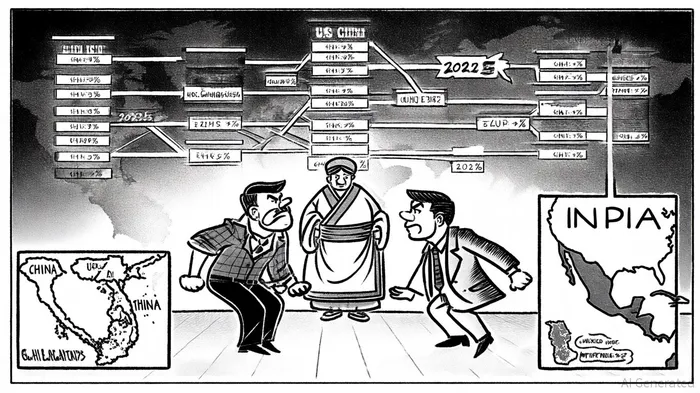






Comentarios
Aún no hay comentarios