
Geopolitical Tensions and Market Volatility: Assessing Risk Premiums and Safe-Haven Demand in 2025
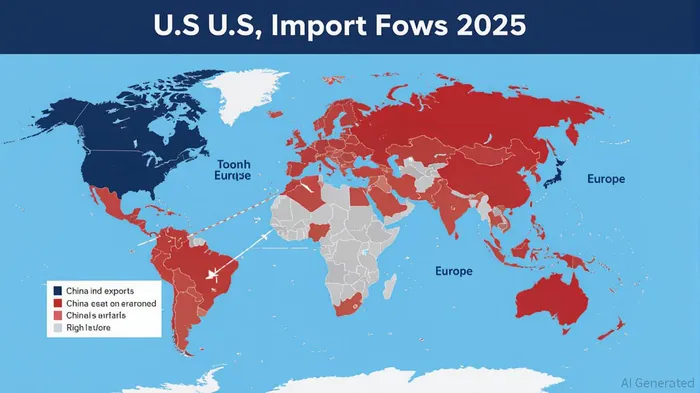
The return of Donald Trump to the U.S. presidency in 2025 has reignited global economic tensions, with sweeping tariff policies reshaping trade dynamics and amplifying uncertainty. By July 2025, the average effective U.S. tariff rate had surged to 18.2%, the highest since 1934, marking a dramatic escalation in the U.S.-China trade war and prompting nations to diversify trade networks [2]. These developments have sent shockwaves through financial markets, driving up international equity risk premiums while fueling demand for safe-haven assets like gold and government bonds.
Equity Risk Premiums: A New Era of Volatility
The imposition of tariffs has introduced unprecedented policy uncertainty, a key driver of equity risk premiums. According to a report by the World Economic Forum, trade policy uncertainty is now the top global concern for chief economists, with 97% citing it as a critical risk in May 2025 [2]. This uncertainty has led to a reevaluation of risk across asset classes. For instance, multinational corporations exposed to U.S. trade policies now face higher costs and supply chain disruptions, prompting investors to demand higher returns for holding equities in these sectors.
The ripple effects are evident in equity markets. As countries like China redirect exports to Europe and North America to circumvent U.S. tariffs, regional markets have experienced uneven growth trajectories. This fragmentation has increased the dispersion of returns, further widening risk premiums. Data from the WEF indicates that 34% of surveyed organizations plan to fundamentally adapt their business models to navigate these shifts [1].
Safe-Haven Assets: Gold and Government Bonds in the Spotlight
Amid the turmoil, gold has emerged as a critical hedge against geopolitical instability. The WEF notes that gold prices have risen in response to heightened economic nationalism and trade tensions, reflecting its role as a traditional safe-haven asset [2]. While specific price metrics remain unquantified in available sources, historical patterns suggest that gold's appeal intensifies during periods of policy-driven uncertainty.
Government bonds, meanwhile, have seen mixed signals. On one hand, investor flight to safety has driven demand for U.S. Treasuries and German Bunds, pushing yields lower. On the other, inflationary pressures from disrupted supply chains and protectionist policies could force central banks to tighten monetary policy, potentially lifting yields. This duality underscores the complex interplay between risk aversion and inflation expectations in shaping bond markets [2].
Strategic Implications for Investors
The 2025 geopolitical landscape demands a recalibration of portfolio strategies. For equities, sectoral diversification—particularly away from industries heavily exposed to U.S. tariffs—has become essential. Technology and manufacturing firms, for example, face elevated risks due to supply chain realignments. Conversely, sectors like energy and agriculture, which benefit from protectionist policies, may see relative resilience.
Safe-haven allocations should prioritize liquidity and diversification. Gold, long-term government bonds, and currencies of stable economies (e.g., the Swiss franc) remain key components. However, investors must also monitor inflation-linked bonds and regional safe-haven assets, as trade fragmentation could create divergent risk profiles across markets.
Conclusion
The 2025 U.S. geopolitical shifts, epitomized by Trump's tariff regime, have redefined global market dynamics. As trade policy uncertainty dominates investor sentiment, equity risk premiums are likely to remain elevated, while safe-haven assets will continue to attract capital. The challenge for investors lies in balancing the need for risk mitigation with the potential for inflation-driven volatility. In this environment, agility and a nuanced understanding of geopolitical currents will be paramount.







Comentarios
Aún no hay comentarios