
Geopolitical Tensions in Latin America and the EU's Strategic Dilemma: Implications for Investors
The EU's Strategic Gambit: Trade Agreements and Green Transition
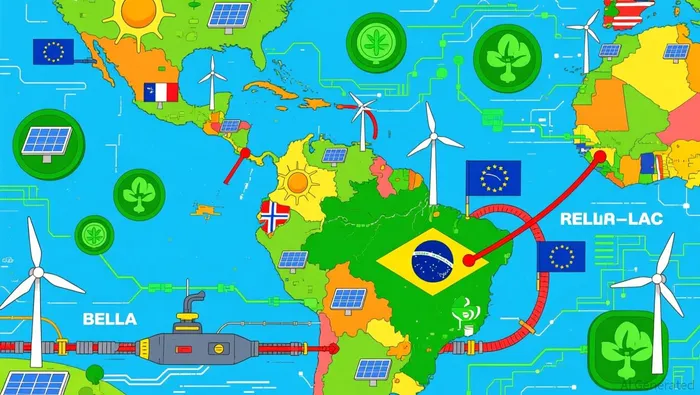
The EU has accelerated its economic integration with Latin America through landmark agreements such as the EU-Mercosur Partnership Agreement (finalized in December 2024) and the EU-Mexico Modernized Global Agreement (September 2025). These deals aim to create a free trade zone spanning 800 million people, with a €1.8 billion EU investment to support sustainable development and green transitions, according to the EU and Latin America and the Caribbean: partners of choice in a changing world (EEAS). Complementing these are initiatives like the EU-LAC Global Gateway Investment Agenda, which mobilizes €45 billion for projects in green energy, digital innovation, and healthcare resilience, as noted in the EEAS report.
However, the EU's ambitions extend beyond economics. By securing access to critical minerals like lithium and rare earth elements-essential for its energy transition-the EU seeks to reduce dependency on China and the U.S. This strategy aligns with Latin America's own goals of advancing green industrialization while avoiding "technological dependence," as the EU and Latin America and the Caribbean: partners of choice in a changing world report notes.
U.S. Pressure: Tariffs, Military Actions, and Diplomatic Fractures
The U.S. has emerged as a wildcard in this equation. Under the Trump administration, policies such as punitive tariffs on renewable energy components and unilateral military operations in the Caribbean have disrupted supply chains and strained regional stability. For instance, U.S. tariffs on solar modules and wind turbines have inflated costs for Latin American clean energy projects, delaying grid modernization efforts, according to a GlobalData report. Meanwhile, military strikes on alleged drug-carrying vessels in the Caribbean-condemned by Colombian President Gustavo Petro as "extrajudicial executions"-have heightened diplomatic tensions, as the NewsMax article reported.
These actions have forced Latin American nations to recalibrate their strategies. Brazil, for example, has cautiously engaged with China's Belt and Road Initiative (BRI) while avoiding full alignment, seeking to balance economic gains with strategic autonomy, as noted in the The Diplomat article. For the EU, this fragmentation complicates efforts to present a unified front, as regional leaders prioritize short-term security concerns over long-term trade integration, according to a GIGA report.
Investor Opportunities: Green Energy and Digital Infrastructure
Despite these challenges, the EU-CELAC partnership offers compelling opportunities. The Global Gateway initiative, according to the EEAS report, is already funding transformative projects, such as the BELLA submarine cable, which enhances digital connectivity across the Caribbean. In green energy, the EU's focus on lithium extraction in Chile and Argentina positions Latin America as a key supplier for Europe's battery and EV industries, as noted in the ECIPE memo.
For investors, the EU's emphasis on "strategic autonomy" could unlock new markets in renewable energy and advanced manufacturing. European firms with expertise in grid modernization or AI-driven climate resilience tools are well-positioned to capitalize on partnerships with Latin American governments, as the ECIPE memo suggests.
Risks: Political Instability and U.S. Geopolitical Leverage
Yet, risks loom large. Political instability in Latin America-exacerbated by U.S. pressure-threatens to derail progress. The absence of key leaders at the IV EU-CELAC Summit in Santa Marta (e.g., Mexico's Claudia Sheinbaum and Chile's Gabriel Boric) underscores the fragility of consensus, as the ECIPE memo notes. Additionally, U.S. tariffs on energy imports and threats to retake the Panama Canal have created an environment of uncertainty, deterring long-term investment, as the El País article reports.
For the EU, the challenge lies in balancing its strategic goals with the realities of regional fragmentation. As one analyst notes, "The success of the EU-CELAC partnership will depend on its ability to transcend political cycles and deliver tangible benefits beyond diplomatic rhetoric," according to the ECIPE memo.
Conclusion: Navigating a Shifting Geopolitical Chessboard
The EU's engagement with Latin America represents a bold attempt to reshape global trade and energy dynamics. However, the interplay of U.S. pressure, regional instability, and divergent priorities creates a volatile environment for investors. While green energy and digital infrastructure present significant opportunities, the risks of geopolitical miscalculation and supply chain disruptions cannot be ignored.
For investors, the key lies in hedging against uncertainty by prioritizing projects with strong EU-LAC alignment and diversifying exposure across sectors. As the IV EU-CELAC Summit unfolds, the coming months will test whether this partnership can evolve from a strategic vision into a resilient economic reality.







Comentarios
Aún no hay comentarios