
Geopolitical Tensions and the Defense Sector: Opportunities Amidst U.S.-Russia Rivalry
The world is no stranger to the cyclical nature of conflict, but the current era of heightened U.S.-Russia tensions is creating a unique inflection point for the defense sector. As global military spending hits post-Cold War highs and NATO allies scramble to modernize their arsenals, investors are increasingly turning their attention to aerospace and naval defense contractors. The war in Ukraine, coupled with Russia's assertive posture in the Black Sea and Arctic, has not only intensified military competition but also accelerated technological innovation in areas like hypersonic weapons, AI-driven logistics, and unmanned systems. For investors, this confluence of geopolitical risk and capital outlays presents both challenges and opportunities.
A New Cold War Budget Landscape
The U.S. defense budget for 2025, at $849.8 billion, reflects a 5.7% real-term increase from 2024. This surge is not an isolated phenomenon but part of a broader global trend: SIPRI data shows that global military spending reached $2.7 trillion in 2024, with the U.S. accounting for 37% of that total. Russia's 38% increase in defense spending to $149 billion in 2024, driven by its war in Ukraine, has further stoked the fires of competition. NATO's pledge to reach 5% GDP defense spending by 2035—up from the current average of 1.5%—has created a ripple effect, with European allies like Germany (up 28% to $88.5 billion) and Poland (up 12% to $22.4 billion) ramping up investments in fighter jets, tanks, and cyber capabilities.
Key Players in the Aerospace and Naval Arms Race
The defense sector's beneficiaries are clear. Lockheed Martin (LMT), the largest U.S. defense contractor, has seen its F-35 jet production surge to meet NATO demand, with Norway recently receiving its final two aircraft. The company's 50% exposure to the U.S. Department of Defense ensures a steady pipeline of work, particularly in hypersonic systems and satellite networks. Similarly, RTX (Raytheon) has secured $250 million in contracts for ESSM Block 2 missiles, showcasing its global reach and critical role in air and missile defense.
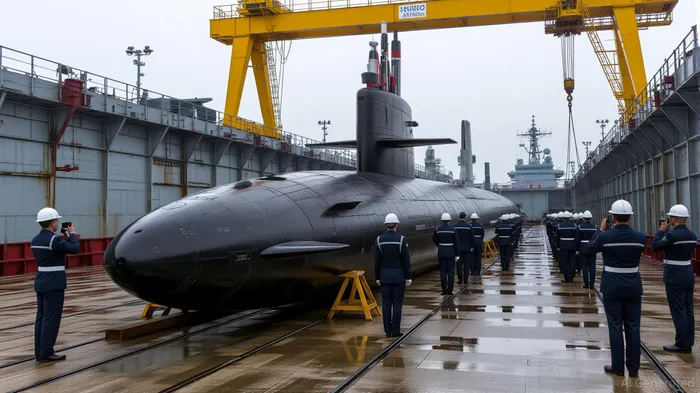
Naval defense is another battleground. General Dynamics (GD) was awarded a $12 billion contract modification to build Virginia-class submarines, a platform essential for countering Russian undersea dominance. The company's backlog has grown to $58 billion, reflecting the Navy's push to expand its fleet amid rising threats. Meanwhile, Boeing (BA) is leveraging its Patriot missile production capabilities, with demand surging as Ukraine and European allies seek to bolster their air defenses.
Innovation as a Growth Catalyst
While traditional heavyweights dominate headlines, smaller, tech-focused firms are capturing investor attention. AeroVironment (AVAV), for instance, has become a key supplier of drones to Ukraine and its allies, with its recent acquisition of BlueHalo expanding its capabilities in autonomous systems. The company's stock has surged 45% year-to-date, driven by its role in modernizing battlefield tactics. Similarly, Leidos Holdings (LDOS) is capitalizing on the Pentagon's push for secure IT infrastructure, with its cybersecurity and intelligence services seeing a 20% revenue bump in 2025.
The sector's future lies in R&D. The DoD's 2025 budget allocates $163.4 million for hypersonic research and $30.6 billion for missile procurement—areas where Northrop Grumman (NOC) and L3Harris Technologies (LHX) are investing heavily. Analysts note that companies with strong AI and predictive maintenance capabilities, such as Honeywell (HON), could outperform peers as the military seeks to optimize asset utilization.
Investment Strategy: Balancing Stability and Innovation
For investors, the defense sector offers a mix of defensive income and growth potential. Large contractors like Lockheed MartinLMT-- and Raytheon provide stable cash flows and dividend yields (LMT yields 0.8%, RTX 0.6%), while smaller innovators like AeroVironmentAVAV-- and LeidosLDOS-- offer higher volatility and upside. A diversified portfolio—combining blue-chip exposure with bets on emerging technologies—could mitigate risk while capturing growth.
The Bottom Line
The U.S.-Russia rivalry is reshaping the defense landscape, with military spending and technological innovation acting as tailwinds for the sector. While geopolitical outcomes remain uncertain, the defense industry's ability to adapt to shifting demands—whether through hypersonic systems, cyber resilience, or drone warfare—ensures its relevance for years to come. For investors, the key is to align with companies positioned at the intersection of strategic necessity and technological leadership. As the world grapples with a new era of great-power competition, the defense sector stands as both a shield and a sword.





Comentarios
Aún no hay comentarios