
Geopolitical Strategy and Bitcoin as a Reserve Asset: The Institutional Gold Rush of 2025
Bitcoin's journey from a niche digital experiment to a geopolitical tool has accelerated dramatically in 2025. What began as a speculative asset is now being treated as a sovereign-grade reserve by governments and corporations alike. This shift is not just a financial phenomenon-it's a strategic reordering of global economic power.
The Institutional Gold Rush: From Treasuries to Treasuries
Institutional adoption of BitcoinBTC-- has reached a fever pitch. As of October 2025, global Bitcoin exchange-traded products (ETPs) and publicly traded companies have collectively acquired 944,330 BTC, surpassing the total purchases of 2024 by a wide margin, according to Forbes. This demand has outpaced Bitcoin's mined supply by 7.4 times, creating a scarcity-driven tailwind for the asset.
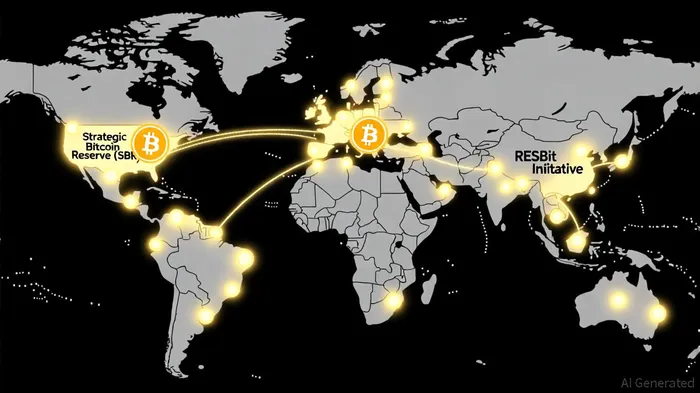
The U.S. government, under the Trump administration, has taken a leading role in this trend. The proposed U.S. Strategic Bitcoin Reserve (SBR) aims to purchase 1 million BTC over five years, with a 20-year holding period to hedge against inflation and dollar depreciation. This initiative, codified in the BITCOIN Act of 2025, signals a deliberate move to diversify national reserves beyond gold and fiat.
Meanwhile, Switzerland is considering a constitutional amendment to allow the Swiss National Bank to hold Bitcoin alongside gold, Forbes reports. Brazil's RESBit initiative seeks to allocate a portion of its international reserves to Bitcoin, while Russia has integrated the asset into its financial strategy to circumvent Western sanctions, according to a Markets article. These moves reflect a broader trend: nations are treating Bitcoin as a tool for economic sovereignty in an era of geopolitical uncertainty.
Corporate Adoption: A New Era of Treasury Management
The corporate sector has mirrored this institutional enthusiasm. According to the River Business Report 2025, businesses now hold 6.2% of the total Bitcoin supply (1.30 million BTC), a 21x increase since 2020. Small businesses, in particular, are driving this trend, with 75% of corporate Bitcoin buyers having fewer than 50 employees. These companies are allocating a median of 10% of their net income to Bitcoin, often through hybrid custody models that balance security and flexibility.
The surge in corporate adoption is closely tied to the success of U.S. spot Bitcoin ETFs. In October 2025 alone, BlackRock's iShares Bitcoin Trust attracted nearly $1 billion in fresh capital, propelling Bitcoin to record highs above $126,000. These ETFs have become a dominant force, with $5.3 billion added to public and private treasuries in September 2025. The result? A tightening of liquidity, as on-chain data shows Bitcoin supply on centralized exchanges is at a six-year low.
Geopolitical Implications: A Multipolar Financial System
The geopolitical ramifications of Bitcoin's rise are profound. A U.S. Bitcoin reserve could challenge the dollar's dominance, potentially triggering a multipolar financial system where power is distributed among digital and fiat assets. Countries like China and the European Union may respond by accelerating their own digital currency initiatives, leading to a new era of global financial competition.
Smaller economies are also leveraging Bitcoin for resilience. El Salvador and Bhutan, for example, have adopted the asset to insulate themselves from external economic shocks. This trend underscores Bitcoin's role as a decentralized alternative to traditional reserve systems, particularly in regions with unstable currencies or political tensions.
Strategic Investment Implications
For investors, the institutionalization of Bitcoin signals a paradigm shift. The asset is no longer a speculative bet but a core component of modern portfolios. As governments and corporations continue to allocate capital to Bitcoin, its price is increasingly driven by macroeconomic factors rather than retail sentiment.
However, risks remain. Bitcoin's volatility-though declining-still poses challenges for traditional investors. Additionally, the centralization of influence among institutional players and asset managers could undermine the asset's decentralized ethos.
Conclusion
Bitcoin's adoption as a reserve asset is reshaping global financial strategy. From the U.S. SBR to corporate treasuries and geopolitical maneuvering, the implications are far-reaching. For investors, the key takeaway is clear: Bitcoin is no longer a fringe asset. It is a strategic tool in the hands of nations and institutions, and its trajectory will define the next era of global finance.






Comentarios
Aún no hay comentarios