
Geopolitical Shifts and the Rise of Humanitarian Healthcare Innovation: A Lucrative Investment Frontier in Conflict Zones
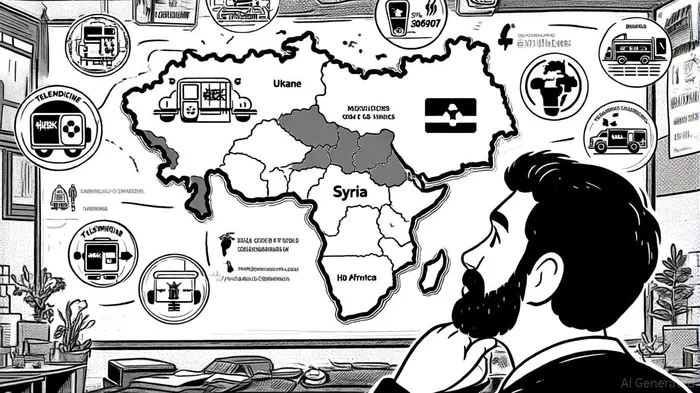
The world is witnessing a seismic shift in global geopolitics, and nowhere is this more evident than in the fragile healthcare infrastructure of conflict zones. As wars, displacement, and natural disasters strain already weak systems, a new investment opportunity is emerging: cross-border medical services and health-tech innovation. These sectors are not only addressing urgent humanitarian needs but also creating long-term value for investors who recognize the interplay between geopolitical instability and technological adaptation.
Geopolitical Shifts: Catalysts for Crisis and Opportunity
According to a report by the World Health Organization (WHO), nearly a quarter of the global population now lives in regions affected by conflict, displacement, or natural disasters, where healthcare systems are either nonfunctional or underfunded [1]. The WHO's 2025 Health Emergency Appeal—a $1.5 billion initiative—targets fragile states like Somalia, Yemen, and Syria, where basic services like maternal care and immunization have collapsed [1]. These crises are not isolated; they are amplified by cross-border health threats such as cholera and polio, which spread rapidly in areas with destroyed infrastructure.
Yet, these challenges are also fueling demand for innovative solutions. Public health diplomacy, once a niche concept, is now a critical strategy. Organizations like (MSF) and the Red Cross are securing temporary ceasefires for vaccination campaigns, while digital tools are enabling real-time disease surveillance across borders [3]. For investors, this represents a dual opportunity: funding technologies that save lives and capitalizing on the growing market for health-tech solutions in unstable regions.
Cross-Border Medical Services: Bridging Gaps in War Zones
The rise of cross-border medical services is perhaps the most tangible example of this trend. Startups like Health Tech Without Borders (HTWB) and Ashconn are leading the charge. In the Ukraine-Russia conflict, , . Similarly, Ashconn's secure telemedicine platform in the Middle East provides encrypted remote diagnostics and mental health support in conflict-affected areas like Syria and Gaza [5].
These initiatives are not just humanitarian—they're economically scalable. For instance, the International Rescue Committee's (IRC) REACH project in the Horn of Africa, supported by Gavi and ZIP, . Such partnerships demonstrate how cross-border collaborations can overcome logistical and political barriers, creating a blueprint for sustainable investment.
Health-Tech Innovation: AI and Telemedicine as Game Changers
Health-tech innovation is the backbone of this transformation. (AI) is revolutionizing diagnostics in conflict zones. For example, Zebra Medical Vision and Apollo Hospitals have developed AI-driven tools that improve diagnostic accuracy, even in areas with scarce medical expertise [1]. Meanwhile, AI's role in conflict prevention is gaining traction. At the 13th World Peace Forum in Beijing, experts emphasized how AI can map patterns of violence and predict conflicts, enabling early intervention [7].
Telemedicine, too, is proving indispensable. In Afghanistan and Iraq, and tele-mental health services are being deployed by humanitarian organizations to address shortages of specialists [2]. However, challenges persist: poor connectivity and limited digital literacy remain barriers, particularly for elderly populations [2]. Startups are responding with low-tech, user-friendly solutions, such as and solar-powered diagnostic kits.
Investment Trends: A Booming Market with Long-Term Potential
The financial landscape for health-tech in conflict zones is equally compelling. , driven by AI and telemedicine [8]. , . This growth is fueled by the increasing adoption of electronic health records (EHRs), AI diagnostics, and wearable technologies [9].
Investors are also eyeing cross-border medical tourism, . Countries like Thailand and India are becoming hubs for cost-effective, high-quality care, attracting patients from conflict zones and beyond. This trend underscores the potential for health-tech startups to integrate humanitarian aid with profitable business models.
Challenges and the Path Forward
Despite the promise, risks remain. Political instability, restricted humanitarian access, and funding gaps hinder long-term projects in places like Yemen and Syria [6]. Additionally, ethical concerns around AI—such as and surveillance—require careful navigation [7].
However, these challenges also highlight the need for innovative financing and public-private partnerships. The WHO's emphasis on decentralized, community-based health systems [2] and the EY 2025 Biotech Beyond Borders Report's focus on [11] point to strategies that can mitigate risks while scaling impact.
For investors, the message is clear: the intersection of geopolitics, health-tech, and cross-border collaboration is a fertile ground for long-term gains. By backing startups and initiatives that address both humanitarian and economic needs, investors can not only generate returns but also contribute to a more resilient global health infrastructure.







Comentarios
Aún no hay comentarios