
Geopolitical Shifts and the Reshaping of Global Financial Institutions: A New Era of Power Dynamics
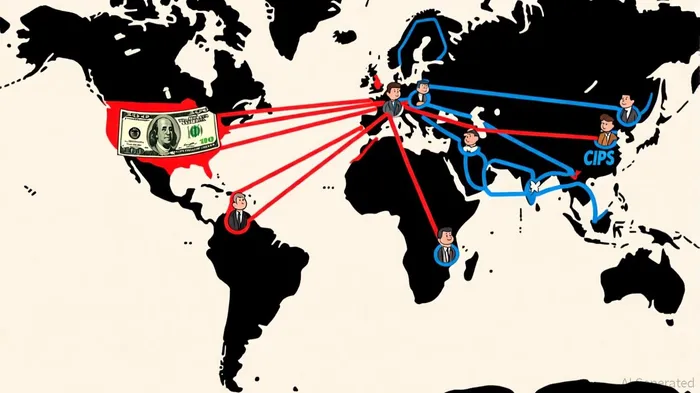
The global financial landscape is undergoing a profound transformation driven by geopolitical shifts that are redefining the influence and governance of multilateral institutions. As power dynamics evolve, investors must grapple with the implications of a fragmented financial order, where traditional U.S.-led systems face challenges from emerging alternatives. This analysis examines how China's strategic expansion, U.S. policy recalibrations, and the rise of alternative financial networks are reshaping the architecture of global finance—and what this means for markets and multilateralism.
China's Strategic Ascendancy in Multilateral Finance
China's growing influence in multilateral financial institutions is no longer a distant possibility but a present reality. By securing leadership roles in agencies such as the Food and Agriculture Organization (FAO), the International Civil Aviation Organization (ICAO), and the International Telecommunication Union (ITU), China has embedded its priorities into global policy frameworks [1]. This strategic placement aligns with its broader goal of promoting a development model that emphasizes state-led infrastructure and technology-driven growth, often diverging from Western liberal-market paradigms.
The Asian Infrastructure Investment Bank (AIIB), with its 26.6% voting share and Chinese leadership under Jin Liqun, exemplifies this trend. While the AIIB has adopted international environmental and social standards, its alignment with China's Belt and Road Initiative (BRI) raises concerns about its role as a geopolitical tool [2]. Critics argue that the AIIB's Beijing-based governance and perceived CCP dominance undermine its multilateral credibility, even as it co-funds projects with institutions like the World Bank [2].
U.S. Retreat and the Fracturing of Financial Systems
The U.S. response to these shifts has been marked by ambivalence. At the 2025 IMF Spring Meetings, Treasury Secretary Scott Bessent called for the IMF to refocus on its original mandate, criticizing its expansion into climate and inequality [3]. This reflects a broader skepticism toward multilateralism under the Trump administration, which has left a vacuum in global governance. Meanwhile, the weaponization of financial systems—such as the SWIFT sanctions against Russia—has accelerated the search for alternatives.
Countries like Russia, Saudi Arabia, and Argentina have increasingly invoiced trade in local or non-dollar currencies, while China's Cross-Border Interbank Payment System (CIPS) and cross-border central bank digital currencies (CBDCs) offer viable substitutes for dollar-centric networks [3]. These developments signal a shift toward financial fragmentation, where regional blocs and alternative systems coexist with traditional institutions.
Implications for Investors and Global Stability
For investors, the fragmentation of financial systems introduces both risks and opportunities. On one hand, the erosion of a unified global financial architecture could exacerbate volatility, as seen in the 2025 IMF Spring Meetings, where Kristalina Georgieva emphasized the need to resolve trade tensions and restore confidence [3]. On the other, alternative systems like CIPS and BRI-linked projects may unlock new markets in Asia and Africa, albeit with higher geopolitical and regulatory uncertainties.
The AIIB's potential to fill a void left by a U.S. retreat from institutions like the World Bank further complicates the landscape [4]. While the AIIB's adherence to international norms is commendable, its alignment with China's strategic interests could lead to a bifurcated global financial order, where institutions are categorized by ideological blocs rather than shared principles.
Conclusion: Navigating a Multipolar Financial Future
The interplay of geopolitical competition and financial innovation is redefining the role of multilateral institutions. While the IMF and World Bank remain critical for crisis management, their authority is increasingly contested by alternative systems that reflect divergent economic philosophies. Investors must adopt a nuanced approach, balancing exposure to traditional markets with hedging against fragmentation risks.
As the world moves toward a multipolar financial order, the ability to navigate competing systems will determine long-term success. The challenge lies not in resisting these shifts but in understanding their implications—and preparing for a future where global finance is no longer a monolith but a mosaic of interdependent yet competing networks.







Comentarios
Aún no hay comentarios