
Geopolitical Risks and the Turkish Stock Market: Navigating Volatility for Long-Term Gains
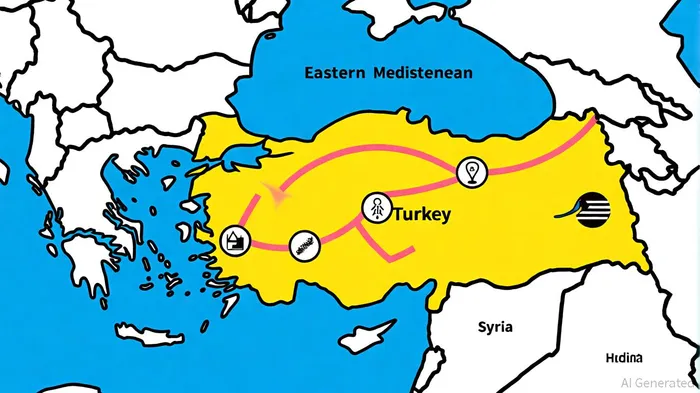
The Turkish stock market, like many emerging markets, is a double-edged sword for investors. In 2025, it faces a perfect storm of geopolitical risks, yet its long-term fundamentals suggest resilience and potential rewards for those willing to navigate the turbulence. The BIST 100 index, currently trading at 10,829 points, has shown a 0.85% gain in its latest session but remains 0.23% lower over the past month[1]. This volatility reflects the interplay of global conflicts, domestic political instability, and economic uncertainty, all of which demand careful scrutiny.
Short-Term Volatility: A Geopolitical Minefield
Turkey's strategic location as a bridge between Europe and Asia makes it both a linchpin and a lightning rod for geopolitical tensions. The Türkiye Risk Report 2025 underscores that 92% of experts rate geopolitical instability as a high or very high risk[2]. Regional flashpoints—the war in Ukraine, the Israel-Palestine crisis, and Syria's ongoing instability—have disrupted energy and trade routes, compounding Turkey's exposure. Internally, the arrest of Istanbul Mayor Ekrem Imamoglu in early September 2025 triggered a selloff, with the lira depreciating over 9% against the dollar[2]. Such events highlight the fragility of investor confidence in a market where political and economic risks are deeply intertwined.
Global volatility spillovers further exacerbate the situation. A study of Turkey's financial assets reveals that 40.37% of investment return variance stems from interconnectedness with global markets[3]. The U.S. dollar and euro are consistent sources of volatility, while gold and real estate have historically served as safe havens during high-risk periods[3]. For instance, the housing market has demonstrated an ability to anticipate geopolitical risk fluctuations, with investors shifting to real estate as a hedge[1].
Long-Term Opportunities: Resilience in the Face of Adversity
Despite the near-term turbulence, Turkey's stock market remains undervalued relative to its long-term potential. The BIST 100's price-to-earnings (PE) ratio of 21.8x as of September 19, 2025, is nearly double its three-year average of 10.5x[2]. This suggests that investors are betting on future growth, even as they grapple with current uncertainties. Analysts project the index to reach 10,290.10 points by the end of the quarter[1], a modest decline that could present buying opportunities for patient investors.
Turkey's role as a transit hub for energy and trade also offers long-term upside. While short-term disruptions are inevitable, the country's strategic position could become a competitive advantage as global supply chains reconfigure post-Ukraine and post-pandemic[3]. Moreover, the central bank's use of foreign reserves to stabilize the lira indicates a commitment to maintaining macroeconomic stability, albeit with limited room for error[2].
A Balancing Act for Investors
For investors, the key lies in hedging against short-term risks while capitalizing on long-term opportunities. Diversification into assets like gold and real estate—both of which have shown safe-haven properties in Turkey—can mitigate exposure to equity volatility[3]. Additionally, sectoral bets on energy infrastructure and regional trade enablers may align with Turkey's geopolitical role.
Conclusion
Turkey's stock market is a microcosm of the broader challenges facing emerging markets in an era of geopolitical uncertainty. While short-term volatility is inevitable, the interplay of strategic assets, resilient fundamentals, and historical investor behavior suggests that long-term opportunities remain. As always, the path to profit lies in balancing caution with conviction—a lesson as old as investing itself.







Comentarios
Aún no hay comentarios