
The Geopolitical Risks of Transatlantic Tech Tensions and Their Impact on Global Tech Stocks
The transatlantic rift over digital regulation has escalated into a high-stakes geopolitical contest, with U.S. sanctions and retaliatory threats reshaping the risk landscape for global tech stocks. At the heart of this conflict lies a clash of regulatory philosophies: the European Union's push for tighter oversight of digital markets through measures like the Digital Markets Act (DMA) and the U.S. response, which frames these rules as discriminatory barriers to American tech dominance. This tension is not merely ideological-it is increasingly financial, with tangible consequences for companies like SAPSAP--, Siemens, and AccentureACN--, whose stock valuations and compliance costs now hinge on the trajectory of U.S.-EU negotiations.
The U.S. Strategy: Retaliation as a Tool of Influence
The U.S. Trade Representative (USTR) has explicitly threatened to impose fees and restrictions on European tech firms if the EU continues its regulatory campaign against American companies. These measures, framed as countermeasures to "non-tariff attacks" such as digital services taxes and forced data localization, target firms like SAP and Siemens, which operate with fewer restrictions in the U.S. market. The Trump 2.0 administration has amplified these threats, leveraging Section 301 of the Trade Act of 1974 to justify tariffs or service restrictions. For instance, SAP, a key player in enterprise software, faces potential retaliation due to its perceived alignment with EU digital regulations, which the U.S. argues disadvantage American firms like Google and Meta.
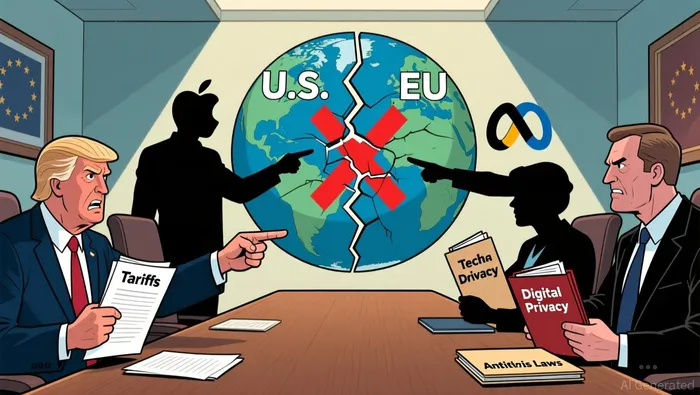 This strategy reflects a broader U.S. effort to defend its tech leadership by countering policies that divert capital from R&D into compliance and localization efforts. However, the asymmetry of these measures-where U.S. firms face EU fines but European companies escape similar U.S. penalties-has created a regulatory arbitrage that risks destabilizing investor confidence.
Financial Impacts: Compliance Costs and Stock Volatility
The financial toll of these tensions is evident in the quarterly reports of affected firms. Siemens, for example, reported a 13% decline in net income for Q4 2025, partly attributed to regulatory uncertainties and trade-related costs. While its Industrial Business saw a 15.3% profit margin, the company excluded legal and regulatory burdens from its fiscal 2025 outlook, signaling potential future headwinds. Similarly, SAP's Q4 2025 results highlighted robust cloud revenue growth (up 27% year-over-year) but also underscored CEO Christian Klein's concerns about trade disputes dampening customer investment decisions.
Regulatory compliance costs are another critical factor. A 2025 study estimated that EU digital regulations cost U.S. tech firms up to $97.6 billion annually, with European companies like SAP and Siemens indirectly bearing the brunt of retaliatory measures. For SAP, compliance with the DMA and AI Act is expected to add operational complexity, even as its cloud business thrives. These pressures are not confined to direct costs; they also influence investor sentiment. European industrial stocks, including Siemens, have seen volatility as traders weigh the likelihood of a full-scale trade war.
Broader Implications for Global Tech Stocks
The U.S.-EU dispute is part of a larger pattern of geopolitical risk in tech, where regulatory fragmentation and retaliatory measures erode market predictability. For investors, this means heightened exposure to policy-driven valuation swings. Companies with significant cross-border operations-like SAP and Siemens-are particularly vulnerable, as their earnings depend on navigating divergent regulatory regimes.
Moreover, the U.S. and EU's recent trade agreement, aimed at reducing non-tariff barriers, has yet to deliver concrete results. This delay exacerbates uncertainty, with analysts projecting that U.S. tariffs could reduce the euro zone's GDP by 0.5–0.6 percentage points in 2026, compared to 0.03 percentage points in 2025. Such macroeconomic risks further complicate investment decisions, especially for firms like Siemens Healthineers, which anticipates tariff-related costs of €400 million in 2026.
Conclusion: Navigating a Fractured Landscape
For investors, the transatlantic tech dispute underscores the need to factor geopolitical risks into portfolio strategies. While companies like SAP and Siemens demonstrate resilience through innovation and market diversification, their long-term valuations remain contingent on the resolution of U.S.-EU tensions. The key question is whether both sides can reconcile their regulatory priorities without triggering a trade war that stifles global tech growth. Until then, compliance costs, stock volatility, and policy uncertainty will remain defining features of this sector.





Comentarios
Aún no hay comentarios