
U.S. Geopolitical Risks and Tech Stock Valuations: TikTok's Regulatory Scrutiny as a Harbinger of Broader Capital Risks in China-Linked Investments
The U.S. Supreme Court's January 2025 decision to uphold the Protecting Americans from Foreign Adversary Controlled Applications Act—forcing ByteDance to divest TikTok or face a U.S. ban—has crystallized a broader narrative of geopolitical risk shaping global technology markets. While the Trump administration's recent extension of the enforcement deadline until December 2025 and a tentative U.S.-China framework deal have temporarily stabilized TikTok's future, the episode underscores how regulatory scrutiny of Chinese tech firms is no longer confined to isolated cases. Instead, it reflects a systemic recalibration of capital flows and investor sentiment toward China-linked assets, with implications for the entire sector.
TikTok as a Canary in the Coal Mine
The TikTok saga has become a litmus test for how U.S. regulators balance national security concerns with economic pragmatism. According to a report by Bloomberg Law, the Supreme Court's affirmation of the divestiture law—rejecting TikTok's First Amendment challenge—signals a hardening stance against foreign-controlled platforms perceived as threats to data privacy and democratic discourse [1]. The subsequent framework deal, which allows U.S. firms like OracleORCL-- and Silver Lake to take an 80% stake in TikTok's U.S. operations, has been hailed as a compromise. Yet, as stated by Reuters, unresolved questions about the algorithm's control and potential Chinese influence linger, casting a shadow over the deal's long-term efficacy [2].
This regulatory tug-of-war has already influenced investor behavior. Oracle's stock surged following its role in managing TikTok's U.S. data, illustrating how geopolitical outcomes can directly impact valuations [3]. However, the broader market's reaction has been mixed. While the deal averts an immediate ban, it also highlights the fragility of cross-border tech partnerships in an era of escalating U.S.-China tensions.
Broader Capital Risks in Chinese Tech Stocks
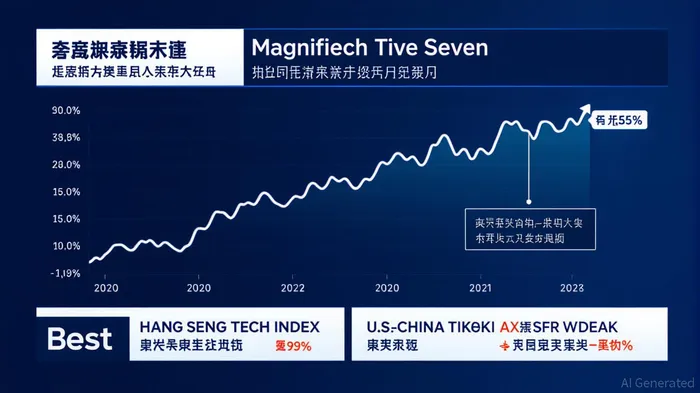
The TikTok case is emblematic of a larger trend: U.S. export controls, forced delistings, and tariff escalations are reshaping the risk profile of China-linked tech investments. The Hang Seng Tech Index, which includes giants like AlibabaBABA-- and Tencent, has surged 31% year-to-date in 2025, driven by AI breakthroughs such as DeepSeek's R1 model [4]. Yet, this optimism is tempered by persistent geopolitical headwinds.
For instance, U.S. export restrictions on advanced semiconductors and the recent blacklisting of Tencent have created volatility. As noted by MorningstarMORN--, Chinese tech stocks trade at a 65% discount to their U.S. counterparts, reflecting both undervaluation and lingering risks [5]. Alibaba's integration of DeepSeek into its cloud services has boosted its stock, but the company's reliance on domestic supply chains—amid U.S. chip bans—raises questions about long-term scalability [6]. Similarly, Xiaomi's stock rally, fueled by its electric vehicle ambitions, has been met with skepticism over its diversified business model [7].
Geopolitical Risk and Capital Flow Dynamics
Geopolitical risks are not merely abstract concerns; they directly influence capital allocation patterns. A study by the Brookings Institution highlights that emerging markets, including China, exhibit heightened sensitivity to global geopolitical shocks, with capital flows shifting toward perceived safe havens [8]. In 2025, this has manifested in reduced foreign direct investment (FDI) into China's tech sector and increased portfolio outflows, particularly after the Russia-Ukraine conflict and Taiwan-related tensions [9].
The U.S. administration's 170% tariffs on Chinese imports under Section 301 have further exacerbated this trend. As J.P. Morgan analysts note, sectors like semiconductors and pharmaceuticals—critical to tech innovation—are particularly vulnerable, with global supply chains fracturing to mitigate exposure [10]. This fragmentation is evident in the strategic diversification of companies like Tencent, which is investing heavily in homegrown AI chips to circumvent U.S. restrictions [11].
The Path Forward: Opportunities and Risks
While the U.S.-China TikTok deal and AI-driven revaluation of Chinese tech stocks suggest cautious optimism, investors must remain vigilant. The DeepSeek breakthrough has narrowed the valuation gap between Chinese and U.S. tech firms, but this progress is contingent on geopolitical stability. As Goldman Sachs' recent analysis underscores, the re-rating of Chinese tech stocks hinges on the resolution of trade disputes and the easing of U.S. export controls [12].
Moreover, the TikTok framework deal itself is far from a panacea. Congressional scrutiny of the agreement and unresolved algorithmic control issues could reignite regulatory battles. For now, the Trump administration's delay of enforcement until December 2025 provides a temporary reprieve, but the underlying tensions remain.
Conclusion
The TikTok case is a microcosm of the broader geopolitical risks reshaping global technology markets. While regulatory clarity and AI innovation have spurred short-term gains for Chinese tech stocks, the long-term outlook remains clouded by U.S. export controls, tariff escalations, and the specter of forced decoupling. Investors must weigh these risks against the sector's potential, recognizing that the interplay of geopolitics and technology will continue to drive volatility. For now, the U.S.-China TikTok deal offers a glimpse of cooperation, but history suggests that such truces are often temporary in an increasingly polarized world.





Comentarios
Aún no hay comentarios