
Geopolitical Risks and Opportunities in U.S.-South Africa Relations Under Bozell's Ambassadorship
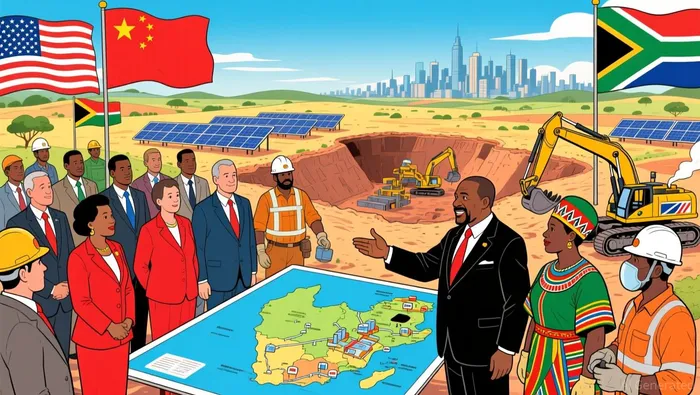
The U.S.-South Africa relationship has entered a period of recalibration under the Trump-era diplomatic tensions and the controversial appointment of Ambassador Brent Bozell III. Bozell, a conservative activist and founder of the Media Research Center, has positioned himself as a staunch advocate for U.S. economic and strategic interests in Africa, framing his mission as a bid to counter South Africa's "geostrategic drift" toward China, Russia, and Iran. This ideological clash, coupled with Trump's transactional Africa policy, has reshaped the landscape of U.S. engagement in the region, creating both risks and niche investment opportunities in energy, agriculture, and infrastructure.
Bozell's Ideological Stance and Diplomatic Tensions
Bozell's nomination as U.S. Ambassador to South Africa in 2025 sparked immediate controversy, with critics in Pretoria condemning it as a provocative move that undermined bilateral relations. His public criticism of South Africa's land reform policies and its legal case against Israel at the International Court of Justice (ICC) underscored a confrontational approach. According to a report, Bozell has prioritized reducing South Africa's economic ties with China, which became its largest trading partner in 2024. This stance aligns with the Trump administration's broader strategy to counter Chinese influence in Africa, particularly in infrastructure and critical mineral sectors. However, Bozell's emphasis on "fair trade practices" and property rights has also raised concerns about U.S. overreach in a country that views its foreign policy as rooted in nonalignment and Global South solidarity.
Trump's Africa Policy: Commerce Over Aid
The Trump administration's Africa policy, characterized by a shift from aid to investment, has had mixed implications for South Africa. While initiatives like the BUILD Act and the Development Finance Corporation (DFC) aimed to channel $60 billion into market-based projects, the administration's protectionist measures-such as the 2025 "Liberation Day" tariffs on African exports- created uncertainty. These tariffs, which included steep levies on goods from Lesotho and South Africa, threatened the African Growth and Opportunity Act, a cornerstone of U.S.-Africa trade. As noted by the Center for Strategic and International Studies, the administration's transactional approach risked alienating African partners who had long sought a partnership based on mutual economic benefit rather than dependency.
Yet, the U.S. has also leveraged Africa's natural resources to advance strategic goals. For instance, the DFC approved investments in 2025 to strengthen critical mineral supply chains, recognizing Africa's 30% share of global reserves in minerals like manganese and cobalt. This focus on critical minerals, essential for electric vehicles and renewable energy, reflects a broader effort to counter China's dominance in global supply chains.
South Africa's Strategic Realignments
South Africa's foreign policy under President Cyril Ramaphosa has increasingly aligned with the BRICS bloc, a move that has drawn U.S. ire. The Trump administration's 2025 executive order halting aid to South Africa and its exclusion from the G20 summit in Johannesburg were direct responses to Pretoria's support for the ICC case against Israel and its deepening ties with Russia. According to a report by FPRI, these tensions have forced South Africa to navigate a delicate balance between its Global South ambitions and its economic reliance on U.S. markets. The African Continental Free Trade Agreement (AfCFTA), which aims to create a $3 trillion market, has become a countermeasure to U.S. trade pressures, with South Africa positioning itself as a leader in regional integration.
Investment Opportunities in Energy, Agriculture, and Infrastructure
Despite the geopolitical friction, the U.S.-Africa energy and infrastructure sectors present compelling opportunities. The Wilson Center highlights that African nations, including South Africa, are at a critical juncture in energy development, with a growing emphasis on both fossil fuels and renewables. U.S. companies could capitalize on this transition by investing in solar and wind projects, particularly in regions with underdeveloped grids. Additionally, the U.S. Chamber of Commerce has emphasized partnerships in critical mineral extraction and processing, noting that local value addition and transparent governance are key to attracting investment.
In agriculture, the U.S. has shown interest in agribusiness collaborations to address food insecurity and enhance supply chain resilience. South Africa's advanced agricultural sector, combined with its role in regional trade, positions it as a strategic partner for American agribusiness firms. However, U.S. tariffs on South African exports-such as the 30% levy on steel and textiles- have complicated these efforts.
Infrastructure remains a high-potential sector, particularly in transportation and digital connectivity. The DFC's 2025 investments in Sub-Saharan Africa, which included projects in road networks and energy grids, demonstrate the U.S. commitment to infrastructure development as a tool for economic and geopolitical influence. Yet, the risk of Chinese competition looms large, with Beijing's Belt and Road Initiative (BRI) already financing major projects across the continent.
Risks and the Path Forward
The primary risks for investors stem from the volatility of U.S.-South Africa relations and the broader U.S.-Africa trade environment. The Trump administration's punitive measures, including the 2025 aid cut and tariffs, have created a climate of uncertainty, deterring some investors while incentivizing others to hedge against geopolitical shifts. Additionally, South Africa's alignment with BRICS and its legal challenges to U.S. allies (e.g., the ICC case against Israel) could lead to further retaliatory measures.
However, the U.S. has also signaled a long-term interest in Africa's economic potential. The U.S.-Africa Business Summit, launched in 2025, reflects a pivot toward trade-based partnerships, prioritizing commercial interests over traditional aid models. For investors, the key will be to navigate the dual pressures of geopolitical competition and market-driven opportunities.
Conclusion
The Trump-era recalibration of U.S.-South Africa relations, driven by Bozell's ideological agenda and the administration's transactional policies, has created a complex landscape for investors. While diplomatic tensions and trade uncertainties pose risks, the focus on critical minerals, renewable energy, and infrastructure offers significant opportunities. As South Africa continues to balance its Global South ambitions with its economic ties to the U.S., investors must remain agile, leveraging U.S. strategic priorities while mitigating the fallout from geopolitical rivalries.







Comentarios
Aún no hay comentarios