
The Geopolitical Risks and Opportunities in the Evolving Crypto Crime Ecosystem
The intersection of geopolitics and cryptocurrency has created a volatile landscape where state-sponsored actors exploit digital assets to evade sanctions, while illicit infrastructure evolves to facilitate large-scale financial crime. For investors, this dynamic ecosystem presents both risks and opportunities, particularly as regulatory frameworks and technological countermeasures race to keep pace with criminal innovation.
State-Sponsored Sanctions Evasion: A Case Study in North Korea
North Korea has emerged as the most sophisticated state-sponsored actor in crypto crime, leveraging decentralized and centralized infrastructure to bypass international sanctions. In 2025 alone, the Democratic People's Republic of Korea (DPRK) accounted for 69% of all funds stolen from crypto services, including the $1.5 billion hack of ByBit-the largest single crypto theft in history. This attack marked a strategic shift from targeting decentralized bridges to exploiting centralized exchanges and service providers through social engineering and human vulnerabilities.
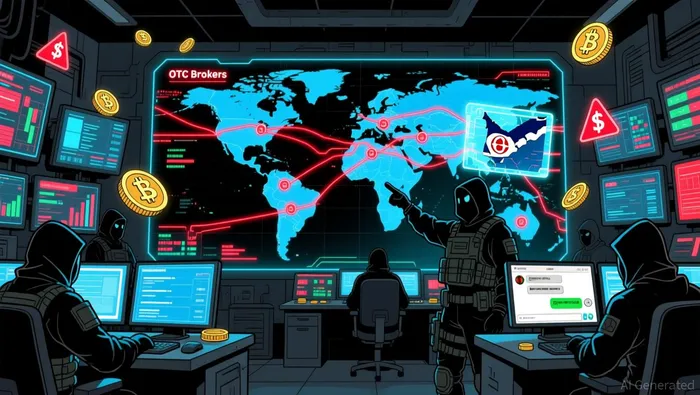
The stolen assets were then laundered via a complex network dubbed the "Chinese Laundromat," involving underground banks, over-the-counter (OTC) brokers, and trade-based laundering intermediaries. This industrialized laundering process, refined after Western sanctions against mixers like Tornado CashTORN--, has enabled North Korea to maintain financial autonomy and circumvent global restrictions. For investors, the DPRK's success underscores the risks of exposure to unregulated crypto infrastructure and the potential for state actors to weaponize digital assets for geopolitical gain.
The Rise of Illicit Full-Stack Infrastructure
The illicit crypto ecosystem has matured into a full-stack infrastructure, with large-scale on-chain services supporting diverse criminal activities. In 2024, stablecoins accounted for 63% of illicit transaction volume, surpassing Bitcoin's historical dominance. This shift reflects stablecoins' utility in cross-border payments and trade, despite their limitations-such as the ability of issuers like Tether to freeze funds.
The scale of illicit activity remains staggering: while 2024's initial estimate of $40.9 billion in value received by illicit addresses was conservative, experts project the figure could exceed $51 billion as more addresses are identified. This growth is driven by the professionalization of criminal networks, which now employ layered tactics to obscure fund flows. For instance, privacy coins, mixers, and tumblers complicate blockchain analytics, while "wrench attacks"-physical coercion of individuals-have become more prevalent.
Investment Opportunities in RegTech and Blockchain Analytics
The escalating threat of crypto crime has spurred demand for regulatory technology (RegTech) and blockchain analytics solutions. By 2025, over 90% of financial institutions had adopted AI-driven anti-money laundering (AML) systems, reducing false positives by 40% and improving detection accuracy. These tools are critical for monitoring cross-chain bridges, decentralized exchanges, and stablecoin flows, which remain vulnerable to exploitation.
Key investment opportunities lie in firms specializing in real-time sanctions screening, AI-powered transaction monitoring, and public-private partnerships. For example, the T3 Financial Crime Unit-a collaboration between TRONTRX--, TetherUSDT--, and TRM-has already frozen $130 million in illicit proceeds on the TRON blockchain. Similarly, platforms like Beacon Network, which facilitate information sharing between compliant virtual asset service providers (VASPs) and law enforcement, are gaining traction.
Regulatory advancements further bolster this sector. The EU's Markets in Crypto-Assets (MiCA) Regulation and the U.S. GENIUS Act have introduced clarity for stablecoin issuers, while the Basel Committee's revised prudential rules for crypto exposures are driving institutional adoption of compliance solutions. Investors should prioritize firms with expertise in tracing sanctioned jurisdictions, such as Iran and Russia, where 39% of illicit crypto transactions occurred in 2024.
Emerging Risks in Compliance Funding
Despite progress, challenges persist in funding compliance solutions. Address poisoning scams, where attackers exploit wallet auto-fill features to siphon funds, highlight the need for robust Know Your Transaction (KYT) systems. Additionally, cryptocurrency kiosks are increasingly used for fraud and money laundering, particularly targeting vulnerable populations.
Regulatory fragmentation also poses risks. While 70% of jurisdictions advanced stablecoin frameworks in 2025, inconsistencies in enforcement remain. The ByBit hack, for instance, exposed vulnerabilities in unregulated infrastructure, underscoring the need for cross-border collaboration. Investors must weigh these risks against the long-term potential of a tokenized financial system, where unified ledgers and central bank digital currencies (CBDCs) could enhance transparency.
Conclusion
The evolving crypto crime ecosystem presents a dual-edged sword for investors. On one hand, state-sponsored evasion and illicit infrastructure pose significant geopolitical and financial risks. On the other, the demand for RegTech, blockchain analytics, and compliance solutions offers lucrative opportunities for those who can navigate regulatory complexity and technological innovation. As the next-generation monetary system emerges, the ability to balance risk mitigation with strategic investment will define success in this high-stakes arena.






Comentarios
Aún no hay comentarios