
Geopolitical Risks and the North Sea Oil Paradox: Navigating U.S.-U.K. Energy Transition Policies
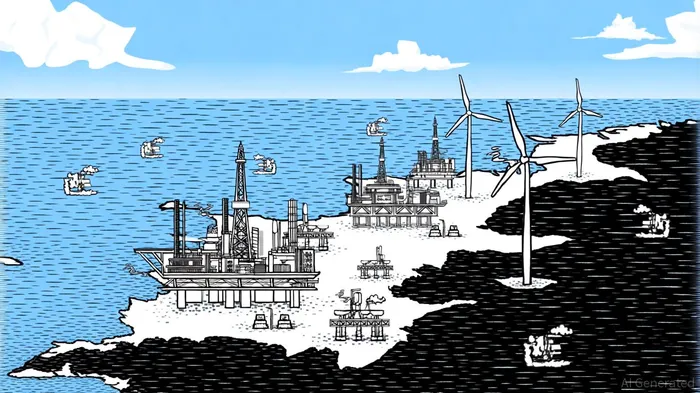
The North Sea, once the lifeblood of European energy security, now stands at a crossroads. For decades, it supplied a third of the UK's oil and gas needs, but production has plummeted by 72% since 1999 [1]. Yet, 2024 saw a surprising £5.95 billion surge in North Sea investments—nearly 50% above forecasts—despite the UK's pledge to phase out new oil and gas exploration licenses [2]. This paradox underscores the tension between geopolitical realities and climate ambitions, as U.S.-U.K. energy policies diverge and converge in ways that reshape the region's long-term viability.
The U.S.-U.K. Policy Divergence: A Clash of Priorities
The UK's Energy Act 2023 and Clean Power Action Plan aim to decarbonize the power sector by 2035, prioritizing offshore wind and hydrogen over hydrocarbons [3]. Meanwhile, the U.S. under President-elect Donald Trump has signaled a starkly different trajectory. Executive orders in early 2025 prioritized fossil fuel deregulation, including lifting methane rules and fast-tracking LNG exports [4]. This divergence has created a rift: Trump has criticized the UK's 38% windfall tax on North Sea producers (part of a 78% headline tax rate) as a “very big mistake,” urging the UK to “open up” its oil fields [5].
Such policy clashes amplify risks for North Sea investors. The UK's high tax burden and regulatory stringency—exacerbated by legal challenges like Scotland's court rulings on downstream emissions—have driven companies like Apache to exit the region by 2029 [6]. Conversely, U.S. deregulation could boost global oil supply, potentially undercutting North Sea prices and delaying the transition to renewables.
Investment Trends: A Balancing Act
Despite these headwinds, North Sea investments remain robust. In 2024, ShellSHEL-- and Equinor's 50-50 joint venture to merge assets reflects industry efforts to offset high taxes and maintain energy security [7]. Meanwhile, the UK's £5 billion grid infrastructure plan aims to fast-track renewables, signaling a dual-track strategy: maximizing output from existing oil fields while building clean energy capacity [2].
However, production forecasts tell a different story. Output is expected to fall from 1.09 million barrels of oil equivalent per day (boepd) in 2024 to 0.62 million boepd by 2030 [2]. This decline, coupled with the UK's reliance on imported LNG (it produces only 13% of its fuel needs), raises questions about the economic and strategic rationale for sustaining North Sea production [8].
Geopolitical Risks: Regulatory Conflicts and Market Volatility
The U.S.-UK Free Trade Agreement (FTA) signed in May 2025 seeks to mitigate trade tensions, but it has not resolved deeper conflicts. The UK's green agenda clashes with Trump's “drill, baby, drill” rhetoric, creating regulatory uncertainty for North Sea operators. For instance, the UK's cluster-based carbon capture and storage (CCUS) initiatives—aimed at creating 50,000 jobs by 2030—face indirect risks if U.S. LNG exports reduce European demand for North Sea oil [3].
Market volatility further complicates the outlook. Global maritime tensions in the Red Sea and South China Sea have forced shipping reroutes, increasing costs for North Sea exports [9]. Meanwhile, U.S. LNG expansion could displace North Sea crude in key markets like Asia, where demand growth is slowing due to decarbonization efforts [4].
The Path Forward: Adaptation or Obsolescence?
The North Sea's future hinges on its ability to repurpose legacy infrastructure. Projects like the Sullom Voe Terminal's conversion to e-fuel production and carbon storage offer a blueprint for a just transition [10]. Yet, success depends on aligning U.S. and UK policies. The U.S.-UK Strategic Energy Dialogue's focus on nuclear and hydrogen collaboration is promising, but it must counterbalance Trump's pro-fossil fuel agenda [11].
For investors, the key lies in hedging against policy shifts. While short-term gains may still exist in North Sea oil, long-term bets should prioritize assets adaptable to low-carbon technologies. The region's workforce and infrastructure, if retooled, could become a cornerstone of Europe's energy transition—provided geopolitical tensions do not derail the delicate balance between energy security and climate goals.





Comentarios
Aún no hay comentarios