
Geopolitical Risks in Global Carbon Policy: U.S. Trade Strategies and Their Implications
The global carbon policy landscape is increasingly shaped by U.S. trade and regulatory responses to foreign climate initiatives, creating both opportunities and geopolitical risks for investors. As the U.S. navigates a complex web of international climate commitments, domestic political shifts, and economic priorities, its policies risk exacerbating trade tensions while also offering pathways for strategic alignment. This analysis examines the U.S. approach to the EU's Carbon Border Adjustment Mechanism (CBAM), China's carbon market expansion, and the 2025 Foreign Pollution Fee Act (FPFA), highlighting the implications for global markets and investment strategies.
U.S. Responses to the EU's CBAM: A Delicate Balancing Act
The EU's CBAM, set to enter full enforcement by 2026, has prompted significant U.S. diplomatic and legislative engagement. While the U.S. has not yet enacted its own CBAM, it has raised concerns about the EU mechanism's compliance with WTO rules, particularly the most-favored-nation (MFN) and national treatment principles, according to a trade.gov market intelligence briefing. A U.S. Trade Representative report suggests the CBAM could create a "leveling-up" effect for U.S. exporters if implemented equitably but risks becoming a de facto trade barrier if it favors EU producers.
The U.S.-EU Framework Agreement of 2025 includes vague commitments to "provide additional flexibilities" for U.S. businesses under the CBAM, as noted in a Columbia SIPA analysis, but these have yet to translate into concrete policy changes. U.S. exporters, particularly in energy-intensive sectors like steel and cement, face compliance challenges, including data collection burdens and liability risks from incomplete supplier emissions data, a CSIS analysis warns. Meanwhile, domestic legislative proposals such as the Energy Innovation and Carbon Dividend Act remain stalled, leaving the U.S. without a clear carbon border adjustment strategy, per a ClearBlue Markets overview.
China's Carbon Market and U.S. Compliance Volatility
China's expansion of its national Emissions Trading System (ETS) to sectors like steel and cement by 2025 has further complicated the U.S. regulatory landscape. While the U.S. federal government has retreated from climate commitments under the Trump administration, state-level programs like California's Cap-and-Trade System and the Regional Greenhouse Gas Initiative (RGGI) remain active, according to an S&P Global report. However, these programs face instability due to delayed regulatory reviews and legal challenges, a Carbon Direct analysis notes.
The voluntary carbon market (VCM) in the U.S., supported by incentives like the 45Q carbon sequestration tax credit, has shown resilience, per an OceanBlocks overview. Yet, the global carbon market is increasingly interconnected, and China's relaunched voluntary Certified Emission Reduction (CCER) program is expected to influence pricing and trading dynamics, according to an American Action Forum analysis. For investors, this duality-between a fragmented U.S. compliance market and a growing global carbon trading ecosystem-poses risks of misalignment and regulatory arbitrage.
The 2025 Foreign Pollution Fee Act: Tariffs, Revenue, and Retaliation Risks
The 2025 FPFA, reintroduced under the Trump administration, represents a bold shift in U.S. carbon trade policy. This legislation imposes tiered tariffs on carbon-intensive imports, targeting sectors like aluminum, cement, and steel, as projected in an RFF brief. Estimates vary: the American Action Forum projects $133.6–$185.4 billion in revenue from 2026–2035, and CSIS insights examine implementation trade-offs. However, the policy faces criticism for potentially violating WTO principles and for lacking a domestic carbon pricing mechanism to incentivize decarbonization, warns an ISEAS perspective.
The FPFA's tiered approach-applying higher tariffs to countries like India and Vietnam while offering lower rates to Canada and Mexico-has already strained trade relations. Canada, for instance, removed all tariffs on U.S. goods under CUSMA in 2025 to preserve its trade advantage, per the Prime Minister's statement. For ASEAN nations, the FPFA's high tariffs on solar equipment and photovoltaics threaten clean energy transitions and regional competitiveness, according to an IISD review. Meanwhile, China's dominance in climate financing in Southeast Asia has created an alternative to U.S. support, raising concerns about dependency and governance gaps, as highlighted in a CleanCarbon analysis.
Geopolitical Risks and Investment Implications
The U.S. approach to carbon policy carries significant geopolitical risks. The CBAM and FPFA could trigger retaliatory measures from China, India, and Russia, escalating trade tensions, as noted in the USTR trade policy agenda. Developing nations, already disadvantaged by carbon-intensive industries, may struggle to adapt to U.S. and EU regulations, creating market volatility. For investors, this underscores the importance of diversifying supply chains and hedging against regulatory shifts.
Conversely, opportunities exist for regions and companies that align with U.S. climate priorities. The EU's CBAM expansion to 2034 and the FPFA's emphasis on low-carbon imports could drive demand for clean technology and carbon credit trading platforms, and COP29 initiatives may bolster ASEAN cooperation on carbon markets, according to an EastAsiaForum piece. A unified ASEAN carbon market, supported by those COP29 initiatives, may also attract investment if it strengthens governance and technical capacity; the American Action Forum has modeled related revenue effects.
Conclusion
The U.S. remains a pivotal actor in shaping global carbon policy, but its fragmented regulatory approach and protectionist trade measures risk deepening geopolitical divides. Investors must navigate these dynamics by prioritizing resilience in supply chains, engaging with policy developments, and capitalizing on emerging markets for low-carbon goods. As the CBAM and FPFA evolve, the alignment-or misalignment-of U.S. policies with international norms will be a critical determinant of global carbon market stability.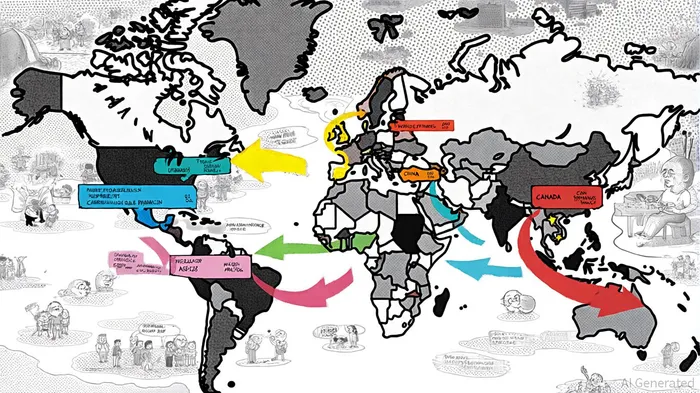







Comentarios
Aún no hay comentarios