
Geopolitical Risks and Free Speech Regulation: Reshaping the Global Tech and Media Stock Landscape
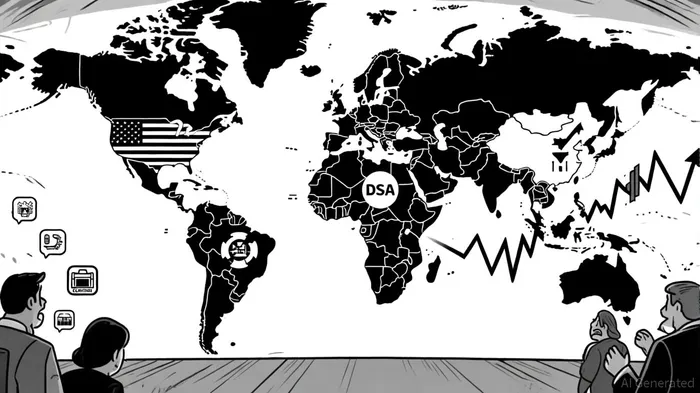
The global technology and media sectors are navigating an increasingly complex web of geopolitical tensions and regulatory shifts in 2025. From the U.S.-EU clash over digital governance to the U.S.-China "tech cold war," these forces are not only reshaping corporate strategies but also directly impacting stock valuations. Investors must now weigh the interplay of ideological clashes, export controls, and regulatory fragmentation when assessing tech and media equities.
The U.S.-EU Free Speech Divide: A Regulatory Battleground
The European Union's Digital Services Act (DSA) has emerged as a flashpoint in the transatlantic rift. By imposing stringent content moderation requirements on platforms like MetaMETA-- (META) and X (formerly Twitter), the DSA mandates proactive monitoring of user-generated content, with penalties tied to global revenue [1]. U.S. tech firms argue these rules violate First Amendment principles, framing the DSA as a threat to free expression. This ideological divide has escalated into a broader "digital imperialism" narrative, where U.S. platforms leverage domestic law to resist foreign regulations. For instance, in Brazil, platforms like Rumble and Trump Media have defied court orders to suspend disinformation-linked accounts, citing free speech protections [2]. Such conflicts are not merely legal but economic: Meta's potential EU fines could reach 6% of its 2024 revenue ($164.5 billion), creating significant financial headwinds [3].
The U.S.-China Tech Cold War: Export Controls and Market Fragmentation
The U.S.-China technological rivalry has intensified, with export controls on advanced semiconductors and AI hardware reshaping global supply chains. Nvidia (NVDA) and ASML Holding NV (ASML) have borne the brunt of these restrictions. U.S. export bans on H20 chips to China are projected to cost Nvidia $5.5 billion in revenue, while ASML's revised 2025 sales forecast (€30-35 billion) reflects a 25% reliance on Chinese markets—down from 36% in 2024 [4]. These controls are part of a broader strategy to curb China's AI ambitions, but they have also fragmented global markets. Chinese firms like Huawei and SMIC are accelerating domestic innovation, creating a dual-track ecosystem where U.S. and non-U.S. tech companies face divergent growth trajectories [1].
Regulatory Shifts in the U.S. and Beyond: Deregulation or Strategic Control?
While the U.S. has signaled a regulatory pullback under new leadership at the FCC and FTC, the focus remains on AI, cybersecurity, and data privacy. Executive orders pausing new rulemaking and withdrawing infrastructure proposals suggest a short-term de-regulatory stance [5]. However, the White House's July 2025 Artificial Intelligence Action Plan hints at a long-term regulatory framework that could reshape AI development. Meanwhile, Nigeria's strict enforcement of the Nigeria Data Protection Act (NDPA) and the SEC's June 2025 digital asset framework underscore the global trend toward fragmented regulatory environments [6]. These shifts increase compliance costs and operational complexity for multinational tech firms.
Stock Market Implications: Winners, Losers, and Strategic Resilience
The financial impact on key players is stark. ASML's stock plummeted 15% after its revised sales forecast, dragging down peers like AMD and Intel [4]. Nvidia's Q3 FY2025 revenue surged 94% year-over-year to $35.1 billion, but export restrictions triggered a 7% stock decline [4]. Meta, meanwhile, faces dual pressures: antitrust litigation threatening divestitures of Instagram and WhatsApp, and rising costs from AI infrastructure investments ($64–$72 billion in 2025) [3]. Conversely, Chinese chipmakers have seen stock gains as domestic innovation accelerates. X's valuation, meanwhile, has collapsed to under $10 billion, reflecting advertiser losses and regulatory uncertainty [7].
Conclusion: Navigating a Fractured Digital Future
For investors, the 2025 landscape demands a nuanced approach. Geopolitical risks and regulatory fragmentation are no longer abstract concerns—they are operational realities. Tech firms must balance compliance with innovation, while investors should prioritize companies with diversified supply chains, robust AI strategies, and regulatory agility. As the U.S. and EU clash over digital governance and the U.S.-China rivalry reshapes markets, the winners will be those who adapt to a world where technology and ideology are inextricably linked.





Comentarios
Aún no hay comentarios