
Geopolitical Risks and the Fragility of Global Payment Systems: A Trump 2025 Scenario
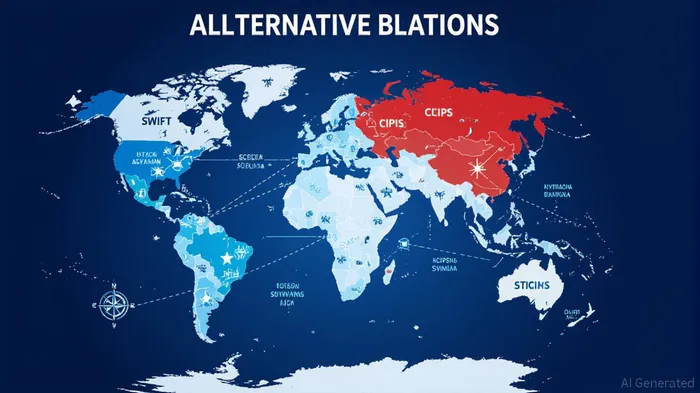
The global financial infrastructure, long dominated by U.S.-centric systems like SWIFT, faces unprecedented risks under a potential Trump 2025 administration. With tariffs, sanctions, and trade policies poised to reshape cross-border payment dynamics, investors must grapple with the fragility of systems that underpin $150 trillion in annual transactions[1]. This analysis evaluates the technical and geopolitical vulnerabilities of global payment systems, focusing on how Trump-era policies could accelerate fragmentation and de-dollarization.
The Trump Legacy: Tariffs, Sanctions, and Systemic Shocks
The Trump administration's first term (2017–2021) already exposed critical weaknesses in global payment systems. Tariffs on Chinese goods, for instance, increased production costs for digital payment infrastructure, raising prices for merchants and end-users[5]. Meanwhile, the weaponization of SWIFT—exemplified by the 2018 exclusion of Iranian banks—forced nations to develop alternative systems like Russia's SPFS and China's CIPS[2]. These shifts underscored a broader trend: when excluded from SWIFT, countries faced immediate economic shocks, including currency collapses and liquidity crises[3].
A second Trump administration is expected to amplify these pressures. Proposed tariffs of up to 100% on imports from key trade partners could disrupt cross-border payment flows, creating volatility in currency markets[5]. Businesses are already adapting, with 40% increasing U.S. sourcing and 33% cutting costs to offset higher tariffs[5]. However, such adjustments may not mitigate the systemic risks posed by a fragmented financial landscape.
Technical Vulnerabilities: SWIFT, CIPS, and the Cybersecurity Challenge
SWIFT, the backbone of global finance, remains vulnerable due to its U.S.-based infrastructure and reliance on legacy systems. The 2025 Trump cybersecurity executive order mandates post-quantum cryptography (PQC) planning and secure software development practices, but these upgrades could strain SWIFT's aging architecture[4]. Meanwhile, CIPS—China's sanctions-resistant alternative—operates 24/7 with real-time gross settlement (RTGS) but still depends on SWIFT for 80% of its messaging[1]. This dependency creates a paradox: CIPS's modern design contrasts with its inherited vulnerabilities from SWIFT.
The administration's focus on AI and PQC may further complicate matters. While CIPS's centralized control by the People's Bank of China allows rapid policy alignment, it also limits agility compared to SWIFT's cooperative governance model[1]. For investors, this duality presents a dilemma: SWIFT's dominance is eroding, but its alternatives lack the interoperability and trust required to replace it entirely.
Geopolitical Fragmentation and the Rise of BRICS Pay
The most significant risk lies in the acceleration of geopolitical fragmentation. Trump's proposed universal tariffs and unilateral sanctions could push nations to adopt local-currency trading and alternative payment systems[5]. BRICS Pay, a blockchain-based platform, exemplifies this trend. By enabling transactions in local currencies, it reduces reliance on the U.S. dollar and challenges SWIFT's hegemony[3]. However, BRICS Pay's scalability and regulatory compliance remain untested, and its adoption could trigger retaliatory tariffs from the U.S., further destabilizing global trade[3].
Data from the European Bank for Reconstruction and Development (EBRD) suggests that extreme fragmentation could cost the global economy up to $5.7 trillion[3]. For context, the 2022 Russian exclusion from SWIFT led to a 30% drop in its cross-border transactions[2]. If similar scenarios play out for other nations, the ripple effects on financial infrastructure resilience could be catastrophic.
Investment Implications: Hedging Against Uncertainty
For investors, the key lies in hedging against both technical and geopolitical risks. Here are three strategic considerations:
- Diversify Exposure to Payment Systems: Allocate capital to firms developing interoperable solutions that bridge SWIFT, CIPS, and blockchain-based systems. Companies like Ripple and StellarXLM-- are already exploring hybrid models[1].
- Prioritize Cybersecurity and Compliance: As the Trump administration enforces stricter cybersecurity mandates, firms with expertise in PQC and secure software development will gain a competitive edge[4].
- Monitor Geopolitical Signals: Track policy shifts in real-time, particularly tariffs and sanctions announcements. The Financial Stability Board's recent call for resilient cross-border payment infrastructure highlights the urgency of proactive risk management[2].
Conclusion: A New Era of Financial Geopolitics
The Trump 2025 administration's policies are poised to redefine the architecture of global payment systems. While SWIFT's vulnerabilities and CIPS's ambitions create a volatile landscape, they also present opportunities for innovation. Investors who anticipate the fragmentation of financial infrastructure—and the rise of alternative systems—will be better positioned to navigate the uncertainties ahead.






Comentarios
Aún no hay comentarios