
Geopolitical Risks in ESG-Aligned Aviation Investments: Navigating U.S.-UN Policy Divergence
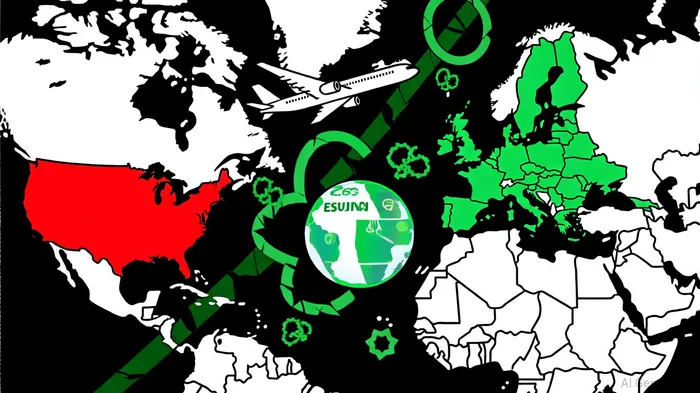
The aviation sector's transition to net-zero emissions by 2050 hinges on robust ESG-aligned investments in sustainable aviation fuel (SAF), carbon offset programs, and green financing mechanisms. However, a growing geopolitical rift between the United States and the United Nations—exacerbated by divergent policy priorities—threatens to destabilize these efforts. As the U.S. retreats from multilateral sustainability frameworks, while the EU and UN-backed institutions push for binding decarbonization targets, investors face a fragmented landscape rife with regulatory uncertainty, financing bottlenecks, and geopolitical friction.
Policy Divergence: A Fractured Global Framework
The U.S. formally rejected the UN Sustainable Development Goals (SDGs) in March 2025, signaling a strategic pivot toward sovereignty-first policies and bilateral cooperation[1]. This shift contrasts sharply with the EU's ReFuelEU Aviation regulation, which mandates a 2% SAF blending requirement at EU airports in 2025, rising to 70% by 2050[2]. While the EU enforces binding mandates and carbon offset systems, the U.S. has rolled back incentives for SAF production under the Inflation Reduction Act (IRA), including the suspension of the SAF Blenders Tax Credit[3]. This regulatory asymmetry creates a “two-speed” market: the EU offers long-term clarity for investors, while the U.S. environment remains volatile due to frequent policy reversals under the Trump administration[4].
The divergence is further compounded by the U.S. withdrawal from the Paris Agreement in January 2025 and its refusal to defend the SEC's climate disclosure rules[5]. These actions have eroded trust in U.S. ESG commitments, prompting international investors to question the credibility of American aviation firms' sustainability claims. Meanwhile, the UN and ICAO continue to advocate for global alignment, with the latter emphasizing the need for harmonized carbon offset standards to avoid “greenwashing”[6].
Green Financing in Peril: Bonds, Loans, and Market Fragmentation
Green bonds and sustainability-linked loans have emerged as critical tools for funding aviation decarbonization. In 2025, global green bond issuance is projected to reach $1 trillion, with $620 billion allocated to ESG-aligned projects[7]. However, the U.S. market lags behind the EU's structured approach. For instance, the EU's Sustainable Finance Disclosure Regulation (SFDR) and Green Bond Standard provide clear criteria for investors, whereas U.S. policies lack centralized oversight, leading to inconsistent reporting and higher litigation risks[8].
Case studies underscore this divide. The EU's ReFuelEU mandate has spurred $1.5 trillion in planned SAF infrastructure investments, supported by a book-and-claim system to address regional supply gaps[9]. Conversely, U.S. SAF producers like CVR Energy have halted projects due to uncertainty over the Clean Fuel Production Credit (§45Z), which expires in 2027[10]. The closure of the World Energy Paramount refinery in 2025—a once-ambitious SAF hub—exemplifies the sector's vulnerability to policy rollbacks[11].
Technology Adoption: Innovation vs. Regulatory Drag
The U.S. and EU are also diverging in their approaches to SAF technology. The EU prioritizes synthetic e-kerosene and advanced biofuels, while the U.S. has leaned on crop-based SAFs, which face international restrictions[12]. This misalignment complicates cross-border technology transfer and supply chain integration. For example, Boeing's 2030 goal to make all commercial aircraft 100% SAF-capable is constrained by the lack of U.S. federal mandates, forcing the company to rely on state-level incentives in California and Washington[13].
Carbon offset programs face similar challenges. The EU's Emissions Trading System (ETS) imposes penalties for non-compliance, whereas U.S. airlines navigate a patchwork of voluntary programs and legal risks. A 2025 report by Reuters highlights how U.S. carriers are increasingly pressured to verify the integrity of their offsets, as greenwashing lawsuits rise[14].
Geopolitical Tensions and Cross-Border Friction
The U.S.-UN divergence has also strained international partnerships. The EU's ReFuelEU regulation, for instance, conflicts with U.S. export control policies on advanced aviation technologies, such as unmanned aerial systems (UAS), which are now subject to stricter national security reviews[15]. Meanwhile, geopolitical conflicts—such as Middle East wars and U.S.-China trade tensions—have disrupted supply chains for SAF feedstocks and aircraft components, further complicating ESG-aligned investments[16].
Investors must also contend with the U.S. withdrawal from multilateral climate finance mechanisms. The EU's European Investment Bank (EIB) has pledged €15 billion to green aviation projects, while U.S. participation in the Green Climate Fund has stalled[17]. This gap risks isolating American firms in global markets where ESG compliance is becoming a non-negotiable requirement for competitiveness[18].
Conclusion: Mitigating Risks in a Fragmented Landscape
For investors, the key to navigating this fractured environment lies in diversification and agility. Prioritizing projects in regions with stable ESG frameworks—such as the EU—while hedging against U.S. policy volatility can mitigate exposure. Additionally, leveraging private-sector partnerships and state-level incentives in the U.S. may offset federal inaction.
However, the long-term solution requires global coordination. As the UN and ICAO push for standardized carbon offset rules and SAF certification, investors must advocate for policy alignment to avoid the reputational and financial risks of a fragmented market. In an era where ESG compliance is both a moral imperative and a business necessity, the stakes for aviation have never been higher.





Comentarios
Aún no hay comentarios