
Geopolitical Risks and Energy Infrastructure Opportunities in South Asia: A 2025 Investment Analysis
The energy and infrastructure landscapes of Pakistan and Afghanistan in 2025 present a paradox: immense potential for transformative investment, shadowed by persistent geopolitical risks. As both nations pursue ambitious development agendas, cross-border tensions, regional instability, and global power dynamics create a volatile environment for capital. This analysis examines the interplay between investment opportunities and geopolitical challenges, drawing on recent policy shifts, project developments, and authoritative economic assessments.
Pakistan: A Renewable Energy Renaissance Amid Structural Challenges
Pakistan's energy sector has emerged as a focal point for foreign direct investment (FDI), driven by policy reforms such as the Tight Gas Policy and the Alternative and Renewable Energy Policy. These initiatives have attracted over $5 billion in domestic and international capital since 2023, with 22 of 24 new power projects prioritizing renewables like solar and wind, according to Pakistan's Energy Renaissance. The World Bank's $20 billion, 10-year Country Partnership Framework (CPF) further underscores confidence in Pakistan's energy transition, allocating $1.96 billion specifically to modernize infrastructure and expand renewable capacity.
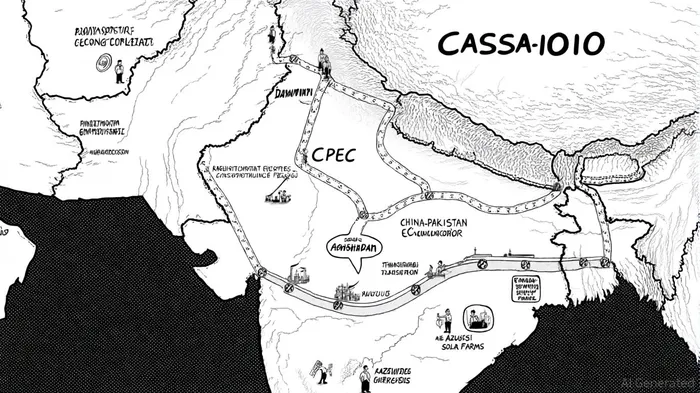
However, structural challenges persist. The renegotiation of power purchase agreements and external financing risks-exacerbated by Pakistan's $65 billion external debt-threaten investor confidence, as noted in the Pakistan's Energy Renaissance piece. For instance, the 2025 Afghanistan-Pakistan conflict, marked by airstrikes and border clashes, has disrupted regional trade routes and raised concerns about the security of cross-border projects like the CASA-1000 electricity transmission initiative, as discussed in The Future of Pakistan-Afghanistan Relations. While Pakistan's strategic location and policy reforms make it an attractive destination for FDI in agriculture, technology, and infrastructure, geopolitical volatility remains a critical risk factor, as outlined in FDI in Pakistan 2025.
Afghanistan: Renewable Ambitions and the Shadow of Conflict
Afghanistan's energy sector is undergoing a quiet revolution, with the Taliban-led government launching a $10 billion energy infrastructure project in collaboration with Azizi Energy. This initiative aims to generate 10,000 megawatts of electricity using solar, wind, hydro, and gas, addressing the country's dire energy deficit-where per capita access remains at just 100 kWh, the lowest in the world, according to Energy Production Potential of Afghanistan. The World Bank's resumption of the CASA-1000 project, a $1.2 billion regional effort to transmit clean energy from Central Asia to Pakistan via Afghanistan, was detailed in a World Bank Group announcement.
Yet, Afghanistan's progress is constrained by security and geopolitical risks. The Islamic State Wilayat Khorasan (ISKP) continues to target infrastructure projects, while the 2025 Pakistan-Afghanistan conflict has heightened cross-border tensions. For example, the Kajaki Dam expansion-a key component of Afghanistan's hydropower strategy-faces delays due to logistical challenges and fears of militant sabotage, as reported in Development Projects in Afghanistan. Additionally, the U.S. tariff hikes and global supply chain fragmentation have increased costs for energy equipment and reduced investor appetite in high-risk regions, a trend noted in KPMG's 2024 Energy Outlook.
Geopolitical Risks: The 2025 Conflict and Regional Dynamics
The 2025 Afghanistan-Pakistan conflict has directly impacted infrastructure investment viability. A September 2025 World Bank MENAAP report highlights that regional conflicts and displacement could reduce economic growth in the Middle East, North Africa, Afghanistan, and Pakistan (MENAAP) region by up to 1.5 percentage points annually. The trilateral talks between China, Pakistan, and Afghanistan-aimed at integrating Afghanistan into the China-Pakistan Economic Corridor (CPEC) and Belt and Road Initiative (BRI)-have yet to resolve these tensions. While CPEC's energy projects, such as the 1,300-megawatt Havelian Power Plant, remain operational, security threats from groups like the Tehreek-i-Taliban Pakistan (TTP) and ISKP create uncertainty for long-term investments, as examined in China, Afghanistan, and Pakistan's Engagement.
Strategic Considerations for Investors
For investors, the key lies in balancing high-reward opportunities with risk mitigation. Pakistan's public-private partnerships (PPPs) in energy and transport have shown positive GDP growth correlations, but due diligence must account for renegotiation risks and currency volatility, as highlighted in the Pakistan's Energy Renaissance analysis. In Afghanistan, while the Azizi Energy project and CASA-1000 offer long-term returns, security assessments and insurance against militant disruptions are essential.
The World Bank's 2025 economic outlook for the MENAAP region-projecting 2.8% growth-suggests cautious optimism, but regional stability hinges on resolving cross-border tensions and securing international support, according to the World Bank MENAAP report. Investors should also monitor China's role: while Beijing's $25 billion investment in Pakistan's energy sector provides a buffer, its reluctance to fully endorse the Taliban government complicates Afghanistan's access to BRI financing, a dynamic explored in China, Afghanistan, and Pakistan's Engagement.
Conclusion
South Asia's energy and infrastructure markets in 2025 are defined by a dual narrative: transformative potential and geopolitical fragility. Pakistan's policy reforms and renewable push, coupled with Afghanistan's ambitious energy projects, offer compelling opportunities. Yet, the 2025 conflict, regional militant threats, and global trade uncertainties demand a nuanced approach. For investors willing to navigate these complexities, the region's strategic location and untapped resources could yield significant returns-but only for those prepared to hedge against its inherent volatility.







Comentarios
Aún no hay comentarios