
Geopolitical Risks in Digital Asset Custody: The U.S.-China Bitcoin Dispute and Its Implications for Institutional Investors
Geopolitical Tensions and Custody Risks
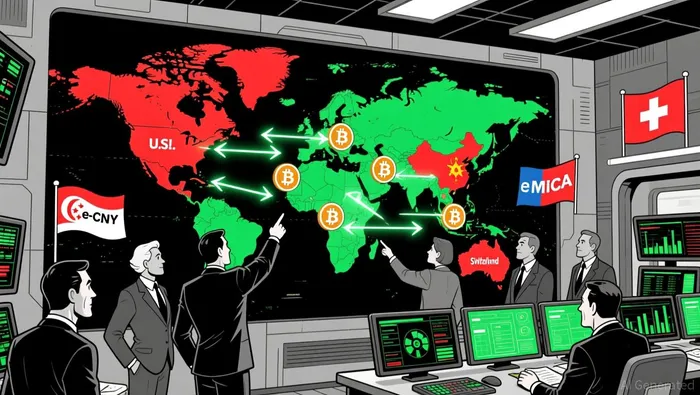
The LuBian incident has heightened scrutiny over digital asset custody practices, particularly for institutions operating in jurisdictions with adversarial policies. China's National Computer Virus Emergency Response Center (CVERC) has labeled the U.S. seizure a "state-backed operation," while the DOJ defends it as part of a criminal case against Chen Zhi, a figure indicted for a large-scale crypto fraud scheme, per the SQ Magazine analysis. This divergence in narratives has created a dual regulatory environment: the U.S. promotes market-driven crypto innovation, while China enforces a strict ban on decentralized assets and advances its e-CNY digital currency, according to a OneSafe blog.
For institutional investors, this bifurcation raises critical questions. How can custodians ensure compliance with conflicting regulations? For example, European SMEs now face elevated compliance costs due to the EU's Markets in Crypto-Assets (MiCA) regulation, which imposes bank-like requirements on crypto service providers, per the OneSafe blog. Meanwhile, Asian fintech startups are leveraging solutions like Thunes' Account Top Up and Withdrawal tools to navigate cross-border custody challenges, enabling faster operations while adhering to local payment method integrations, according to a PR Newswire release.
Regulatory Frameworks and Institutional Strategies
The U.S. regulatory landscape has evolved rapidly in 2025, driven by geopolitical pressures. On January 23, 2025, the U.S. President issued an executive order to strengthen American leadership in digital assets, revoking previous frameworks and banning Central Bank Digital Currencies (CBDCs) within U.S. jurisdiction, according to a White House announcement. This move signals a prioritization of private-sector innovation over state-controlled digital currencies, aligning with the DOJ's aggressive enforcement of crypto-related crimes.
Conversely, China's approach remains centralized and restrictive. Its rare earth licensing regime, while flexible in certain sectors, reinforces a strategic focus on state-controlled digital infrastructure, according to a Modern Diplomacy analysis. This regulatory asymmetry has pushed institutional investors to diversify portfolios, as highlighted by Sygnum's report on risk mitigation strategies, according to a Decrypt article. For instance, the upcoming Consensus x SALT Hong Kong Institutional Summit in February 2026 aims to create a unified platform for capital allocation in Asia's crypto market, reflecting a shift toward regional hubs less entangled in U.S.-China tensions, according to a Morningstar PR release.
Trade Policy Uncertainty and Market Volatility
The U.S.-China trade negotiations in late 2025 further complicate the landscape. A preliminary framework agreement to suspend Trump-era tariffs on Chinese goods could boost investor confidence in Bitcoin, while a breakdown risks renewed uncertainty and a stronger U.S. dollar, according to a CoinDoo analysis. This dynamic is already evident in Bitcoin's price action, which has shown heightened sensitivity to diplomatic developments. For example, short-term volatility spikes coincided with the October 2025 Kuala Lumpur summit, where high-level talks hinted at both escalation and de-escalation, per the Modern Diplomacy analysis.
Institutional investors must now balance exposure to Bitcoin's growth potential with the risks of geopolitical shocks. The Sygnum report emphasizes diversification as a key strategy, urging investors to allocate across stablecoins, tokenized assets, and cross-border custody solutions, according to a Decrypt article. However, this requires navigating a fragmented regulatory patchwork, from MiCA in Europe to China's e-CNY mandates.
Conclusion
The U.S.-China Bitcoin dispute exemplifies how digital assets are becoming geopolitical tools, reshaping custody practices and regulatory risk for institutional investors. As both nations vie for dominance in the crypto space, the path forward will depend on diplomatic outcomes, regulatory harmonization, and technological innovation. For now, investors must remain agile, leveraging tools like Thunes' infrastructure and regional summits to mitigate risks while capitalizing on opportunities in a rapidly evolving market.






Comentarios
Aún no hay comentarios