
Geopolitical Risks in the Crypto Sector: Sanctions Evasion and Stablecoin Volatility
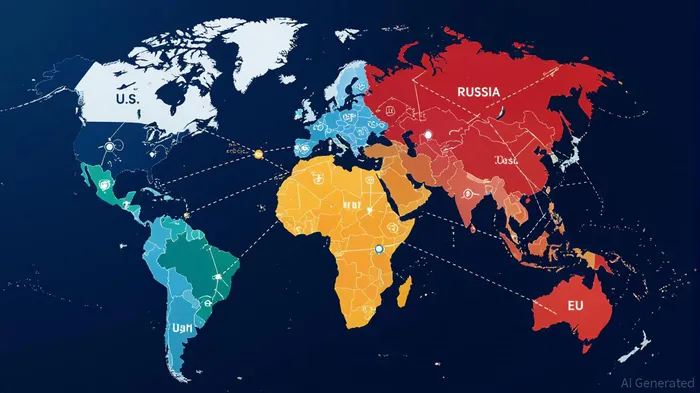
The cryptocurrency sector has evolved into a critical player in global finance, but its rapid growth has also exposed vulnerabilities that geopolitical actors are exploiting. Two pressing risks—sanctions evasion and stablecoin volatility—are reshaping the landscape, with profound implications for investors, regulators, and the broader financial system.
Sanctions Evasion: A New Frontier for Illicit Finance
Cryptocurrencies have become a tool for sanctioned entities to bypass traditional financial systems. The U.S. Treasury's Office of Foreign Assets Control (OFAC) has highlighted alarming cases:
- Garantex/Grinex: This exchange network facilitated over $100 million in transactions linked to cybercriminals and ransomware groups, including the use of the A7A5 ruble-backed stablecoin to obscure flows after sanctions were imposed in 2022 and 2025 [1].
- Russian and Iranian Networks: Iurii Gugnin, founder of Evita, laundered $500 million through U.S. institutions to support Russian banks, while an Iranian network led by Alireza Derakhshan and Arash Estaki Alivand enabled $100 million in crypto transactions tied to Iranian oil sales [3].
- North Korea: The regime leverages stablecoins for cybercriminal activities, using them to pay operatives and evade sanctions [3].
These cases underscore a troubling trend: sanctions evasion is no longer a fringe risk but a systemic threat. OFAC has responded by adding stablecoin addresses to its Specially Designated Nationals (SDN) list, compelling exchanges to monitor transactions [3]. However, the decentralized nature of crypto makes enforcement challenging, especially as bad actors migrate operations to unregulated jurisdictions.
Stablecoin Volatility: The Hidden Geopolitical Weapon
While stablecoins are designed to offer price stability, their volatility during geopolitical crises has raised red flags. From 2023 to 2025, inflows into dollar-backed stablecoins reduced U.S. Treasury yields by 2–2.5 basis points within 10 days, while outflows spiked yields by 6–8 basis points [4]. This volatility is exacerbated by:
1. Technical Risks: Smart contract flaws and oracleORCL-- manipulation have led to catastrophic failures, such as the TerraUSD collapse in 2022 [3].
2. Economic Fragility: Depeg events—where stablecoins lose their $1 peg—highlighted liquidity stress during the 2023 SVB crisis [4].
3. Regulatory Divergence: The U.S. and EU are adopting conflicting frameworks. The U.S. GENIUS Act promotes rapid stablecoin issuance, while the EU's MiCA regulation imposes strict licensing and reserve requirements [2].
The geopolitical stakes are high. U.S. dollar-backed stablecoins now dominate 99% of the $232 billion market, enabling Washington to project financial influence globally [2]. However, this dominance risks fragmenting the financial system. Russia and Italy, for instance, are developing their own stablecoin frameworks to counter dollar hegemony [4].
The Dual-Edged Sword of Innovation
Stablecoins are undeniably transformative. Institutions like VisaV-- and MastercardMA-- are integrating them into payment systems, while Circle's CircleCRCL-- Payments Network (CPN) is redefining cross-border transactions [1]. Yet, their potential for misuse cannot be ignored. For example:
- Venezuela's PDVSA has begun accepting TetherUSDT-- (USDT) for oil contracts to circumvent U.S. sanctions [3].
- Iranian front companies use stablecoins to obscure oil sales revenue [3].
Regulators are scrambling to balance innovation with oversight. The Bank for International Settlements (BIS) warns that stablecoins could undermine central bank control over monetary policy [2]. Meanwhile, Nobel laureate Jean Tirole has cautioned that a lack of safeguards could trigger liquidity crises akin to traditional banking collapses [3].
Strategic Implications for Investors
For investors, the crypto sector's geopolitical risks demand a nuanced approach:
1. Diversify Exposure: Avoid over-reliance on dollar-backed stablecoins, which face regulatory and geopolitical headwinds.
2. Monitor Sanctions Enforcement: Track OFAC actions and SDN list updates to identify high-risk assets.
3. Prioritize Security: Invest in platforms with robust smart contract audits and transparent reserve backing.
Conclusion
The crypto sector is at a crossroads. While stablecoins and blockchain innovation promise to democratize finance, they also enable unprecedented avenues for sanctions evasion and geopolitical manipulation. Investors must navigate this duality with caution, recognizing that the future of crypto is inextricably linked to the evolving dynamics of global power. As regulators and policymakers grapple with these challenges, the sector's resilience will depend on striking a delicate balance between innovation and oversight.





Comentarios
Aún no hay comentarios