
Geopolitical Risks in the Crypto Sector: Navigating Regulatory and Reputational Vulnerabilities in Politically Exposed Ventures
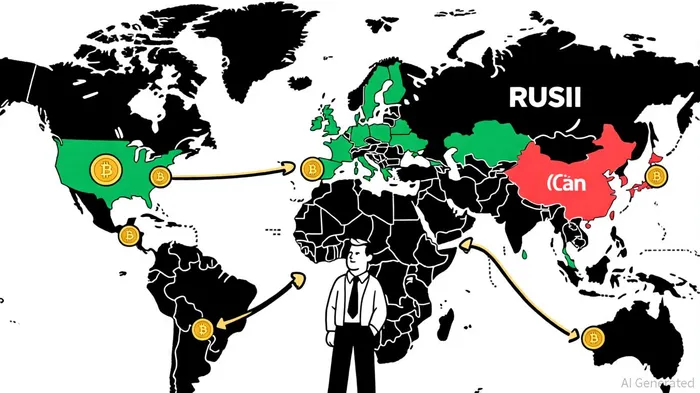
The cryptocurrency sector, once hailed as a decentralized refuge from traditional financial systems, has become a battleground for geopolitical risks. Politically exposed persons (PEPs)—individuals in prominent public roles or their associates—have increasingly leveraged crypto's pseudonymity to navigate regulatory gray areas, often with disastrous consequences for both compliance frameworks and market integrity. As 2025 unfolds, the intersection of crypto, geopolitics, and regulatory enforcement has never been more volatile.
Regulatory Challenges: The PEP Conundrum
The Financial Action Task Force (FATF) has long flagged PEPs as high-risk actors due to their potential exposure to corruption and money laundering[1]. In the crypto sector, this risk is amplified by the borderless, decentralized nature of transactions. For instance, the European Union's Markets in Crypto-Assets (MiCA) regulation, effective December 30, 2024, mandates enhanced due diligence (EDD) for PEPs, requiring crypto-asset service providers (CASPs) to implement stringent KYC protocols and real-time transaction monitoring[2]. These measures aim to curb illicit flows but have also exposed gaps in cross-border compliance.
A case in point is the 1MDB scandal in Malaysia, where former Prime Minister Najib Razak was implicated in a $4.5 billion corruption scheme involving crypto transfers[3]. Such incidents underscore the need for advanced blockchain analytics and AI-driven compliance tools, as recommended by legal experts[4]. However, the fragmented global regulatory landscape—where definitions of PEPs vary across jurisdictions—continues to complicate enforcement[5].
Reputational Risks: When PEPs Go Rogue
Reputational damage looms large for institutions failing to vet PEP-linked crypto ventures. In 2023, UK-based ADM Investor Services was fined £6.47 million by the FCA for inadequate AML controls involving PEPs[6]. More recently, OKX, a Seychelles-based exchange, faced a $504 million penalty from the U.S. DOJ for enabling $5 billion in suspicious transactions, including those tied to PEPs[7]. These cases highlight the reputational and financial toll of non-compliance.
The U.S. Securities and Exchange Commission (SEC) has also cracked down on PEP-linked projects. Terraform Labs and co-founder Do Kwon were hit with a record $4.68 billion fine for misleading investors and offering unregistered securities[8]. Meanwhile, Binance's $50 million penalty for AML violations underscores the SEC's enforcement-driven approach under Chair Gary Gensler[9].
Geopolitical Tensions and Sanctions Evasion
The crypto sector has become a tool for geopolitical actors to evade sanctions. In 2025, the Russian exchange Garantex rebranded as Grinex after being sanctioned for laundering $100 million in illicit funds, including ransomware proceeds[10]. Similarly, Iran has deepened its reliance on crypto platforms to circumvent economic restrictions, with U.S. Treasury's OFAC targeting a $600 million Iranian shadow banking network exploiting crypto[11].
North Korea's cyber-enabled crypto crimes further illustrate the risks. In February 2025, hackers stole $1.5 billion in EthereumETH-- from Dubai's ByBit, with Elliptic reporting that criminals moved $21 billion through decentralized exchanges (DEXs) and cross-chain bridges in 2025, much of it linked to sanctioned regimes[12].
Diverging Regulatory Approaches: U.S. vs. EU
The U.S. and EU have adopted starkly different strategies. Under President Donald Trump, the U.S. has embraced a pro-crypto stance, banning CBDCs and promoting market-driven innovation[13]. This contrasts with the EU's MiCA framework, which prioritizes stability over agility, imposing bank-like standards on stablecoin issuers and delisting non-compliant tokens like Tether's USDT[14].
This divergence creates a fragmented global market. While the U.S. model may attract institutional investors seeking regulatory clarity, the EU's structured approach could limit agility. For PEP-linked ventures, the risk of regulatory arbitrage—exploiting laxer jurisdictions—remains high[15].
Implications for Investors
For investors, the risks are twofold: regulatory penalties and reputational fallout. PEP-linked ventures in sanctioned jurisdictions face heightened scrutiny, as seen with Grinex and Iranian networks[16]. Conversely, projects adhering to MiCA or U.S. AML standards may gain long-term trust, particularly as institutional adoption grows.
However, the geopolitical landscape remains fraught. Conflicts in the Middle East and Europe have spurred tighter controls on crypto transactions, with governments prioritizing sanction enforcement[17]. Investors must weigh these risks against opportunities in emerging markets, where crypto adoption is rising despite regulatory uncertainty.
Conclusion
The crypto sector's entanglement with geopolitical risks is here to stay. As PEPs continue to exploit digital assets for illicit gains, regulators and institutions must adapt. For investors, the path forward lies in rigorous due diligence, leveraging blockchain analytics, and aligning with compliant platforms. Yet, the evolving regulatory landscape—marked by U.S.-EU divergence and sanctions enforcement—demands constant vigilance. In this high-stakes environment, the line between innovation and risk has never been thinner.






Comentarios
Aún no hay comentarios