
Geopolitical Risks and Crypto Asset Flows: Authoritarian Regimes Exploit DeFi to Circumvent Sanctions
The intersection of geopolitics and decentralized finance (DeFi) has become a critical frontier in the global struggle to enforce sanctions against authoritarian regimes. As traditional financial systems tighten oversight, these regimes are increasingly turning to DeFi platforms to bypass restrictions, leveraging the pseudonymous and borderless nature of blockchain technology. According to the 2025 Crypto Crime Report, sanctions evasion now accounts for 33% of illicit crypto activity, underscoring the scale of this challenge. This analysis explores how authoritarian actors exploit DeFi tools, the evolving regulatory responses, and the implications for investors navigating this volatile landscape.
Authoritarian Exploitation of DeFi Infrastructure
Authoritarian regimes have weaponized DeFi protocols to obscure the flow of illicit funds and sustain economies under international pressure. A key tool in this strategy is stablecoins, which offer value stability while operating on public blockchains. For instance, the A7A5 stablecoin has been flagged for its role in enabling sanctions evasion through its decentralized infrastructure. These stablecoins facilitate cross-border transactions without the need for traditional banking systems, making them ideal for circumventing asset freezes.
Cross-chain bridges and decentralized exchanges (DEXs) further compound enforcement challenges. These platforms allow actors to move assets across multiple blockchains and jurisdictions, effectively fragmenting transaction trails. In 2024, U.S. and global partners imposed sanctions on exchanges like NetEx24 and Bitpapa, which were linked to Russia's illicit economy. While these actions temporarily disrupted flows, the adaptability of authoritarian actors-such as shifting to less-regulated protocols-has allowed evasion tactics to persist.
Blockchain Analysis and Regulatory Countermeasures
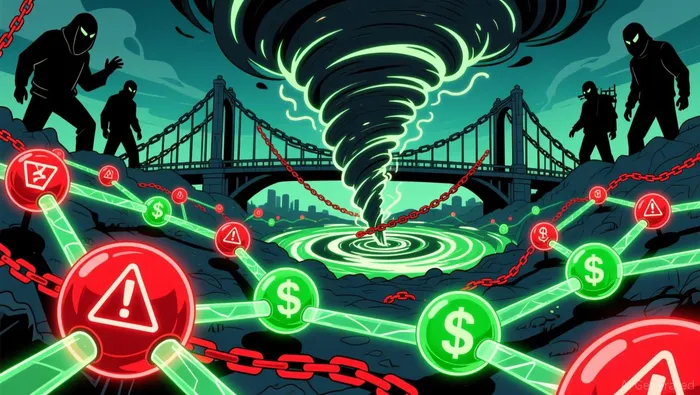 The rise of sophisticated blockchain analytics has provided regulators with tools to trace illicit activity. Techniques like address clustering and wallet tagging are now standard in identifying sanctioned entities. For example, Elliptic's algorithmic analysis revealed over $60 billion in transactions on the Russian exchange Garantex, primarily involving USDTUSDT-- on the TronTRX-- blockchain. Similarly, TRM Labs reported that sanctioned entities accounted for 33% of illicit crypto volume in 2024, with platforms like Garantex and Nobitex processing 85% of inflows.
However, the use of mixers such as Tornado CashTORN-- and Blender remains a persistent threat. These tools obscure transaction trails by pooling and redistributing funds, complicating attribution. The U.S. Treasury's 2023 sanctions on Tornado Cash- linked to over $1 billion in laundering, including funds for North Korea's Lazarus Group-highlight the scale of this risk.
Regulatory frameworks are evolving to address these vulnerabilities. The EU's Markets in Crypto-Assets (MiCA) regulation and the U.S. GENIUS Act aim to impose stricter oversight on stablecoins and cross-chain activities. Meanwhile, global bodies like the Financial Action Task Force (FATF) and Financial Stability Board (FSB) are advocating for coordinated efforts to close jurisdictional gaps.
Investment Implications and Geopolitical Risks
For investors, the interplay between DeFi innovation and geopolitical risk presents both opportunities and hazards. The 140% year-over-year surge in on-chain stablecoin settlements-reaching $18.4 trillion in 2024-reflects the growing importance of crypto in global finance. However, this growth is shadowed by the risk of regulatory crackdowns and asset freezes.
Investors must also consider the asymmetric advantages held by authoritarian regimes. As noted in the U.S. International Cyberspace & Digital Policy Strategy, these actors are actively working to undermine global commitments to an open internet, using digital tools to erode trust in decentralized systems. This could lead to fragmented regulatory environments, where jurisdictions with weaker oversight become safe havens for illicit activity.
Conclusion
The use of DeFi by authoritarian regimes to circumvent sanctions represents a profound challenge to global financial governance. While blockchain analytics and regulatory frameworks are advancing, the decentralized and pseudonymous nature of DeFi ensures that evasion tactics will remain a persistent threat. For investors, the key lies in balancing exposure to the transformative potential of DeFi with a keen awareness of geopolitical risks. As the 2025 Crypto Crime Report emphasizes, the future of crypto asset flows will be shaped by the ongoing tug-of-war between innovation and enforcement.







Comentarios
Aún no hay comentarios