
Geopolitical Risks in Crypto Adoption: Navigating Regulatory Uncertainty and Privacy Tech Opportunities
Regulatory Uncertainty: A Fractured Global Landscape
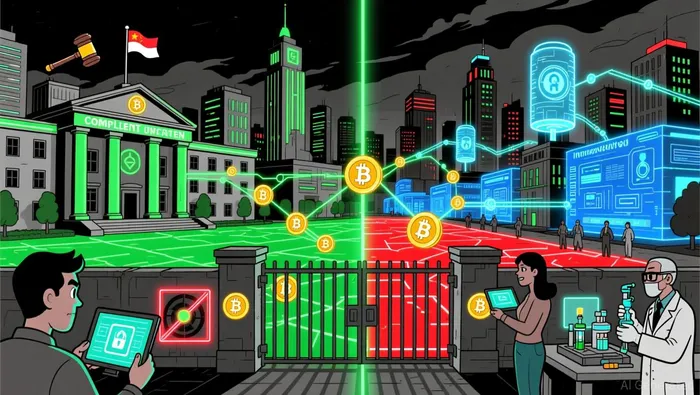
The United States and China represent two poles of crypto regulation in 2025. In the U.S., the SEC's expansive interpretation of securities law has created a patchwork of compliance challenges, with agencies like the CFTC and FinCEN overlapping in jurisdiction. Legislative efforts such as the Digital Asset Anti-Money Laundering Act and the Responsible Financial Innovation Act remain stalled due to political polarization, leaving market participants in a state of limbo according to recent reports. Meanwhile, China's continued prohibition of crypto trading and mining contrasts sharply with Hong Kong's aggressive push to become a global crypto hub, creating a regulatory arbitrage that complicates cross-border operations for multinational firms according to analysis.
The EU's Markets in Crypto-Assets (MiCA) framework, by contrast, has achieved a degree of harmonization across the EEA. MiCA's 2025 implementation has accelerated the adoption of EUR-denominated stablecoins, which grew by 2,727% between July 2024 and June 2025. This shift is partly driven by U.S. tariff policy changes, which have incentivized European entities to reduce reliance on dollar-based stablecoins. However, the transition period allowing firms to operate without MiCA licenses until 2026 introduces lingering compliance risks.
Privacy Tech: A Double-Edged Sword
Privacy technology has emerged as both a solution and a regulatory flashpoint. The U.S. SEC's rescheduled Privacy Roundtable on December 15, 2025 underscores growing scrutiny of privacy-preserving tools. Commissioner Hester Peirce has emphasized the need to balance innovation with safeguards against illicit activity, reflecting broader institutional concerns.
0xbow's Privacy Pools, integrated into the EthereumETH-- Foundation's Kohaku wallet, exemplify the sector's evolution. By leveraging zero-knowledge proofs and an Association Set Provider (ASP), the protocol enables users to prove transaction legitimacy without exposing sensitive data. This innovation addresses regulatory demands for transparency while preserving privacy—a critical differentiator in jurisdictions like the EU, where MiCA mandates stringent anti-money laundering (AML) measures according to regulatory analysis.
However, the fate of decentralized privacy tools like Tornado Cash highlights the geopolitical risks. Sanctioned by the U.S. Treasury in 2022, Tornado Cash saw a 70% drop in activity until sanctions were lifted in March 2025. While usage partially rebounded, the episode illustrates how enforcement actions can disrupt decentralized networks, even as sanctioned nations like Iran and Russia increasingly adopt crypto to circumvent sanctions according to research. In 2024 alone, sanctioned nations received $15.8 billion in crypto, with Iran's outflows surging to $4.18 billion according to financial data.
Geopolitical Implications: Sanctions, Sovereignty, and Systemic Risk
The strategic use of crypto by sanctioned nations has transformed the geopolitical landscape. Russia's $49 billion in crypto payments during Q4 2023–Q1 2024, for instance, demonstrates how state actors are leveraging digital assets to bypass traditional financial systems. This trend raises systemic risks for global financial stability, as crypto becomes a tool for both economic coercion and evasion.
For investors, the interplay of regulatory and geopolitical forces creates a paradox: privacy tech is essential for compliance in regulated markets but also enables illicit activity in unregulated ones. The rise of MiCA-compliant stablecoins like EURC suggests that jurisdictions prioritizing regulatory clarity will attract institutional capital, while privacy-focused protocols like 0xbow's Privacy Pools may dominate in markets where user anonymity is paramount according to market analysis.
Investment Thesis: Balancing Risk and Resilience
The 2025 crypto landscape demands a nuanced approach to risk management. In the U.S., investors should prioritize projects aligned with the SEC's evolving priorities, such as AML-compliant privacy tools. In the EU, exposure to MiCA-compliant stablecoins and infrastructure providers (e.g., Ethereum's Kohaku wallet) offers long-term growth potential according to industry reports. Conversely, jurisdictions like China and sanctioned nations present high-risk, high-reward opportunities, particularly for privacy-first protocols that can operate in regulatory gray zones according to financial research.
However, the geopolitical volatility of 2025 necessitates caution. Sanctions on privacy tools, as seen with Tornado Cash, can abruptly shift market dynamics. Similarly, U.S.-China tensions and EU-U.S. tariff disputes may further fragment the global crypto ecosystem, creating jurisdictional silos according to policy analysis.
Conclusion
The convergence of regulatory uncertainty and privacy technology in 2025 has redefined the geopolitical risks of crypto adoption. While MiCA and compliant privacy solutions like 0xbow's Privacy Pools signal a path toward institutional legitimacy, the weaponization of crypto by sanctioned nations and the fragility of decentralized privacy tools underscore the sector's inherent volatility. For investors, the key lies in hedging against jurisdictional fragmentation while capitalizing on innovations that bridge the gap between privacy and compliance.






Comentarios
Aún no hay comentarios