
Geopolitical Risks in Cross-Border AI Acquisitions: The Meta-Manus Case and Its Implications for Tech Investors
The acquisition of the Singapore-based AI startup Manus by MetaMETA-- for an estimated $2–3 billion has become a focal point for understanding the escalating regulatory and geopolitical risks in cross-border AI mergers and acquisitions (M&A). This case study, unfolding amid heightened U.S.-China technological rivalry, underscores how national security concerns, export control laws, and strategic competition are reshaping the landscape for global tech investors.
Regulatory Challenges: A Test of China's Export Control Framework
China's Ministry of Commerce (MOFCOM) has launched an internal review of the Meta-Manus deal, scrutinizing whether the transaction complies with the country's export control regulations, technology transfer laws, and overseas investment guidelines. The core issue lies in the relocation of Manus' headquarters and operations from mainland China to Singapore, which triggered questions about whether the transfer of AI technologies and personnel required an export license under China's 2021 Export Control Law. MOFCOM spokesperson He Yadong emphasized that the review would assess whether the deal adheres to legal frameworks governing "outward investment, technology exports, and cross-border M&A."
While the investigation is currently classified as an internal review rather than a formal enforcement action, experts warn that it could still impose compliance measures, such as structural adjustments to the deal or restrictions on how technology developed in China can be used post-acquisition. According to trade law expert Cui Fan, concerns exist that Manus may have transferred "prohibited or restricted technologies" without proper authorization, particularly given the AI agent's capability to execute autonomous tasks. These uncertainties reflect Beijing's broader effort to tighten control over its strategic technology sectors, a trend that will likely complicate future cross-border AI deals involving Chinese-origin assets. 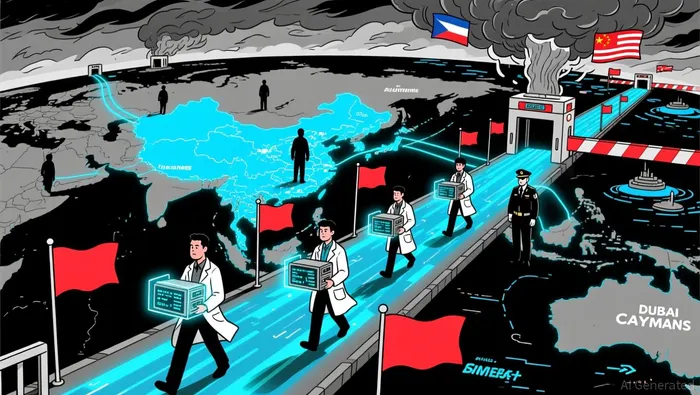
Strategic Implications: A Geopolitical Proxy Battle
The Meta-Manus case is emblematic of the intensifying U.S.-China tech rivalry, where AI capabilities are increasingly treated as critical national assets. According to a report by , the acquisition has been interpreted as an attempt to access U.S. capital and technology resources while distancing itself from Chinese regulatory oversight. This mirrors a broader trend of Chinese AI startups relocating to jurisdictions like Singapore to navigate U.S. investment screening mechanisms, such as the Outbound Investment Security Program (OISP).
The geopolitical stakes are further amplified by the strategic value of AI agents like Manus' general-purpose system. While Chinese authorities have downplayed the technology's significance- suggesting it is not "core technology vital to national interests"-the deal's scrutiny signals a shift in Beijing's approach to protecting its AI ecosystem. As one expert noted, the case could set a precedent for how China manages the offshore transfer of AI talent and intellectual property, particularly as it seeks to reduce reliance on foreign AI capabilities.
Lessons for Tech Investors
For investors, the Meta-Manus case highlights three critical risks in cross-border AI M&A:
1. Regulatory Uncertainty: The lack of clear guidelines on export controls and technology transfer obligations creates a volatile environment for deals involving Chinese-origin AI assets. Investors must factor in prolonged approval timelines and potential compliance costs.
2. Geopolitical Sensitivity: AI technologies are increasingly politicized, with governments prioritizing national security over market efficiency. Deals that appear commercially viable may face unexpected hurdles due to strategic concerns.
3. Relocation Strategies: The use of third-party jurisdictions to circumvent regulatory scrutiny is likely to become a common tactic, but it also raises questions about the long-term stability of such arrangements.
As noted by , Meta's decision to integrate Manus' software into its product portfolio while discontinuing operations in China marks a broader trend of tech firms navigating a fragmented global regulatory landscape. However, the Meta-Manus case demonstrates that even well-resourced companies cannot fully insulate themselves from the geopolitical dynamics shaping AI innovation.
Conclusion
The Meta-Manus acquisition serves as a cautionary tale for tech investors. While the deal may ultimately proceed with minimal intervention, the regulatory and strategic risks it exemplifies will persist. Investors must adopt a nuanced understanding of how national security policies, export controls, and geopolitical rivalries intersect in the AI sector. As China and the U.S. continue to assert control over their technological ecosystems, cross-border AI M&A will remain a high-stakes arena where commercial logic and geopolitical strategy collide.





Comentarios
Aún no hay comentarios