
Geopolitical Risks in AI and Crypto Investments: Navigating Regulatory and Political Volatility
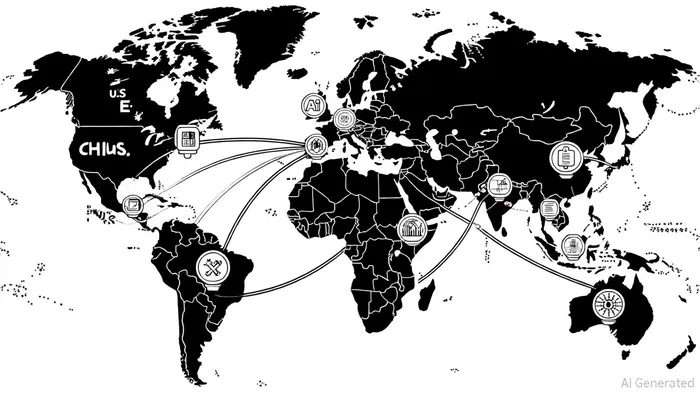
The intersection of artificial intelligence (AI) and cryptocurrency has become a focal point for global investment, innovation, and geopolitical strategy. However, the rapid evolution of regulatory frameworks and political dynamics in 2025 has introduced unprecedented volatility, reshaping risk profiles for investors. This analysis examines how regulatory shifts, international conflicts, and divergent policy approaches are amplifying geopolitical risks in AI and crypto markets, with implications for asset allocation and long-term strategy.
U.S. and EU Regulatory Divergence: A Double-Edged Sword
The U.S. has adopted a pro-innovation stance toward AI and crypto, exemplified by President Trump's AI Action Plan (July 2025), which prioritizes infrastructure development and export leadership[1]. Concurrently, the Strategic Bitcoin Reserve—funded by forfeited Bitcoin—signals a strategic embrace of crypto as a reserve asset[4]. These moves contrast sharply with the European Union's Markets in Crypto-Assets (MiCA) framework, which emphasizes financial stability through stringent licensing and reserve requirements for stablecoins[5]. While MiCA has attracted exchanges like Binance and Kraken to the EU, U.S. policies under the GENIUS Act and SAB 121 repeal are fostering institutional participation, with Bitcoin's price surging from $94,000 to $110,000 in early 2025[5].
This regulatory divergence creates market fragmentation, complicating cross-border investment flows. For instance, U.S. firms leveraging AI-driven trading algorithms face hurdles in EU markets due to MiCA's compliance demands[3]. Meanwhile, the SEC's Project Crypto and the formation of a Crypto Task Force aim to harmonize U.S. oversight, but the absence of a unified global standard remains a risk[1].
Emerging Markets: Policy Shifts and Strategic Competition
Emerging economies are recalibrating their AI and crypto strategies to counterbalance Western dominance. India's regulatory sandbox for crypto has supported 40 blockchain startups, though high taxes (30% capital gains, 1% TDS) are pushing users to offshore platforms[4]. In contrast, China's state-led AI initiatives prioritize national security and technological self-reliance, with government-backed open-source tools targeting emerging markets[3].
The U.S.-China AI rivalry is intensifying, with the U.S. adopting a “deregulate and invest” approach while China focuses on supply chain integration and state-controlled data ecosystems[4]. This competition extends to crypto, where China's opaque regulatory environment contrasts with India's cautious openness. Such divergences create asymmetric risks for investors, particularly in sectors reliant on cross-border data flows or hardware supply chains[5].
Geopolitical Conflicts and Cybersecurity Vulnerabilities
Regional conflicts are exacerbating risks in AI and crypto infrastructure. In the Middle East, Iranian state-sponsored groups like APT33 and CyberAv3ngers are leveraging AI for advanced cyberattacks, targeting energy and telecom sectors[1]. Israel's integration of AI into military operations—such as the Habsora targeting system—highlights how AI is reshaping warfare, while U.S. restrictions on AI chip exports to Gulf states underscore geopolitical tensions[5].
Meanwhile, Asia-Pacific supply chain disruptions—driven by U.S.-China trade wars and semiconductor shortages—threaten AI development. AON's 2025 Cyber Risk Report notes a 53% increase in AI-driven deepfake attacks, with social engineering incidents rising by 233%[1]. These trends suggest that geopolitical instability is not only a macroeconomic risk but also a cybersecurity threat multiplier, particularly for decentralized systems like crypto networks[3].
Investment Implications: Balancing Innovation and Risk
The regulatory and geopolitical landscape demands a nuanced approach to AI and crypto investments. Key considerations include:
1. Institutional Adoption: The repeal of SAB 121 has enabled banks like BNY Mellon to enter crypto custody, reducing volatility and attracting pension funds[2].
2. Regulatory Arbitrage: Firms may prioritize jurisdictions with clear frameworks (e.g., U.S. GENIUS Act, EU MiCA) over politically unstable regions[5].
3. Diversification: AI-integrated crypto platforms in MiCA-compliant EU markets or India's sandbox could offer growth opportunities amid U.S.-China tensions[4].
Conclusion
The AI and crypto sectors are at a crossroads, where regulatory clarity and geopolitical stability are as critical as technological innovation. While U.S. and EU policies are fostering institutional adoption, divergent frameworks and regional conflicts are creating friction. Investors must navigate these dynamics by prioritizing jurisdictions with robust regulatory guardrails, hedging against supply chain disruptions, and monitoring cyber risks. As the 2025 AI Index Report notes, global AI legislation increased by 21.3% in 2024[2], signaling a pivotal year for aligning investment strategies with evolving geopolitical realities.






Comentarios
Aún no hay comentarios