
Geopolitical Risk as a Tailwind: China's Strategic LNG Imports from Russia and Energy Sector Opportunities
The interplay between geopolitical risk and energy sector investments has never been more pronounced than in the case of China's strategic liquefied natural gas (LNG) imports from Russia. As global energy markets recalibrate in response to the Russia-Ukraine war, Western sanctions, and shifting trade dynamics, China and Russia have forged a symbiotic relationship that transforms geopolitical challenges into economic opportunities. For investors, this evolving landscape offers both risks and rewards, demanding a nuanced understanding of how geopolitical volatility can drive long-term value in energy infrastructure and commodity markets.
![]https://cdn.ainvest.com/aigc/hxcmp/images/compress-qwen_generated_1760679592007.jpg.png
Geopolitical Drivers Reshaping the China-Russia LNG Trade
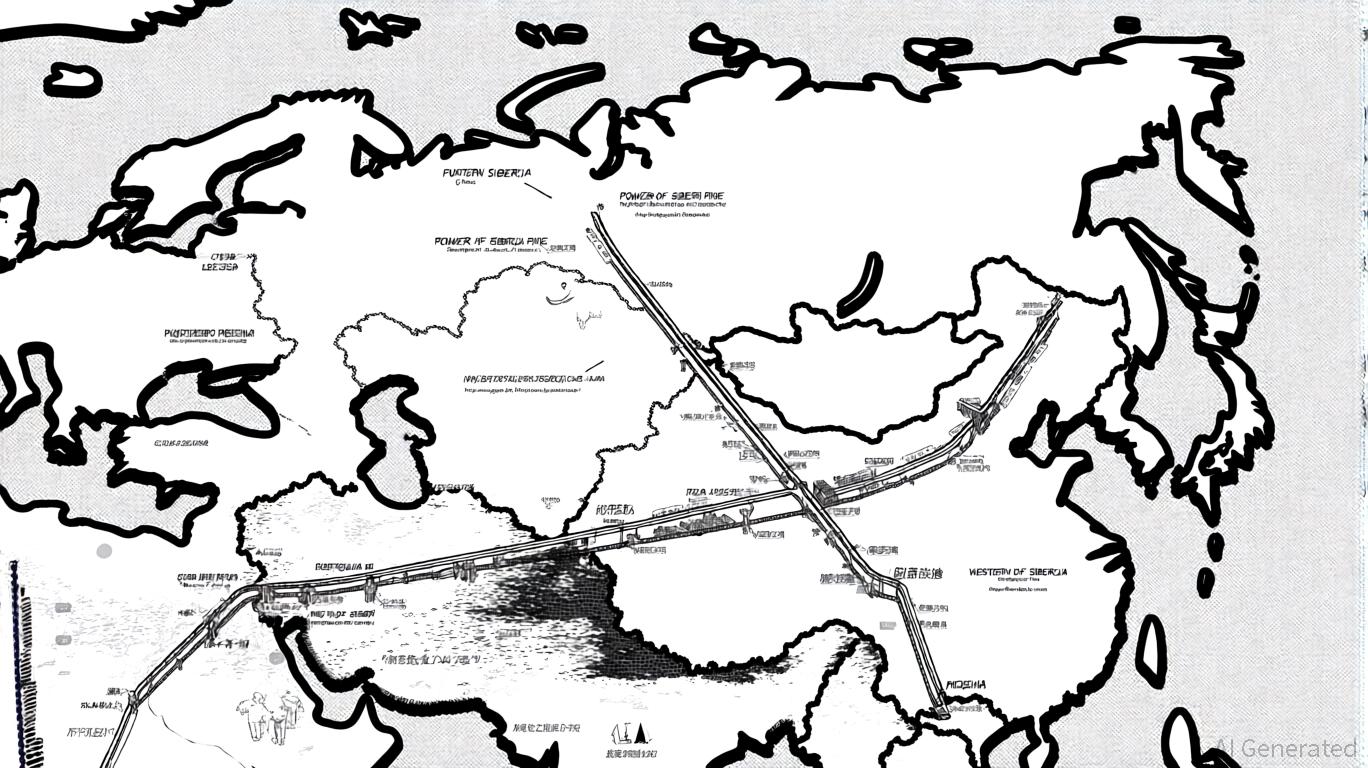
The collapse of Russian gas exports to Europe following Western sanctions has forced Moscow to pivot toward Asia, with China emerging as its most critical partner. By 2024, Russian LNG accounted for 11% of China's total imports, securing Russia's position as the third-largest LNG supplier to the Asian giant, according to the New Lines Institute. This shift is not merely economic but deeply geopolitical. The Power of Siberia pipeline, which began operations in 2019, has become a lifeline for Russia's energy exports, with deliveries projected to reach full capacity of 38 billion cubic meters annually by 2025, according to a GlobalSecurity report. Meanwhile, the newly inked Power of Siberia 2 pipeline—designed to transport 50 billion cubic meters of gas annually from Russia's Arctic to China via Mongolia—represents a strategic bet on long-term energy security for both nations, as noted by China Strategy.
For China, this partnership diversifies its energy supply chains, reducing reliance on politically sensitive regions like the Middle East and Southeast Asia. For Russia, it provides a stable market for discounted energy exports, circumventing Western economic pressure. According to the Atlantic Council, while the Power of Siberia 2 pipeline remains a "distraction" from more immediate LNG export opportunities, its symbolic and strategic value cannot be overstated.
Investment Implications: Navigating Risk and Reward
The China-Russia LNG trade exemplifies how geopolitical risk can act as a tailwind for energy investments. For Russia, the redirection of energy exports to Asia has mitigated the economic impact of sanctions. By 2024, 63% of Russian crude oil exports were rerouted to Asian markets, with China becoming its top oil supplier, China Strategy reported. This pivot has allowed Moscow to sustain military funding and maintain economic stability, despite Western efforts to isolate it.
For China, the investment in Russian energy infrastructure aligns with its broader Belt and Road Initiative (BRI), which prioritizes energy security and regional connectivity. However, Chinese investors face their own set of challenges, including currency fluctuations, regulatory uncertainties, and the logistical complexities of Siberian and Mongolian terrain, the New Lines Institute notes. A study published in Energy Policy highlights that Chinese energy firms operating in Russia must adopt diversified investment models and legal protections to mitigate these risks, as also discussed by the New Lines Institute.
From a global investment perspective, the China-Russia LNG trade underscores the resilience of traditional energy assets in times of geopolitical uncertainty. In China, for instance, stocks in the energy sector have shown relative stability compared to ESG-focused equities, which are more sensitive to geopolitical shocks, according to a ScienceDirect study. This dynamic suggests that investors should not view geopolitical risk solely as a deterrent but as a catalyst for rethinking portfolio allocations in energy markets.
Data Visualization and Future Outlook
Looking ahead, the projected expansion of Russian gas supplies to China—both via pipeline and LNG—could reach 85 billion cubic meters annually by 2030, GlobalSecurity reports. This growth hinges on resolving unresolved commercial terms for the Power of Siberia 2 pipeline, including pricing and financing. While the project's economic returns for Russia remain uncertain, its strategic value as a geopolitical tool is clear.
For investors, the key takeaway is to balance short-term volatility with long-term structural trends. The China-Russia LNG trade is not a static arrangement but a dynamic response to global energy realignments. As the U.S. and Europe grapple with their own energy transitions, the Asia-Pacific region—led by China—is poised to become the epicenter of global LNG demand.
Conclusion
The China-Russia LNG partnership is a testament to how geopolitical risk can be harnessed as a strategic asset. For energy investors, this relationship offers opportunities in infrastructure development, commodity trading, and regional energy markets. However, success requires a careful assessment of geopolitical, economic, and environmental risks. As the world navigates an era of fragmentation and uncertainty, the ability to turn geopolitical challenges into investment opportunities will define the next chapter of global energy markets.







Comentarios
Aún no hay comentarios