
Geopolitical Risk and the Rise of European Defense Stocks: How Merz's Leadership is Reshaping the Landscape
The geopolitical landscape in Europe has shifted dramatically in 2025, with Germany's political realignment under Chancellor Friedrich Merz catalyzing a defense spending surge that is reshaping the continent's security architecture. Merz's leadership has prioritized national security as a cornerstone of economic policy, breaking with decades of fiscal restraint to fund a €500 billion defense and infrastructure package, a Reuters report. This historic move, enabled by a temporary suspension of Germany's constitutional "debt brake," underscores a strategic pivot toward military modernization and NATO cohesion amid persistent Russian aggression in Ukraine and uncertainty over U.S. commitments under President Donald Trump, NPR reported.
Merz's Fiscal Revolution and Its Strategic Implications
Merz's budget speech in March 2025 explicitly framed defense as a "non-negotiable priority," with the chancellor arguing that "whatever it takes" must apply to security in an era of escalating threats, an OvertDefense report noted. The German parliament's approval of the spending package has already triggered a ripple effect across Europe, as neighboring nations recalibrate their defense budgets to align with NATO's 2% of GDP target, according to a KKrVA analysis. This shift is not merely symbolic: the coalition government has outlined a multi-year investment plan focused on cutting-edge technologies such as satellite surveillance, AI-driven logistics, and drone swarms-sectors where European firms are now competing globally, as shown in Norbit results.
The Merz administration's policies are also redefining the role of defense in Germany's economy. By exempting defense expenditures from fiscal rules, the government has signaled to investors that the sector will enjoy long-term stability, a critical factor for capital-intensive industries. As a Reuters analysis stated, "This fiscal flexibility could unlock private sector participation in defense R&D, accelerating innovation cycles that were previously constrained by bureaucratic inertia."
A European Defense Renaissance: Trends and Opportunities
Germany's leadership has amplified broader European trends. The EU's $840 billion military readiness plan and the European Commission's $158 billion defense modernization fund are creating a fertile ground for defense contractors, NPR reported. Venture capital inflows into European defense tech startups have already surpassed $5 billion in 2024, with AI, cyber, and drone technologies attracting the most interest, a trend highlighted by OvertDefense. This ecosystem is being further energized by private equity firms, which are now viewing defense as a "responsible investment" aligned with geopolitical resilience, as noted earlier.
For investors, the most compelling opportunities lie in companies directly benefiting from Merz's policies and EU-wide rearmament. Three high-conviction names stand out:
Rheinmetall AG (DE:RHMGF): The German defense giant has secured a €3.1 billion contract to upgrade the Bundeswehr's infantry systems, part of its €63 billion order backlog. With H1 2025 sales up 24% to €4.7 billion and an operating margin of 12.4%, Rheinmetall is well-positioned to capitalize on Germany's €100 billion annual defense budget by 2027. Its focus on digital battlefield solutions aligns perfectly with Merz's modernization agenda.
Norbit ASA (OSLO:NORBIT): This Norwegian tech firm has seen revenues soar 63% year-to-date to 684.4 million NOK, driven by demand for its maritime surveillance and drone detection systems. With a 25% EBIT margin and a revised 2025 revenue target of 2.5–2.6 billion NOK, Norbit is a beneficiary of both EU defense funding and Germany's push for border security technologies.
Kongsberg Gruppen ASA (OSLO:KONG): The Norwegian conglomerate's Q3 2025 revenues rose 19% to NOK 14.62 billion, fueled by a NOK 6.5 billion contract for Joint Strike Missiles with Germany. Kongsberg's expansion into drone defense systems-already deployed in Ukraine-positions it to profit from NATO's emphasis on asymmetric warfare capabilities, according to earlier reporting.
Risks and the Road Ahead
While the tailwinds for European defense stocks are robust, investors must remain mindful of execution risks. Delays in EU defense procurement processes, inflationary pressures on raw materials, and potential U.S. policy shifts could temper growth. However, the scale of current spending commitments-Germany alone plans to maintain a €500 billion defense fund for a decade-suggests that these risks are secondary to the long-term structural shift.
For those with a medium-term horizon, the European defense sector offers a rare combination of geopolitical tailwinds, policy certainty, and high-margin growth. As Merz's government continues to prioritize security over austerity, defense stocks like Rheinmetall, Norbit, and Kongsberg Gruppen are likely to outperform, reflecting their pivotal roles in Europe's rearmament.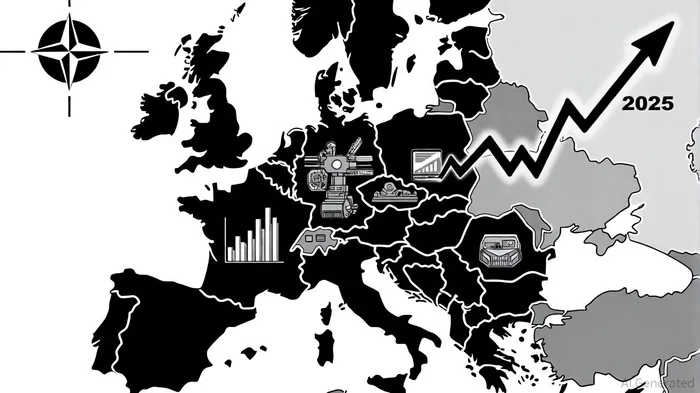







Comentarios
Aún no hay comentarios