
Geopolitical Risk and the Rise of Defense and Crisis-Response Equities: A Strategic Investment Outlook
Geopolitical Tensions Fuel Defense Sector Resilience
The global defense sector has emerged as a cornerstone of market resilience amid escalating geopolitical risks. By 2024, global defense spending had surged to an unprecedented $2.3 trillion, driven by conflicts such as Russia's invasion of Ukraine and rising tensions in the Indo-Pacific and Middle East [1]. European nations, in particular, have accelerated rearmament efforts, with Germany committing $110 billion to its 2025 defense budget and NATO members prioritizing investments in land, air, and naval systems [2]. This spending boom has directly benefited defense contractors like Lockheed MartinLMT--, General DynamicsGD--, and Rheinmetall, whose shares have outperformed broader markets during periods of heightened uncertainty [2].
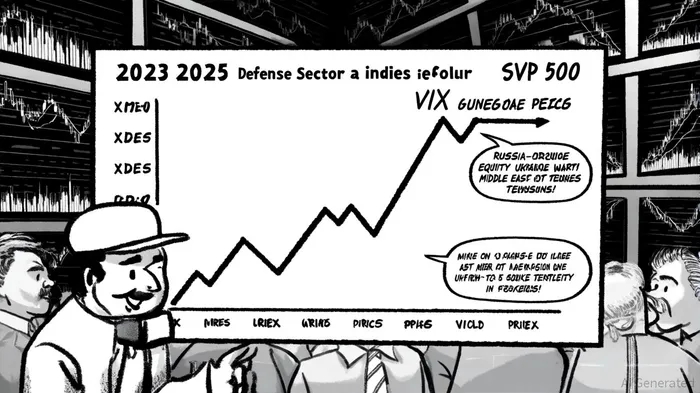
Historically, defense equities have demonstrated a strong correlation with volatility indicators like the VIX and gold prices, reflecting their role as a hedge against geopolitical shocks [3]. For instance, during the Russia-Ukraine war, defense stocks such as Lockheed Martin saw significant price increases due to surging demand for advanced weaponry and military systems [3]. This pattern has repeated in 2025, with defense stocks gaining traction as investors seek stability in a fragmented global landscape [2].
Cybersecurity and Energy Resilience: The New Frontlines of Crisis Response
As geopolitical tensions spill into digital and energy domains, crisis-response equities in cybersecurity and energy resilience have gained prominence. The energy sector, in particular, has faced a surge in cyberattacks, with ransomware incidents increasing by 80% in 2024 compared to the previous year [4]. High-profile breaches, such as Halliburton's $35 million loss from a RansomHub attack and the exposure of 177 GB of data at Ikav Energy, underscore the sector's vulnerability [4]. In response, energy firms are investing in AI-driven intrusion detection, blockchain, and OT cybersecurity measures, creating tailwinds for cybersecurity firms like CrowdStrikeCRWD-- and Palo Alto NetworksPANW-- [5].
The cybersecurity sector has delivered robust returns, with the First Trust Nasdaq Cybersecurity ETF (CIBR) rising 21% year-to-date in 2024, outpacing the S&P 500's 12% gain [5]. Similarly, energy resilience stocks have shown mixed but notable performance. Midstream energy companies like Targa ResourcesTRGP-- achieved an 110.1% total return in 2024, driven by infrastructure investments and stable fundamentals, while upstream producers faced volatility due to supply chain disruptions [6].
Strategic Implications for Investors
The interplay between geopolitical risks and market dynamics underscores the importance of a diversified, active investment approach. Defense equities, with their historical resilience and alignment with global spending trends, offer a compelling long-term play. Meanwhile, cybersecurity and energy resilience sectors present shorter-term opportunities amid urgent demand for infrastructure modernization and threat mitigation [7].
For investors, the key lies in balancing exposure to these sectors while leveraging macroeconomic signals. As J.P. Morgan notes, geopolitical risks remain a top concern for 34% of private bank clients in 2024, emphasizing the need for defensive positioning [8]. Strategies such as overweighting quality companies with strong balance sheets, diversifying across geographies, and incorporating AI-driven analytics can enhance portfolio resilience [8].
Conclusion
The 2024–2025 period has reaffirmed the defense and crisis-response sectors as critical assets in navigating geopolitical volatility. With defense spending on a supercycle trajectory, cybersecurity threats escalating, and energy markets adapting to new risks, investors are uniquely positioned to capitalize on these trends. However, success requires a nuanced understanding of sector-specific dynamics and a proactive approach to risk management. As global tensions persist, the ability to identify and act on these opportunities will define the next phase of market performance.





Comentarios
Aún no hay comentarios