
The Geopolitical Risk Premium in Venezuelan Oil Exports and Its Impact on Refiners
The U.S. government's escalating sanctions on Venezuela, including the December 2025 seizure of the Chevron-operated tanker Skipper, have created a unique market dynamic: steep discounts on Venezuelan crude oil that could offer strategic opportunities for risk-tolerant investors in the refining sector. As geopolitical tensions and enforcement actions drive down prices for Chevron's Venezuelan crude, refiners like Valero Energy CorporationVLO-- and Phillips 66PSX-- face a critical decision: whether to capitalize on these discounted feedstocks to expand margins, despite the inherent volatility. This analysis evaluates the interplay between sanctions-driven pricing, refiner financial performance, and the potential for margin expansion, while weighing the risks of geopolitical instability.
The Sanctions-Driven Discount: A Geopolitical Risk Premium
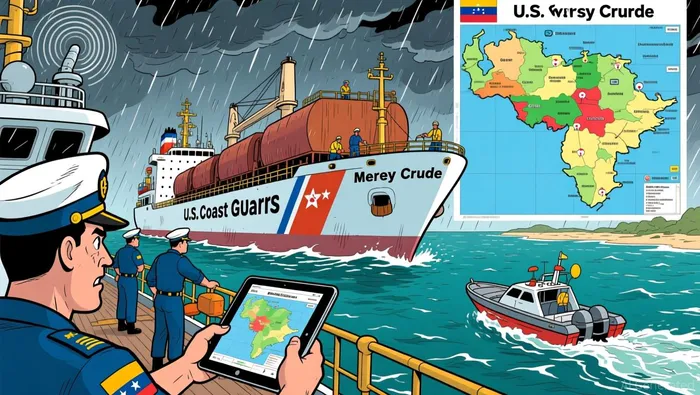
The U.S. government's intensified enforcement actions, including the blockade of sanctioned oil tankers and the designation of Venezuela's state oil company (PDVSA) as a "foreign terrorist organization," have directly pressured Chevron's operations. Following the Skipper seizure, ChevronCVX-- slashed the price of its Venezuelan crude sold to U.S. refiners, with Bloomberg reporting a $21-per-barrel discount for Merey crude relative to Brent prices in December 2025. This discount reflects a "geopolitical risk premium," where buyers demand compensation for the heightened uncertainty of trading with sanctioned entities.
 The discounts are further amplified by Venezuela's deteriorating infrastructure and production capacity. Output has plummeted from 3.4 million barrels per day in 2019 to just 1 million barrels per day in 2025, due to underinvestment and political instability. This fragility has forced Chevron to offer steeper markdowns to retain U.S. refiner interest, even as alternative heavy crude sources like Canadian oil sands and Mexican Maya crude trade at narrower discounts. For example, Western Canadian Select (WCS) averaged a $5.14-per-barrel discount to WTI in December 2025, while Colombian Castilla crude traded at a $3.58-per-barrel discount. These differentials highlight the competitive advantage of Venezuelan crude for refiners willing to absorb geopolitical risk.
Refiner Financial Performance: Margin Expansion Amid Constraints
The financial performance of U.S. refiners offers insight into the potential rewards of accessing discounted Venezuelan crude. ValeroVLO-- Energy Corporation, for instance, reported a 44% year-over-year increase in refining margins per barrel of throughput in Q3 2025, reaching $13.14. This surge was driven by strong demand and falling gasoline and diesel inventories, but it also occurred against a backdrop of constrained heavy crude supply. Valero's refining throughput averaged 3.1 million barrels per day, with a 97% utilization rate, underscoring its operational efficiency despite the challenges of sourcing alternative feedstocks.
Similarly, Phillips 66 achieved a realized refining margin of $12.15 per barrel in Q3 2025, up from $8.31 in the same period in 2024 according to financial reports. The company's midstream operations and recent acquisition of WRB Refining LP bolstered its margins, but its refining segment faced headwinds from higher environmental costs tied to the idling of its Los Angeles Refinery. The resumption of Chevron's Venezuelan crude shipments, however, could alleviate some of these pressures by reintroducing a cost-effective feedstock for heavy crude processing.
Strategic Opportunities and Risks for Investors
For risk-tolerant investors, the discounted pricing of Chevron's Venezuelan crude presents a compelling case for margin expansion. Refiners optimized for heavy crude-such as Valero and Phillips 66-could benefit from lower feedstock costs, provided they can secure stable supply chains. The yield of marketable products from Venezuelan heavy crude (82–88% per barrel) is lower than that of light crude (90–95%), but the price differential may offset this inefficiency according to market analysis. Additionally, the Trump administration's December 2025 blockade of sanctioned tankers has created a fragmented market, with restricted crude trading at steep discounts while alternatives command premiums due to perceived supply security.
However, the geopolitical risks remain significant. The U.S. government's enforcement actions have disrupted PDVSA's export operations, with stuck oil cargoes and rising price discounts signaling a fragile market. Refiners must also contend with infrastructure limitations; unlike Canadian crude, which can be transported via reversed pipelines, Venezuelan crude lacks such logistical advantages, complicating its integration into U.S. refining hubs. Furthermore, the potential for further sanctions or military escalation in the region could exacerbate volatility, making long-term planning challenging.
Conclusion: A High-Risk, High-Reward Proposition
The steep discounts on Chevron's Venezuelan crude, driven by U.S. sanctions and geopolitical enforcement, offer a unique opportunity for refiners to expand margins. For companies like Valero and Phillips 66, which are optimized for heavy crude processing, these bargains could enhance profitability if supply chains stabilize. However, the inherent risks-ranging from enforcement actions to infrastructure constraints-demand a cautious approach. Investors seeking margin expansion should weigh the potential rewards against the volatility of the geopolitical landscape. While the current environment favors risk-tolerant players, the long-term viability of these opportunities will depend on the trajectory of U.S.-Venezuela relations and the resilience of Chevron's operations in Caracas.







Comentarios
Aún no hay comentarios