
Geopolitical Risk and Opportunity: Aviation & Defense Sectors in Emerging Markets Amid Russian Asset Reallocations
The global geopolitical landscape in 2025 is being reshaped by Russian asset reallocations, driven by sanctions, capital outflows, and shifting defense priorities. These dynamics are creating both risks and opportunities, particularly in emerging markets where aviation and defense sectors are experiencing rapid transformation. As Russia's influence wanes in traditional markets, new players-ranging from NATO-aligned nations to tech-driven startups-are capitalizing on the vacuum, offering investors a unique window to assess risk and reward.
The Russian Exodus and Capital Reallocation
Since February 2022, an estimated 650,000 to 920,000 Russian high-net-worth individuals have emigrated, triggering capital outflows exceeding $280 billion, according to a CitizenX analysis. This exodus has not only strained Russia's labor markets but also redirected investments into emerging markets. For instance, that same CitizenX analysis notes Dubai alone has attracted $6.3 billion in Russian real estate investments since 2022. While this capital influx benefits luxury sectors, its indirect impact on aviation and defense is profound: labor shortages in Russia have accelerated the modernization of military-industrial complexes in countries like India and Turkey, which now prioritize self-sufficiency and foreign partnerships.
Aviation and Defense: A New Geopolitical Battleground
Geopolitical tensions, particularly between the U.S. and Russia, have amplified defense spending in emerging markets. European defense companies like Rheinmetall and BAE Systems are benefiting as NATO allies push toward a 5% GDP defense spending target, an ETFAlert piece reports. Meanwhile, the iShares U.S. Aerospace & Defense ETF (ITA) has surged 40.6% year-to-date, reflecting investor confidence in the sector's resilience amid uncertainty, as ETFAlert also highlights.
Emerging markets are also seeing direct gains. India, for example, signed a $10 billion deal with Dassault Aviation for 100 Rafale fighter jets under its "Make in India" initiative, emphasizing local production and advanced technologies in an AviationRise report. Similarly, Poland procured 150 South Korea's K9 self-propelled howitzers for $2.6 billion, signaling a shift toward cost-effective, technologically competitive alternatives to Russian systems, according to a National Interest article.
Case Studies: Winners in the New Order
- Israel's Rafael Advanced Defense Systems: Developing the Sky Sonic interceptor to counter hypersonic threats, Rafael has positioned itself as a key player in Europe's air defense upgrades, as reported in a National Defense Magazine article. Its partnerships with NATO members highlight the growing demand for advanced missile systems.
- South Korea's K9 Howitzer: South Korea's defense exports to Eastern Europe and Southeast Asia have surged, with the K9 system becoming a benchmark for affordability and performance. Poland's procurement underscores South Korea's role as a post-Russia supplier, a trend covered by The National Interest.
- India's Defense Ecosystem: Companies like Hindustan Aeronautics Limited (HAL) and Larsen & Toubro (L&T) are central to India's $10 billion Rafale deal and its Advanced Multirole Combat Aircraft (AMCA) project, detailed in a DefenceXP roundup. Adani Defense and Aerospace's drone manufacturing partnerships further illustrate India's pivot toward indigenous production.
The Rise of Non-Traditional Players
Silicon Valley startups like Anduril Industries and Palantir Technologies are disrupting traditional defense contracting. With $38 billion in venture capital funding in 2025, these firms are leveraging AI and dual-use technologies to challenge legacy contractors like Lockheed MartinLMT--, as noted in a CNBC report. For example, Anduril's GhostEye radar system is now deployed in NATO countries, offering a cost-effective alternative to Russian and U.S. systems, a development covered by National Defense Magazine.
Emerging markets are also embracing innovation. The Global Combat Air Programme (GCAP)-a joint stealth fighter project between the U.K. and Japan-aims to reduce costs and strengthen alliances through shared R&D, according to AviationRise. Such initiatives highlight how geopolitical risk is driving collaboration and technological leapfrogging.
Risks and Mitigation Strategies
While opportunities abound, investors must navigate risks. Sanctions on Russian defense firms have disrupted supply chains, as seen in Saudi Arabia's $2.3 billion Pantsir-S1M air defense system deal with sanctioned Russian companies documented in an OCCRP investigation. Additionally, over-reliance on Western or Israeli systems could expose emerging markets to new geopolitical tensions. Diversification-such as India's partnerships with France and Israel-remains critical.
Conclusion: Strategic Investment in a Fragmented World
The reallocation of Russian assets is accelerating a tectonic shift in global defense dynamics. Emerging markets with agile aviation and defense sectors-particularly those aligned with NATO or leveraging AI-driven innovation-are poised to outperform. Investors should prioritize companies with diversified supply chains, strong R&D pipelines, and strategic geopolitical positioning. As the sector evolves, the interplay between risk and opportunity will demand nuanced, data-driven strategies.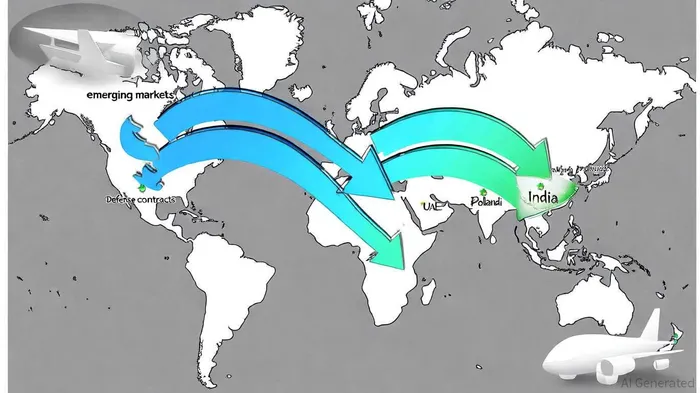





Comentarios
Aún no hay comentarios