
Geopolitical Risk and Operational Resilience: Chevron's Strategy in Sanctioned Venezuela
Geopolitical risk has long been a defining factor in energy market volatility, but the case of Chevron's operations in Venezuela under U.S. sanctions offers a unique lens into how multinational corporations navigate high-stakes regulatory environments. As global energy markets grapple with shifting alliances and sanctions regimes, Chevron's approach to maintaining operational resilience in Venezuela-despite stringent U.S. policies-provides critical insights for investors assessing risk and opportunity in sanctioned environments.
Chevron's Challenges in Venezuela: A Sanctions-Driven Landscape
Chevron's operations in Venezuela have been under intense scrutiny since the U.S. government designated the Cartel de los Soles-a group allegedly linked to the Maduro regime-as a Foreign Terrorist Organization (FTO) in 2025. This move significantly complicated Chevron's ability to operate, as the Venezuelan military controls critical infrastructure such as ports and logistics networks essential for oil production. According to a Bloomberg report, the FTO designation heightened legal and operational risks, forcing ChevronCVX-- to avoid any interactions with entities suspected of supporting the cartel.
Compounding these challenges, the Trump administration revoked a prior Biden-era license in February 2025 that allowed Chevron to export Venezuelan crude to the U.S. This decision, announced by the Office of Foreign Assets Control (OFAC), mandated a wind-down of Chevron's operations by April 3, 2025, with subsequent extensions granted under General License 41B until May 27, 2025. By May 2025, Chevron's production had effectively reached negligible levels, as it adhered to the restrictions prohibiting tax payments to the Venezuelan government and exports beyond the U.S.
Compliance and Risk Mitigation: Chevron's Strategic Adaptations
To navigate this complex regulatory environment, Chevron implemented a multi-layered compliance strategy. A key component was the establishment of a "sanctions firewall," which included a dedicated compliance team with direct reporting lines to U.S. authorities and the use of segregated financial channels to avoid commingling with sanctioned entities as detailed in a Reuters analysis. This approach, detailed in a Reuters analysis, enabled Chevron to conduct enhanced transaction monitoring and adhere to "pre-clearance" protocols for major operational decisions.
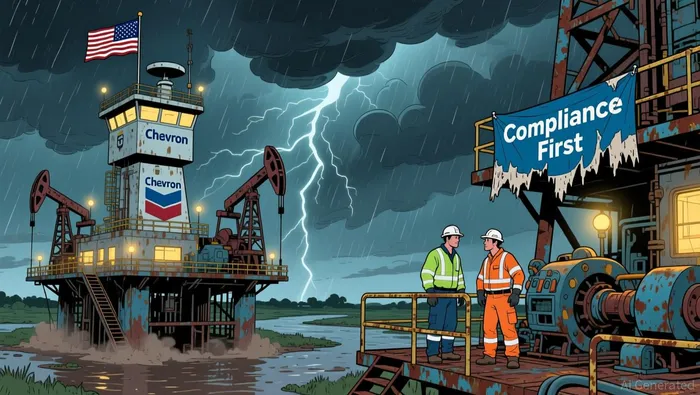 The company also prioritized personnel safety and environmental integrity, aligning its activities with the U.S. "preserve and protect" mandate. For instance, Chevron continued limited maintenance and production in joint ventures like Petropiar and Petroboscan while supporting humanitarian initiatives such as the Venezuela Relief Initiative, which focuses on health and education programs. These measures underscore Chevron's commitment to balancing operational continuity with regulatory compliance in a high-risk environment.
Operational Resilience: Lessons for Investors
Chevron's experience in Venezuela highlights the importance of adaptive strategies in sanctioned markets. Despite the revocation of its export license, the company managed to extend its wind-down period through successive general licenses, demonstrating its ability to negotiate regulatory constraints while safeguarding assets as detailed in a Federal Register publication. However, the lack of transparency in newer U.S. licenses-such as the private export authorization granted in 2025-raises concerns about the long-term predictability of such arrangements.
For investors, Chevron's case underscores the dual-edged nature of geopolitical risk. While sanctions can erode operational flexibility, they also create opportunities for companies with robust compliance frameworks to maintain a presence in strategic markets. As noted by a Georgetown Journal analysis, the opacity of U.S. sanctions policy in Venezuela has drawn criticism for potentially enabling authoritarian regimes and human rights abuses. This duality requires investors to weigh not only financial risks but also reputational and ethical implications.
Conclusion: Navigating the Future of Sanctioned Energy Markets
Chevron's operations in Venezuela exemplify the delicate balance between geopolitical risk and operational resilience. By leveraging compliance innovations, strategic partnerships, and a focus on asset preservation, the company has managed to sustain its presence in a volatile environment. However, the broader implications for energy markets remain complex. As Venezuela pivots to smaller international partners like China and Argentina to offset Chevron's departure, the long-term stability of its oil sector remains uncertain.
For investors, the key takeaway is clear: in an era of escalating geopolitical tensions, operational resilience in sanctioned environments demands not only legal agility but also a commitment to ethical and transparent practices. Chevron's journey in Venezuela serves as both a cautionary tale and a blueprint for navigating the turbulent intersection of energy, politics, and compliance.







Comentarios
Aún no hay comentarios